Colombia Cultured Meat Market Size, Share & Growth Rate
The Colombia Cultured Meat Market was estimated at USD 383 Million in 2025 and is projected to reach USD 513 Million by 2032, growing at a CAGR of 4.3% from 2026 to 2032. This growth trajectory is largely fueled by an increasing consumer shift towards sustainable and ethical food sources, coupled with technological advancements in cell culture methods. As awareness of the environmental and ethical concerns surrounding conventional meat production escalates, more Colombian consumers are considering cultured meat as a viable alternative.
Colombia Cultured Meat Market Year-wise Growth Rate and Key Drivers
This graph highlights how the Colombia Cultured Meat Market has steadily grown over the years, supported by major growth factors.
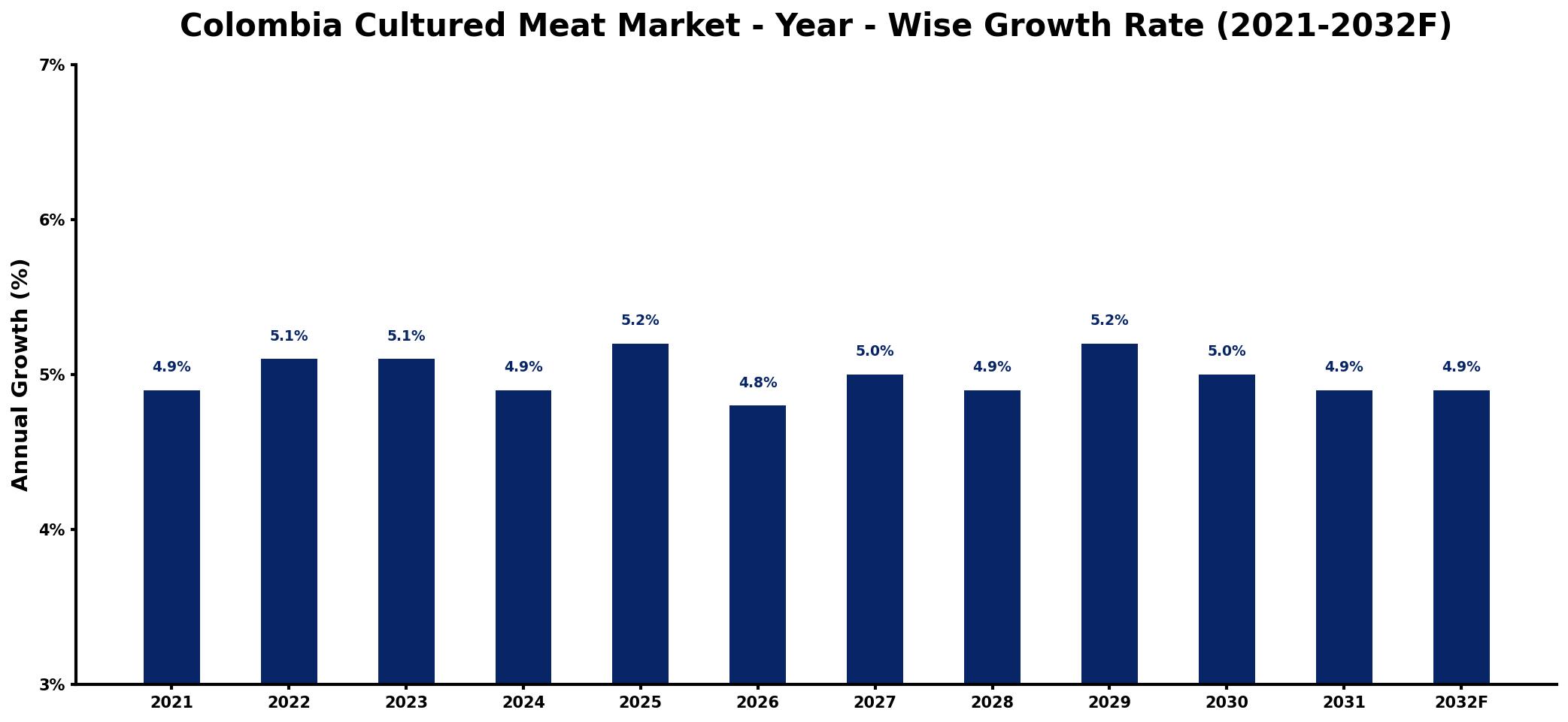
The table below presents the year‑wise growth rates along with the key drivers influencing the market
| Year | Growth Rate | Major Drivers |
| 2021 | 4.9% | Rising consumer health consciousness |
| 2022 | 5.1% | Increased investment in innovation |
| 2023 | 5.1% | Growing environmental sustainability awareness |
| 2024 | 4.9% | Expanding retail distribution channels |
| 2025 | 5.2% | Emerging alternative protein trends |
| 2026 | 4.8% | Strengthening partnerships with restaurants |
| 2027 | 5.0% | Advancements in production technology |
| 2028 | 4.9% | Enhanced consumer education initiatives |
| 2029 | 5.2% | Growing international market access |
| 2030 | 5.0% | Increased regulatory support frameworks |
| 2031 | 4.9% | Wider adoption of plant-based options |
| 2032 | 4.9% | Strengthened supply chain collaborations |
Note: Market size estimations and growth projections presented in this report are based on 6Wresearch's proprietary forecasting methodology, utilizing the latest available industry data, government publications, and primary research inputs.
Colombia Cultured Meat Market Synopsis
The Colombian market for cultured meat is witnessing a notable surge as consumers gravitate towards innovative protein sources that align with their values. As urbanization progresses and lifestyles evolve, there is a growing appetite for ethically produced, environmentally friendly food options.
Furthermore, Colombian entrepreneurs and investors are increasingly recognizing the potential of this market. With supportive initiatives from local universities and research institutions, the landscape is set for the rapid advancement of cultured meat technologies, positioning Colombia as a future leader in this revolutionary industry.
Colombia Cultured Meat Market Key Takeaways
- Rising consumer demand for sustainable and ethical food alternatives is a primary growth driver.
- Technological advancements in tissue engineering are accelerating product development and commercialization.
- Government interest in sustainable agriculture is fostering a conducive environment for market growth.
- Consumer education on cultured meat remains a crucial factor in overcoming market barriers.
- High production costs present challenges that need to be addressed for broader market adoption.
Evaluation of Restraints in Colombia Cultured Meat Market
Despite its promising outlook, the Colombia cultured meat market faces significant hurdles that could impede its growth. One of the primary restraints is the regulatory landscape; obtaining approvals and establishing clear labeling for cultured meat products remains a complex process. This can deter investment and slow down product launches. Furthermore, while there is a segment of consumers eager for these products, widespread acceptance is still lacking. Many potential customers harbor uncertainties about the safety and taste of lab-grown meat, necessitating focused marketing and educational initiatives. Additionally, the current high production costs limit scalability, making it challenging for businesses to achieve economies of scale, which is vital for the market's viability in the long term.
Colombia Cultured Meat Market Trends
The trends shaping the Colombia cultured meat market indicate a growing integration of technological innovations that enhance production efficiency. Techniques such as bioprinting and enhanced cell culture methods are being explored to reduce costs and increase output. Moreover, as more startups enter the space, there is a notable rise in partnerships between tech companies and food producers, creating a dynamic ecosystem aimed at overcoming existing challenges.
Additionally, consumer demand for transparency and ethical sourcing is compelling companies to adopt more sustainable practices, thereby amplifying the appeal of cultured meat products. The trend towards plant-based diets is also influencing the development of hybrid products that incorporate both cultured meat and plant proteins, which can cater to a wider audience and enhance market penetration.
Colombia Cultured Meat Market Opportunities
There are considerable growth opportunities within the Colombian cultured meat market that can be capitalized upon by savvy investors and entrepreneurs. One significant opportunity lies in developing localized production facilities to shorten supply chains and reduce costs. Additionally, collaborations with academic institutions can spur research and development initiatives, pushing forward innovative solutions that enhance product offerings. Furthermore, as Colombia seeks to improve food security, investments in cultured meat could play a pivotal role in providing reliable protein sources to the population.
Government Initiatives in the Colombia Cultured Meat Market
The Colombian government has begun to recognize the importance of sustainable agriculture and alternative protein sources. While specific policies aimed explicitly at cultured meat are still evolving, there are broader initiatives in place that support research and development in innovative food technologies. This includes funding for agricultural technology programs and grants for research institutions focusing on sustainable food production, which indirectly bolsters the cultured meat sector. Such government support lays a solid foundation for growth and innovation in the market.
Future Insights of the Colombia Cultured Meat Market
Looking ahead to the period from 2026 to 2032, the Colombia cultured meat market is poised for substantial growth as consumer awareness continues to rise and technological advancements mature. As production methods become more efficient and cost-effective, we can expect an influx of products to enter the market, catering to diverse consumer preferences. Moreover, increased collaboration between stakeholders in the supply chain, including producers, researchers, and regulatory bodies, will streamline the path to commercialization and enhance consumer trust. If current trends persist, the Colombian market could emerge as a significant player in the global cultured meat landscape.
Colombia Cultured Meat Market Latest Developments (2025 - 2026)
Recent months have seen a flurry of activity within the Colombian cultured meat sector, with several research institutions unveiling new initiatives aimed at optimizing production techniques. Additionally, local startups are increasingly securing partnerships that focus on expanding their reach and enhancing product visibility. Efforts to engage the public and raise awareness about the benefits of cultured meat have also gained momentum, paving the way for broader consumer acceptance. The overall industry climate indicates a shift towards more innovative and sustainable practices, setting the stage for significant future developments.
Colombia Cultured Meat Market - Key Attractiveness of the Report
- 10 Years of Market Numbers
- Historical Data Starting from 2022 to 2025
- Base Year: 2025
- Forecast Data until 2032
- Key Performance Indicators Impacting the Market
- Major Upcoming Developments and Projects
Key Highlights of the Report:
- Colombia Cultured Meat Market Outlook
- Market Size of Colombia Cultured Meat Market, 2025
- Forecast of Colombia Cultured Meat Market, 2032
- Historical Data and Forecast of Colombia Cultured Meat Revenues & Volume for the Period 2022-2032F
- Colombia Cultured Meat Market Trend Evolution
- Colombia Cultured Meat Market Drivers and Challenges
- Colombia Cultured Meat Price Trends
- Colombia Cultured Meat Porter's Five Forces
- Colombia Cultured Meat Industry Life Cycle
- Historical Data and Forecast of Colombia Cultured Meat Market Revenues & Volume By Product Type for the Period 2022-2032F
- Historical Data and Forecast of Colombia Cultured Meat Market Revenues & Volume By Poultry for the Period 2022-2032F
- Historical Data and Forecast of Colombia Cultured Meat Market Revenues & Volume By Beef for the Period 2022-2032F
- Historical Data and Forecast of Colombia Cultured Meat Market Revenues & Volume By Seafood for the Period 2022-2032F
- Historical Data and Forecast of Colombia Cultured Meat Market Revenues & Volume By Pork for the Period 2022-2032F
- Historical Data and Forecast of Colombia Cultured Meat Market Revenues & Volume By Duck for the Period 2022-2032F
- Historical Data and Forecast of Colombia Cultured Meat Market Revenues & Volume By End-Use for the Period 2022-2032F
- Historical Data and Forecast of Colombia Cultured Meat Market Revenues & Volume By Nuggets for the Period 2022-2032F
- Historical Data and Forecast of Colombia Cultured Meat Market Revenues & Volume By Burgers for the Period 2022-2032F
- Historical Data and Forecast of Colombia Cultured Meat Market Revenues & Volume By Meatballs for the Period 2022-2032F
- Historical Data and Forecast of Colombia Cultured Meat Market Revenues & Volume By Sausage for the Period 2022-2032F
- Historical Data and Forecast of Colombia Cultured Meat Market Revenues & Volume By Hot dogs for the Period 2022-2032F
- Historical Data and Forecast of Colombia Cultured Meat Market Revenues & Volume By Others for the Period 2022-2032F
- Colombia Cultured Meat Import Export Trade Statistics
- Market Opportunity Assessment By Product Type
- Market Opportunity Assessment By End-Use
- Colombia Cultured Meat Top Companies Market Share
- Colombia Cultured Meat Competitive Benchmarking By Technical and Operational Parameters
- Colombia Cultured Meat Company Profiles
- Colombia Cultured Meat Key Strategic Recommendations






































