Colombia High Strength Steel Market Size, Share & Growth Rate
The Colombia High Strength Steel Market was estimated at USD 1033 Million in 2025 and is projected to reach USD 1495 Million by 2032, growing at a CAGR of 5.4% from 2026 to 2032. This positive trajectory is largely fueled by a surge in infrastructure projects and a growing emphasis on lightweight materials in the automotive sector. Additionally, advancements in steel manufacturing technologies are enhancing the production capabilities within Colombia, presenting a robust foundation for sustainable market growth.
Colombia High Strength Steel Market Year-wise Growth Rate and Key Drivers
This graph highlights how the Colombia High Strength Steel Market has steadily grown over the years, supported by major growth factors.
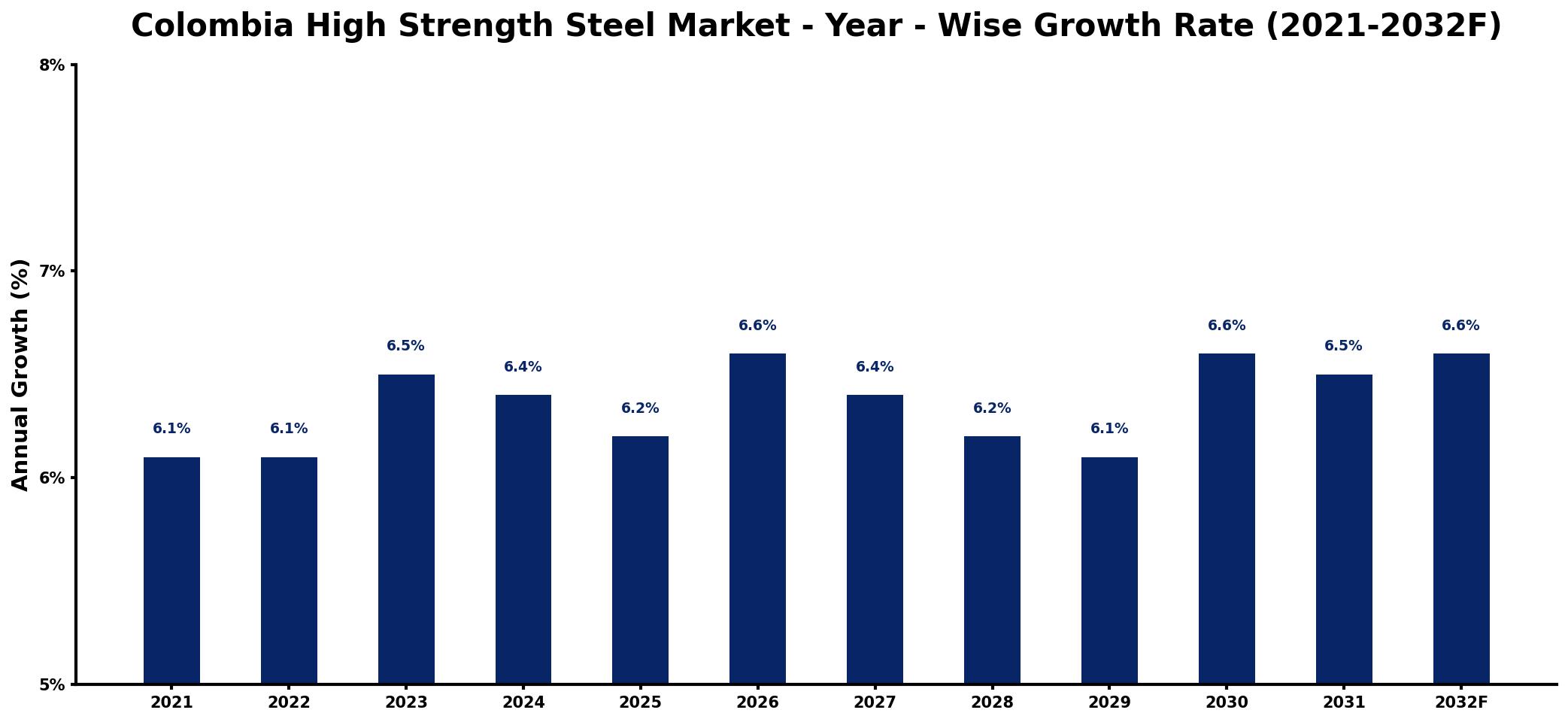
The table below presents the year‑wise growth rates along with the key drivers influencing the market
| Year | Growth Rate | Major Drivers |
| 2021 | 6.1% | Infrastructure projects driving demand |
| 2022 | 6.1% | Manufacturing sector expansion continues |
| 2023 | 6.5% | Increased automotive production activities |
| 2024 | 6.4% | Renewable energy investments rise significantly |
| 2025 | 6.2% | Construction activity experiences growth |
| 2026 | 6.6% | Technological advancements in applications |
| 2027 | 6.4% | Robust industrial sector performance observed |
| 2028 | 6.2% | Rising export opportunities identified |
| 2029 | 6.1% | Urbanization trends support investments |
| 2030 | 6.6% | Government initiatives foster development |
| 2031 | 6.5% | Sustainability practices gain traction |
| 2032 | 6.6% | Emerging markets increasing consumption |
Note: Market size estimations and growth projections presented in this report are based on 6Wresearch's proprietary forecasting methodology, utilizing the latest available industry data, government publications, and primary research inputs.
Colombia High Strength Steel Market Synopsis
In recent years, the Colombia High Strength Steel Market has gained momentum due to rising investments in construction and automotive industries. However, as the market evolves, there is a pressing need for domestic producers to enhance their capabilities to meet growing demand while contending with imported products. Looking ahead, the market is poised for further growth, backed by governmental support and an increasing preference for durable, high-performance materials.
Despite these advancements, the Colombian market must navigate challenges such as quality control and competition from alternative materials. As stakeholders recognize the significant advantages of high-strength steel—namely, its lightweight properties and structural integrity—there is a potential to reshape market dynamics and drive expanded applications across various sectors.
Colombia High Strength Steel Market Key Takeaways
- Growth is primarily driven by infrastructure projects and the automotive industry's shift towards lightweighting.
- Government policies are fostering a more conducive environment for advanced steel production technologies.
- Domestic producers are challenged by limited production capabilities for specialized steel grades.
- Market dynamics are influenced by competition from imports and the need for enhanced manufacturing processes.
- Investment opportunities are emerging in R&D to improve high-strength steel performance and applications.
Evaluation of Restraints in Colombia High Strength Steel Market
The Colombia High Strength Steel Market is currently hindered by several key restraints that could affect its growth trajectory. Notably, the country's limited domestic production capabilities for high-strength steel grades tailored to meet specific industry standards pose a significant challenge. This limitation is exacerbated by competition from imported steel products, which often come at a lower cost. Additionally, the lack of specialized heat treatment facilities further diminishes local competitiveness in this sector. Fluctuations in raw material prices and the impact of trade tariffs contribute to market instability, creating an uncertain environment for both producers and consumers.
Colombia High Strength Steel Market Trends
One of the most notable trends influencing the Colombia High Strength Steel Market is the increasing adoption of advanced manufacturing techniques, which enhance the performance characteristics of high-strength steel. Moreover, there is a growing focus on sustainable practices, prompting industries to seek lightweight materials that can reduce overall energy consumption and emissions. As technological advancements continue to emerge, the integration of smart manufacturing and automation is likely to reshape production processes, driving efficiency and reducing costs.
Colombia High Strength Steel Market Opportunities
The market is ripe with opportunities for investment, particularly in research and development aimed at enhancing the quality and performance of high-strength steel products. Collaborative efforts between industry stakeholders and academic institutions can lead to innovations that meet evolving sector demands. Furthermore, as Colombia continues to expand its infrastructure, the increasing need for durable construction materials presents a significant growth avenue for high-strength steel applications across various sectors, including transportation and heavy machinery.
Government Initiatives in the Colombia High Strength Steel Market
The Colombian government has recognized the importance of the high-strength steel market and is actively promoting its growth through a range of supportive policies. This includes tax incentives for companies investing in advanced steel production technologies, which aim to bolster domestic manufacturing capabilities. Additionally, there are ongoing initiatives to encourage research and development activities focused on improving the performance and durability of high-strength steel products, ensuring they meet both local and global standards.
Future Insights of the Colombia High Strength Steel Market
Looking ahead to 2026-2032, the Colombia High Strength Steel Market is anticipated to witness a shift towards more integrated and sustainable production practices. As the construction and automotive sectors increasingly emphasize efficiency and performance, the demand for high-strength steel will likely continue to grow. Furthermore, ongoing government support and evolving consumer preferences for lightweight and durable materials will play a crucial role in shaping the market landscape, ultimately driving further advancements and investments.
Colombia High Strength Steel Market Latest Developments (2025 - 2026)
Recent developments in the Colombia High Strength Steel Market indicate a shift towards more sustainable production practices, with several manufacturers investing in new technologies to improve efficiency. There has also been a notable increase in collaborative projects focused on research and development, aimed at enhancing the performance of high-strength steel for specific applications. Additionally, industry stakeholders are actively exploring partnerships to expand their market reach and reduce dependency on imports.
Colombia High Strength Steel Market - Key Attractiveness of the Report
- 10 Years of Market Numbers
- Historical Data Starting from 2022 to 2025
- Base Year: 2025
- Forecast Data until 2032
- Key Performance Indicators Impacting the Market
- Major Upcoming Developments and Projects
Key Highlights of the Report:
- Colombia High Strength Steel Market Outlook
- Market Size of Colombia High Strength Steel Market, 2025
- Forecast of Colombia High Strength Steel Market, 2032
- Historical Data and Forecast of Colombia High Strength Steel Revenues & Volume for the Period 2022-2032F
- Colombia High Strength Steel Market Trend Evolution
- Colombia High Strength Steel Market Drivers and Challenges
- Colombia High Strength Steel Price Trends
- Colombia High Strength Steel Porter's Five Forces
- Colombia High Strength Steel Industry Life Cycle
- Historical Data and Forecast of Colombia High Strength Steel Market Revenues & Volume By Product Type for the Period 2022-2032F
- Historical Data and Forecast of Colombia High Strength Steel Market Revenues & Volume By Dual Phase Steel for the Period 2022-2032F
- Historical Data and Forecast of Colombia High Strength Steel Market Revenues & Volume By Bake Hardenable Steel for the Period 2022-2032F
- Historical Data and Forecast of Colombia High Strength Steel Market Revenues & Volume By Carbon Manganese Steel for the Period 2022-2032F
- Historical Data and Forecast of Colombia High Strength Steel Market Revenues & Volume By Other Product Types for the Period 2022-2032F
- Historical Data and Forecast of Colombia High Strength Steel Market Revenues & Volume By Application for the Period 2022-2032F
- Historical Data and Forecast of Colombia High Strength Steel Market Revenues & Volume By Automotive for the Period 2022-2032F
- Historical Data and Forecast of Colombia High Strength Steel Market Revenues & Volume By Construction for the Period 2022-2032F
- Historical Data and Forecast of Colombia High Strength Steel Market Revenues & Volume By Yellow Goods and Mining Equipment for the Period 2022-2032F
- Historical Data and Forecast of Colombia High Strength Steel Market Revenues & Volume By Aviation and Marine for the Period 2022-2032F
- Historical Data and Forecast of Colombia High Strength Steel Market Revenues & Volume By Other Applications for the Period 2022-2032F
- Colombia High Strength Steel Import Export Trade Statistics
- Market Opportunity Assessment By Product Type
- Market Opportunity Assessment By Application
- Colombia High Strength Steel Top Companies Market Share
- Colombia High Strength Steel Competitive Benchmarking By Technical and Operational Parameters
- Colombia High Strength Steel Company Profiles
- Colombia High Strength Steel Key Strategic Recommendations






































