Costa Rica Automotive Market: Top 5 Importing Countries and Market Competition (HHI) Analysis
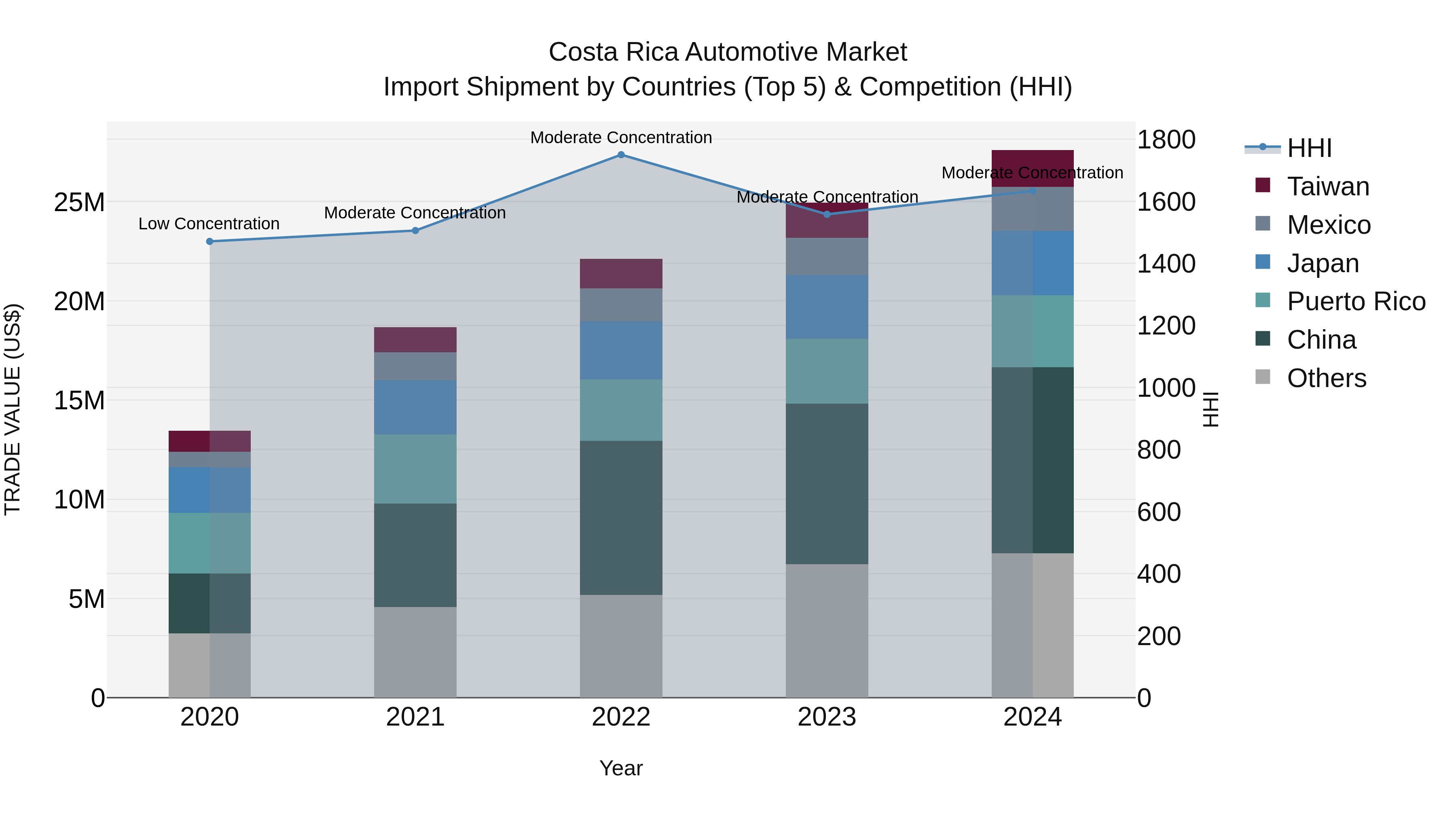
Costa Rica automotive import market continues to show strong growth, with a notable CAGR of 19.68% from 2020 to 2024. In 2024, top exporting countries include China, Puerto Rico, Japan, Mexico, and Taiwan. Despite this growth, the market maintains a moderate concentration level with the Herfindahl-Hirschman Index (HHI). The growth rate from 2023 to 2024 is also impressive at 10.58%, indicating sustained interest and demand for automotive imports in Costa Rica.
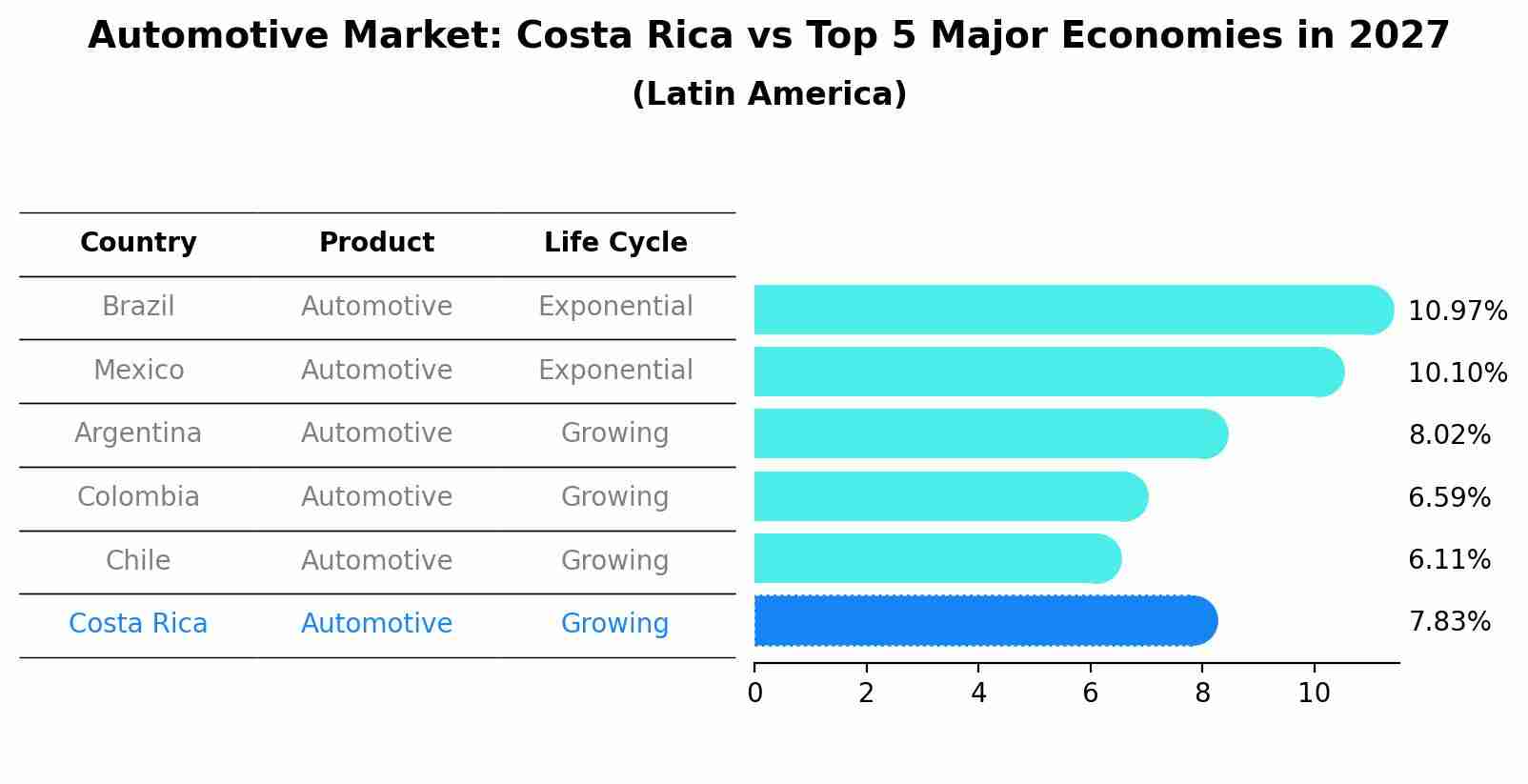
Automotive Market: Costa Rica vs Top 5 Major Economies in 2027 (Latin America)
By 2027, Costa Rica's Automotive market is forecasted to achieve a growing growth rate of 7.83%, with Brazil leading the Latin America region, followed by Mexico, Argentina, Colombia and Chile.
Key Highlights of the Report:
- Costa Rica Automotive Market Outlook
- Market Size of Costa Rica Automotive Market, 2025
- Forecast of Costa Rica Automotive Market, 2032
- Historical Data and Forecast of Costa Rica Automotive Revenues & Volume for the Period 2022 - 2032F
- Costa Rica Automotive Market Trend Evolution
- Costa Rica Automotive Market Drivers and Challenges
- Costa Rica Automotive Price Trends
- Costa Rica Automotive Porter`s Five Forces
- Costa Rica Automotive Industry Life Cycle
- Historical Data and Forecast of Costa Rica Automotive Market Revenues & Volume By Product Type for the Period 2022 - 2032F
- Historical Data and Forecast of Costa Rica Automotive Market Revenues & Volume By Electric for the Period 2022 - 2032F
- Historical Data and Forecast of Costa Rica Automotive Market Revenues & Volume By Hybrid Electric for the Period 2022 - 2032F
- Historical Data and Forecast of Costa Rica Automotive Market Revenues & Volume By Plug-In Hybrid Electric for the Period 2022 - 2032F
- Historical Data and Forecast of Costa Rica Automotive Market Revenues & Volume By Mild Hybrid for the Period 2022 - 2032F
- Historical Data and Forecast of Costa Rica Automotive Market Revenues & Volume By Natural Gas for the Period 2022 - 2032F
- Historical Data and Forecast of Costa Rica Automotive Market Revenues & Volume By Fuel Cell Electric for the Period 2022 - 2032F
- Historical Data and Forecast of Costa Rica Automotive Market Revenues & Volume By Diesel for the Period 2022 - 2032F
- Historical Data and Forecast of Costa Rica Electric Automotive Market Revenues & Volume By Petrol for the Period 2022 - 2032F
- Costa Rica Automotive Import Export Trade Statistics
- Market Opportunity Assessment By Product Type
- Costa Rica Automotive Top Companies Market Share
- Costa Rica Automotive Competitive Benchmarking By Technical and Operational Parameters
- Costa Rica Automotive Company Profiles
- Costa Rica Automotive Key Strategic Recommendations






































