Global Automotive Market Highlights
| Market Size (2025) | USD 3980 Billion |
| Forecast Size (2032) | USD 5210 Billion |
| CAGR | 5.24% |
| Base Year | 2025 |
| Forecast Period | 2026-2032 |
| Largest Region | North America |
| Fastest Growing Region | Asia |
| Largest Segment | Passenger Cars |
| Fastest Growing Segment | Commercial Vehicles |
| Leading Companies | Toyota, Volkswagen, General Motors, Ford, Honda |
Global Automotive Market Size & Growth Rate (2026-2032)
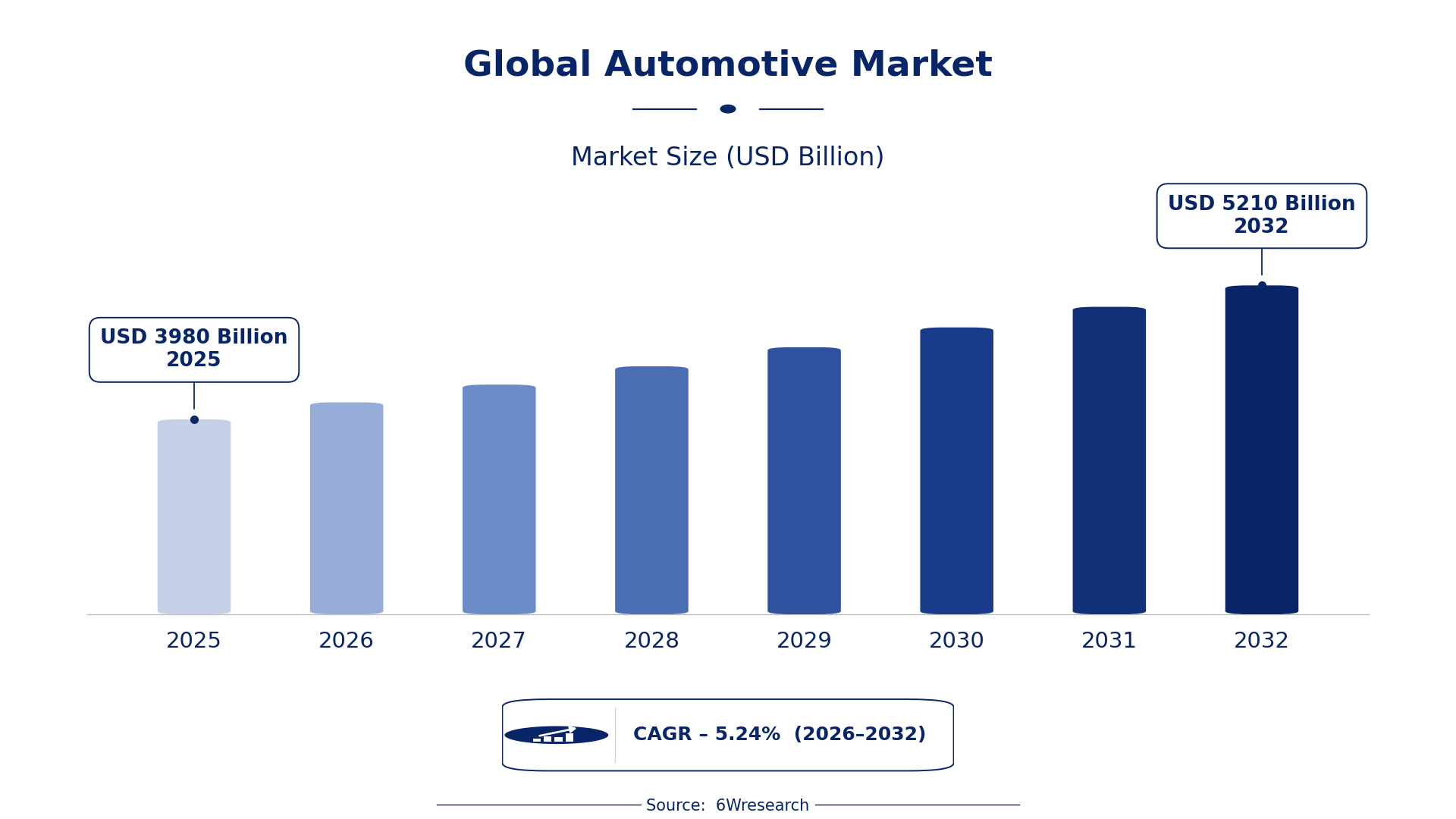
The Global Automotive Market was estimated at USD 3980 Billion in 2025 and is projected to reach USD 5210 Billion by 2032, growing at a CAGR of 5.24% from 2026 to 2032.
Global Automotive Market Synopsis
The Global Automotive Market is undergoing transformative changes, driven by a convergence of consumer preferences towards sustainability and technological integration. Demand for electric vehicles (EVs) is surging, as awareness of environmental impacts influences purchasing choices, while the automotive sector also adapts to advancements in autonomous driving technology.
Strategic investments by traditional manufacturers, alongside tech companies entering the space, are sparking innovation in vehicle connectivity. Beyond the passenger segment, commercial vehicles are experiencing increased demand for electrification and automation, essential for logistics optimization and regulatory compliance. This evolving landscape sets a foundation for robust growth in the automotive market.
Global Automotive Market Year-wise Growth Rate and Key Drivers
This graph illustrates the annual growth rates of the Global Automotive Market from 2022 to 2032, highlighting a steady upward trajectory and projected expansion over the forecast period.
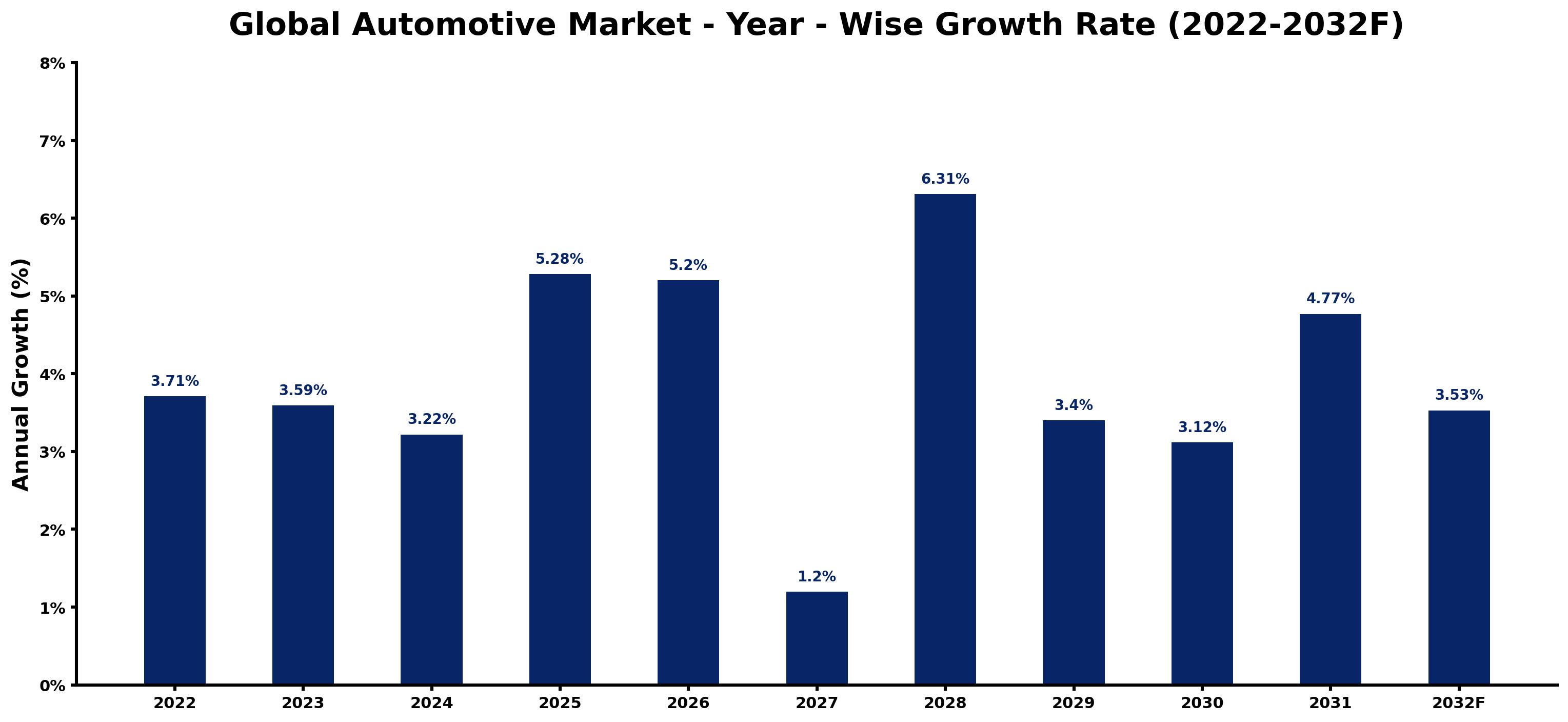
The table below presents the year‑wise growth rates along with the key drivers influencing the market
| Year | Growth Rate (%) | Major Drivers |
| 2022 | 3.71 | Changing consumer preferences for electric vehicles signal a new automotive market trend. |
| 2023 | 3.59 | Manufacturers face rising raw material costs impacting EV battery technology supply chains. |
| 2024 | 3.22 | Aligning with emissions regulations drives automakers to adopt sustainable production practices. |
| 2025 | 5.28 | Powertrain electrification technologies enhance production capabilities within the automotive industry. |
| 2026 | 5.2 | While global markets expand, increased competition shapes automotive pricing strategies and dynamics. |
| 2027 | 1.2 | Supply chain disruptions challenge the availability of aftermarket parts in the automotive sector. |
| 2028 | 6.31 | OEM incentives for autonomous driving software accelerate vehicle adoption across various segments. |
| 2029 | 3.4 | Fleet operators increasingly seek advanced ADAS systems for improved safety and efficiency. |
| 2030 | 3.12 | In North America, consumer interest in electric vehicle offerings reshapes automotive purchasing trends. |
| 2031 | 4.77 | Battery recycling processes are pivotal to automotive sustainability initiatives and cost management. |
| 2032 | 3.53 | A shift toward strategic automotive investments enhances competitive positioning in emerging markets. |
Note - Market size estimations and growth projections presented in this report are based on 6Wresearch's proprietary research methodology, combining internal industry data, secondary research, and primary validation, updated periodically to reflect current market conditions. As markets evolve rapidly, figures for certain industries may vary slightly and are intended as informed estimates rather than absolute figures. For the most current market sizing, we recommend validating figures with a 6Wresearch analyst.
Global Automotive Market Key Takeaways
Below are some of the specific key takeaways from the market, including:
- North America commands a market share of approximately 40% in 2025, primarily due to strong consumer spending and a mature automotive ecosystem.
- Commercial vehicles are projected to grow at a CAGR of 7.2% between 2026 and 2032, highlighting the rise in demand for electric and autonomous driving technologies.
- Toyota's revenue from hybrid and electric vehicles reached $40 billion in 2023, demonstrating its leadership in the Eco-friendly automotive segment.
- With an anticipated market growth of 8.6% in the Asia region, OEMs are rapidly shifting their focus toward electric vehicle production capabilities.
- Volkswagen aims to produce 1.5 million electric vehicles annually by 2025, marking its aggressive strategy in the EV market.
Evaluation of Restraints in Global Automotive Market
The Global Automotive Market faces several significant restraints, including escalating raw material costs and stringent regulatory environments. For example, the current lithium prices have surged by over 300% in the past year, due to increased demand for batteries, impacting the cost structures of EV producers. Additionally, regulatory hurdles surrounding emissions, such as the European Union's CO2 emissions norm of 95 g/km for 2021, further complicate compliance and bring about financial burdens for companies that fail to adapt swiftly.
Global Automotive Market Trends
A key trend reshaping the Global Automotive Market is the rapid adoption of electrification technologies, driven by consumer awareness and regulatory mandates. Notably, as of 2026, nearly 30% of vehicles sold in Europe are expected to be electric. For example, Tesla's sales figures in 2023 revealed that they sold more than 1.3 million electric vehicles globally, reflecting a paradigm shift towards electrification.
Another prominent trend is the increased integration of digital technologies within vehicles. Companies like Ford have integrated over-the-air software updates in their models, enabling easier management of performance enhancements and vehicle diagnostics. This pivot not only aims to enhance customer experience but also streamlines maintenance operations. The rising demand for shared mobility, catalyzed by urbanization, is also influencing how automotive companies strategize and manage fleet operations.
Global Automotive Market Opportunities
Future revenue opportunities in the Global Automotive Market are diverse and robust, particularly within the electric vehicle (EV) sector. Companies like Rivian are pushing boundaries, with a promise to deliver 100,000 delivery vans to Amazon by 2030, reflecting the commercial shift toward electric functionalities. Additionally, the rise of hydrogen fuel cell technology presents an interesting venture, with expected revenue growth correlating with the expansion of hydrogen refueling stations aimed at supporting heavier transport vehicles.
Moreover, advancements in autonomous vehicle technologies create avenues for partnerships between automotive manufacturers and tech firms. The ongoing collaboration between Waymo and various automotive giants inspires innovations in safety and vehicle functionality, providing a potential revenue stream in the coming years. These various channels underscore the extensive market opportunities awaiting smart investments.
Global Automotive Market by Vehicle Type
In the Global Automotive Market, Passenger Cars hold the largest share at approximately 55% in 2025, thanks to consistent consumer preference for personal mobility and affordability. On the other hand, Commercial Vehicles emerge as the fastest-growing segment, projected to achieve a CAGR of 7.2% from 2026 to 2032 as businesses increasingly opt for electrified fleets to enhance operational efficiency and meet stringent regulatory standards. The demand for commercial EVs is further fueled by the need for sustainable logistics solutions that can address climate concerns.
Global Automotive Market by Region
North America stands as the largest region in the Global Automotive Market with an estimated share of around 40% in 2025, boosted by its established automotive manufacturing base and a strong consumer market. Meanwhile, Asia is set to be the fastest-growing region, with a projected CAGR of 8.6% from 2026 to 2032, driven by increasing urbanization and rising incomes, particularly in countries like China and India. The robust growth in EV adoption in these regions also highlights the ongoing shift towards more sustainable automotive solutions.
Government Initiatives in the Global Automotive Market
The regulatory landscape for the Global Automotive Market is experiencing notable shifts as governments worldwide implement diverse initiatives aimed at enhancing sustainability and fostering innovation. These policies not only seek to address environmental concerns but also strive to stimulate economic growth within the sector by funding specific projects and establishing supportive frameworks for emerging technologies.
- U.S. Department of Energy, Clean Cities Program, 2023: This initiative offers funding to enhance electric vehicle adoption and associated infrastructure, benefitting both manufacturers and consumers.
- European Commission, Green Deal, 2020: A comprehensive framework targeting substantial reductions in emissions across the automotive sector, providing financial resources and clear timelines for compliance.
- Government of India, FAME II Scheme, 2019: This ongoing program promotes electric mobility through subsidies, thereby incentivizing both private consumers and manufacturers to invest in electric vehicles.
- China Ministry of Industry and Information Technology, New Energy Vehicle Policy, 2021: An upcoming framework aimed at achieving a significant increase in electric vehicle production capabilities and technological advancements by 2025.
Future Insights of the Global Automotive Market
The Global Automotive Market is anticipated to witness transformative shifts, particularly in manufacturing techniques and technology integration. By 2032, the focus on sustainable production methods is expected to intensify, partly driven by auto manufacturers like General Motors transitioning to all-electric lineups. This reflects a broader trend of vertical integration in supply chains for electric and autonomous components, aiming to cut costs and enhance quality. With the European Green Deal and similar initiatives globally, automakers will likely accelerate investments in clean technology and digital upgrades to maintain competitive edges.
Global Automotive Market Latest Developments
The landscape of the Global Automotive Market continues to evolve with strategic initiatives from leading companies aimed at enhancing their positions and meeting shifting consumer demands. Recent developments include:
- Recently completed, Toyota launched a new series of hybrid vehicles, which incorporates advancements in battery technology, positioning the company as a leader in eco-friendly options and broadening its market offerings.
- Ongoing, Volkswagen is investing heavily in its electric vehicle manufacturing capabilities, specifically targeting the production of 1.5 million electric vehicles annually by 2025, which is vital for gaining market share in the green vehicle segment.
- Upcoming, Ford plans to expand its production facilities in Michigan, expected to be completed by 2024, to enhance its capacity for electric vehicle assembly and meet growing consumer interest.
- Recently announced, Honda is collaborating with battery manufacturers to develop next-generation batteries, projected for a launch in 2026, aiming to improve vehicle range and performance, thus solidifying its competitive advantage.
Global Automotive Market Key Players and Industry Positioning
The competitive structure of the Global Automotive Market is notably consolidated, dominated by several key players with a significant market share. These companies have established strong brand recognition and advanced technological capabilities, forcing new entrants to devise unique competitive strategies. Ongoing collaborations and strategic partnerships are crucial for innovation and market expansion.
| Leading Company | Core Strength | Strategic Focus |
|---|---|---|
| Toyota | Extensive experience in hybrid technology | Sustainable models and electric vehicle advancements |
| Volkswagen | Strong global manufacturing footprint | Aggressive electrification and digital transformation |
| General Motors | Established brand loyalty in North America | Transitioning to an all-electric fleet |
| Ford | Innovation in mobility solutions | Expansion in electric vehicle production |
| Honda | Strong reputation for reliability | Development of advanced battery technology |
The strategic directions of these companies emphasize their commitment to innovation and sustainability, essential for thriving amid the ongoing market transformation.
Key Attractiveness of the Report
- 10 Years of Market Numbers
- Historical Data Starting from 2022 to 2025
- Base Year: 2025
- Forecast Data until 2032
- Key Performance Indicators Impacting the Market
- Major Upcoming Developments and Projects
Key Highlights of the Report:
- Global Automotive Market Outlook
- Market Size of Global Automotive Market, 2025
- Forecast of Global Automotive Market, 2032
- Historical Data and Forecast of Global Automotive Revenues & Volume for the Period 2022-2032
- Global Automotive Market Trend Evolution
- Global Automotive Market Drivers and Challenges
- Global Automotive Price Trends
- Global Automotive Porter's Five Forces
- Global Automotive Industry Life Cycle
- Historical Data and Forecast of Global Automotive Market Revenues & Volume
- Historical Data and Forecast of Global Automotive Market Revenues & Volume By Vehicle Type for the Period 2022-2032
- Historical Data and Forecast of Global Automotive Market Revenues & Volume By Passenger Cars for the Period 2022-2032
- Historical Data and Forecast of Global Automotive Market Revenues & Volume By Commercial Vehicles for the Period 2022-2032
- Historical Data and Forecast of North America Automotive Market Revenues & Volume By Vehicle Type for the Period 2022-2032
- Historical Data and Forecast of North America Automotive Market Revenues & Volume By Passenger Cars for the Period 2022-2032
- Historical Data and Forecast of North America Automotive Market Revenues & Volume By Commercial Vehicles for the Period 2022-2032
- Historical Data and Forecast of United States of America Automotive Market Revenues & Volume for the Period 2022-2032
- Historical Data and Forecast of Canada Automotive Market Revenues & Volume for the Period 2022-2032
- Historical Data and Forecast of Rest of North America Automotive Market Revenues & Volume for the Period 2022-2032
- Historical Data and Forecast of Latin America (LATAM) Automotive Market Revenues & Volume By Vehicle Type for the Period 2022-2032
- Historical Data and Forecast of Latin America (LATAM) Automotive Market Revenues & Volume By Passenger Cars for the Period 2022-2032
- Historical Data and Forecast of Latin America (LATAM) Automotive Market Revenues & Volume By Commercial Vehicles for the Period 2022-2032
- Historical Data and Forecast of Brazil Automotive Market Revenues & Volume for the Period 2022-2032
- Historical Data and Forecast of Mexico Automotive Market Revenues & Volume for the Period 2022-2032
- Historical Data and Forecast of Argentina Automotive Market Revenues & Volume for the Period 2022-2032
- Historical Data and Forecast of Rest of LATAM Automotive Market Revenues & Volume for the Period 2022-2032
- Historical Data and Forecast of Asia Automotive Market Revenues & Volume By Vehicle Type for the Period 2022-2032
- Historical Data and Forecast of Asia Automotive Market Revenues & Volume By Passenger Cars for the Period 2022-2032
- Historical Data and Forecast of Asia Automotive Market Revenues & Volume By Commercial Vehicles for the Period 2022-2032
- Historical Data and Forecast of China Automotive Market Revenues & Volume for the Period 2022-2032
- Historical Data and Forecast of India Automotive Market Revenues & Volume for the Period 2022-2032
- Historical Data and Forecast of Japan Automotive Market Revenues & Volume for the Period 2022-2032
- Historical Data and Forecast of Rest of Asia Automotive Market Revenues & Volume for the Period 2022-2032
- Historical Data and Forecast of Africa Automotive Market Revenues & Volume By Vehicle Type for the Period 2022-2032
- Historical Data and Forecast of Africa Automotive Market Revenues & Volume By Passenger Cars for the Period 2022-2032
- Historical Data and Forecast of Africa Automotive Market Revenues & Volume By Commercial Vehicles for the Period 2022-2032
- Historical Data and Forecast of South Africa Automotive Market Revenues & Volume for the Period 2022-2032
- Historical Data and Forecast of Nigeria Automotive Market Revenues & Volume for the Period 2022-2032
- Historical Data and Forecast of Egypt Automotive Market Revenues & Volume for the Period 2022-2032
- Historical Data and Forecast of Rest of Africa Automotive Market Revenues & Volume for the Period 2022-2032
- Historical Data and Forecast of Europe Automotive Market Revenues & Volume By Vehicle Type for the Period 2022-2032
- Historical Data and Forecast of Europe Automotive Market Revenues & Volume By Passenger Cars for the Period 2022-2032
- Historical Data and Forecast of Europe Automotive Market Revenues & Volume By Commercial Vehicles for the Period 2022-2032
- Historical Data and Forecast of United Kingdom Automotive Market Revenues & Volume for the Period 2022-2032
- Historical Data and Forecast of France Automotive Market Revenues & Volume for the Period 2022-2032
- Historical Data and Forecast of Germany Automotive Market Revenues & Volume for the Period 2022-2032
- Historical Data and Forecast of Rest of Europe Automotive Market Revenues & Volume for the Period 2022-2032
- Historical Data and Forecast of Middle East Automotive Market Revenues & Volume By Vehicle Type for the Period 2022-2032
- Historical Data and Forecast of Middle East Automotive Market Revenues & Volume By Passenger Cars for the Period 2022-2032
- Historical Data and Forecast of Middle East Automotive Market Revenues & Volume By Commercial Vehicles for the Period 2022-2032
- Historical Data and Forecast of Saudi Arabia Automotive Market Revenues & Volume for the Period 2022-2032
- Historical Data and Forecast of UAE Automotive Market Revenues & Volume for the Period 2022-2032
- Historical Data and Forecast of Turkey Automotive Market Revenues & Volume for the Period 2022-2032
- Historical Data and Forecast of Rest of Middle East Automotive Market Revenues & Volume for the Period 2022-2032
- Global Automotive Market - Key Performance Indicators
- Global Automotive Market - Import Export Trade Statistics
- Global Automotive Market - Opportunity Assessment By Countries
- Global Automotive Market - Opportunity Assessment By Vehicle Type
- 0
- Global Automotive Market - Top Companies Market Share
- Global Automotive Market - Top Companies Profiles
- Global Automotive Market - Comparison of Players in Technical and Operating Parameters
- Global Automotive Market - Strategic Recommendations
Markets Covered
The Global Automotive Market report provides a detailed analysis of the following market segments:
By Regions and Countries:
- North America
- Europe
- LATAM
- Middle East
- Asia
- Africa
By Vehicle Type:
- Passenger Cars
- Commercial Vehicles






































