Croatia Lumber Market Top 5 Importing Countries and Market Competition (HHI) Analysis
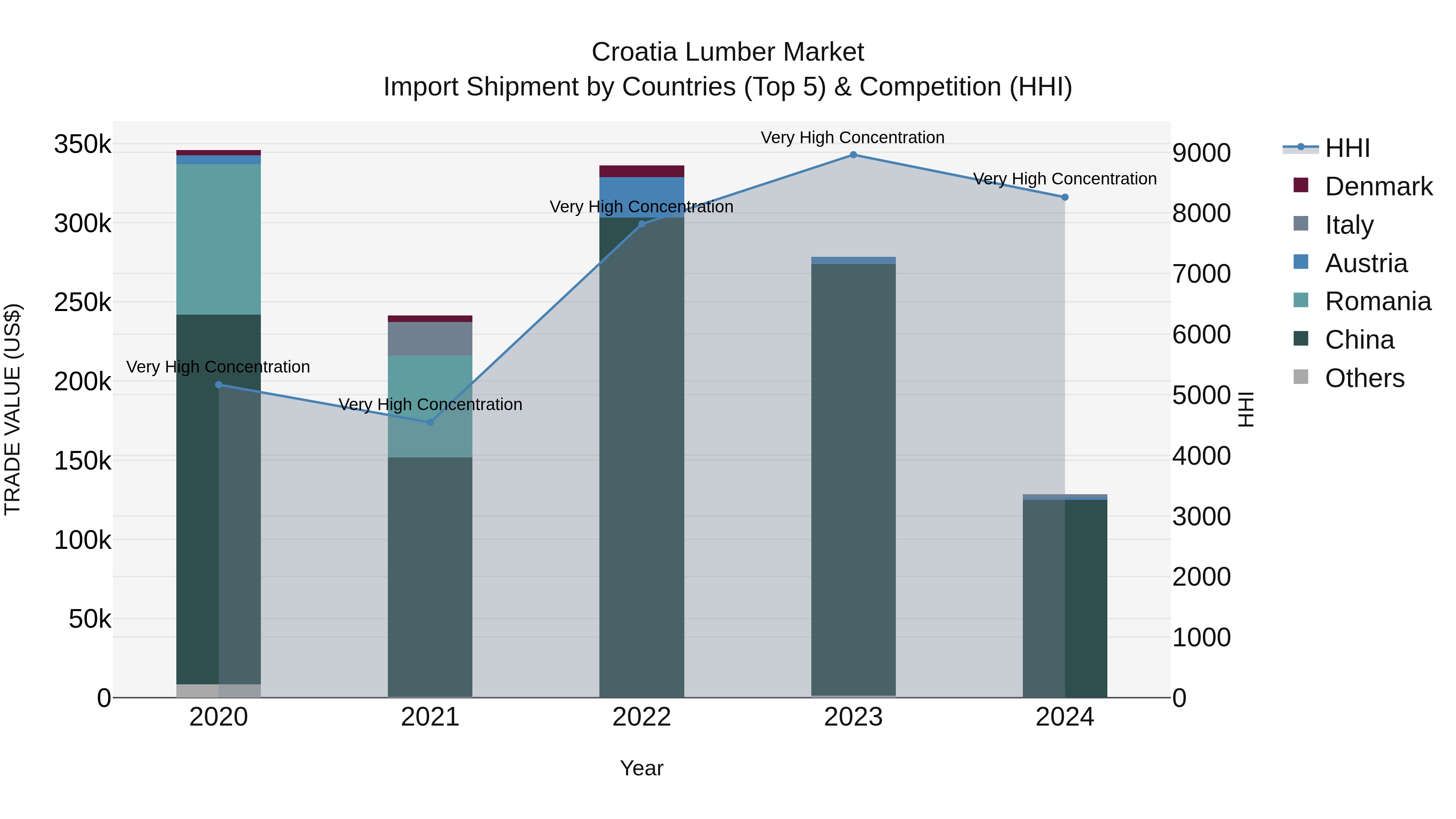
Despite a significant decline in the growth rate of Croatia lumber imports in 2024, the market remains dominated by top exporters including China, Italy, Austria, Czechia, and Denmark. The high Herfindahl-Hirschman Index (HHI) indicates a concentrated market landscape, potentially leading to pricing power for suppliers. The negative compound annual growth rate (CAGR) from 2020 to 2024 reflects challenges in the industry, while the sharp decline in growth rate from 2023 to 2024 suggests a recent downturn. Monitoring market dynamics and exploring strategies to stimulate demand may be crucial for businesses in the lumber import sector in Croatia.
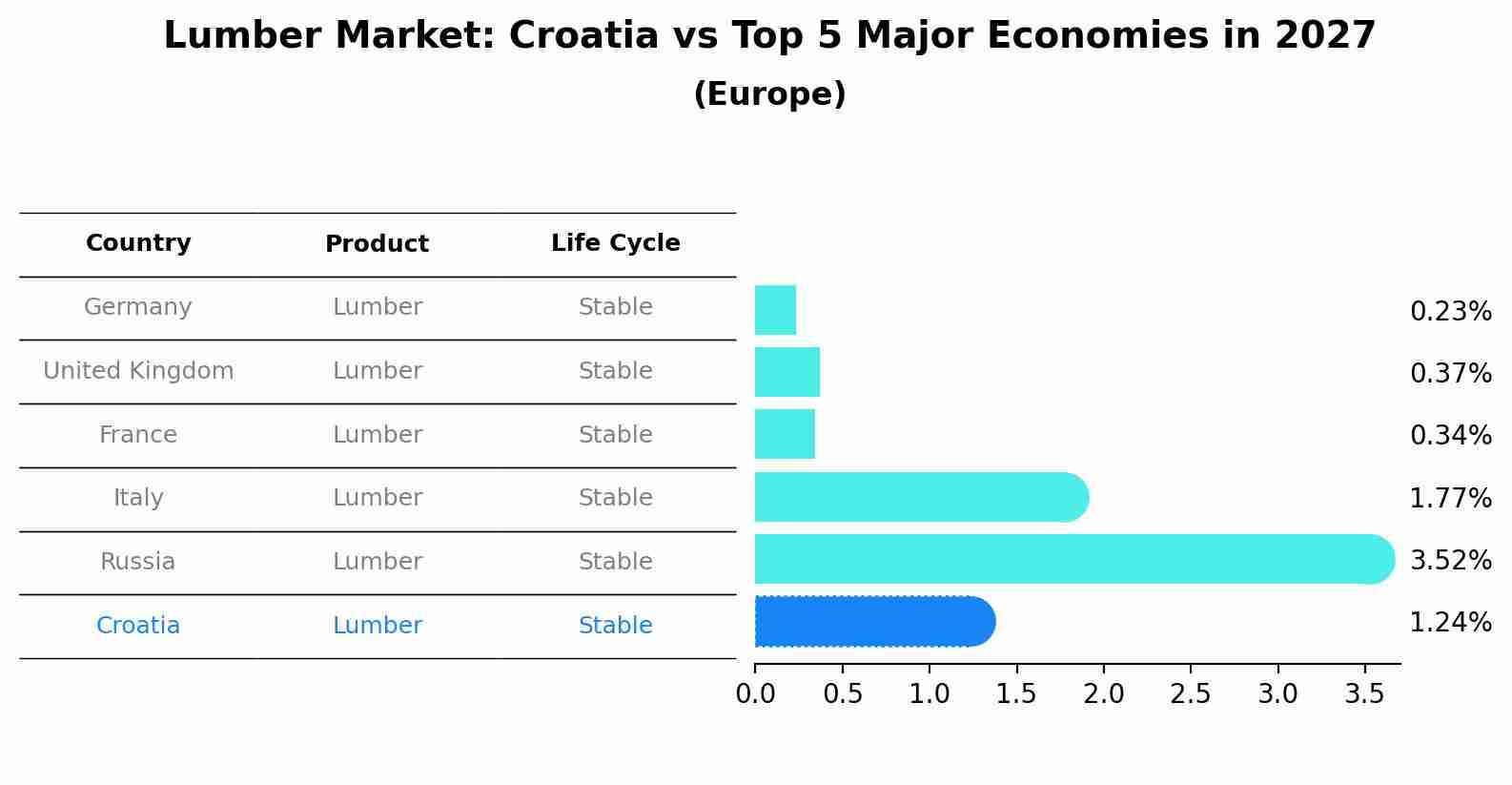
Lumber Market: Croatia vs Top 5 Major Economies in 2027 (Europe)
Croatia's Lumber market is anticipated to experience a stable growth rate of 1.24% by 2027, reflecting trends observed in the largest economy Germany, followed by United Kingdom, France, Italy and Russia.
Croatia Lumber Market Overview
The lumber market in Croatia is influenced by the country`s forestry resources and the demand for wood in construction, furniture, and paper industries. Sustainable forestry practices and the growing use of wood as a renewable building material contribute to the market`s stability and expansion.
Drivers of the market
The lumber market in Croatia is influenced by the growing demand for construction and renovation projects, which require high-quality wood products. The expansion of the residential and commercial construction sectors is driving the need for lumber. Additionally, increasing interest in sustainable building practices and the use of certified wood products are contributing to market growth. The growth of the furniture industry and the rising popularity of wood-based interior design are also supporting demand for lumber.
Challenges of the market
The lumber market in Croatia faces several challenges, including fluctuations in supply and demand, which can impact prices and availability. The market is also affected by environmental regulations and the need for sustainable forestry practices. Competition from international suppliers and the impact of global trade policies can influence market dynamics. Additionally, managing supply chain logistics and addressing quality control issues are important considerations.
Government Policy of the market
In the lumber market, Croatian policies focus on promoting sustainable forestry practices and supporting the local timber industry. The government provides subsidies for sustainable logging operations and funding for research into efficient and eco-friendly lumber processing technologies. Policies also aim to enhance the competitiveness of Croatian lumber products in international markets.
Key Highlights of the Report:
- Croatia Lumber Market Outlook
- Market Size of Croatia Lumber Market, 2024
- Forecast of Croatia Lumber Market, 2031
- Historical Data and Forecast of Croatia Lumber Revenues & Volume for the Period 2021-2031
- Croatia Lumber Market Trend Evolution
- Croatia Lumber Market Drivers and Challenges
- Croatia Lumber Price Trends
- Croatia Lumber Porter`s Five Forces
- Croatia Lumber Industry Life Cycle
- Historical Data and Forecast of Croatia Lumber Market Revenues & Volume By Types for the Period 2021-2031
- Historical Data and Forecast of Croatia Lumber Market Revenues & Volume By Hardwood Lumber for the Period 2021-2031
- Historical Data and Forecast of Croatia Lumber Market Revenues & Volume By Softwood Lumber for the Period 2021-2031
- Historical Data and Forecast of Croatia Lumber Market Revenues & Volume By Application for the Period 2021-2031
- Historical Data and Forecast of Croatia Lumber Market Revenues & Volume By Construction for the Period 2021-2031
- Historical Data and Forecast of Croatia Lumber Market Revenues & Volume By Furniture for the Period 2021-2031
- Historical Data and Forecast of Croatia Lumber Market Revenues & Volume By Flooring for the Period 2021-2031
- Historical Data and Forecast of Croatia Lumber Market Revenues & Volume By Moldings for the Period 2021-2031
- Historical Data and Forecast of Croatia Lumber Market Revenues & Volume By Others for the Period 2021-2031
- Croatia Lumber Import Export Trade Statistics
- Market Opportunity Assessment By Types
- Market Opportunity Assessment By Application
- Croatia Lumber Top Companies Market Share
- Croatia Lumber Competitive Benchmarking By Technical and Operational Parameters
- Croatia Lumber Company Profiles
- Croatia Lumber Key Strategic Recommendations






































