Croatia Soybean Meal Market Size (2020-2030)
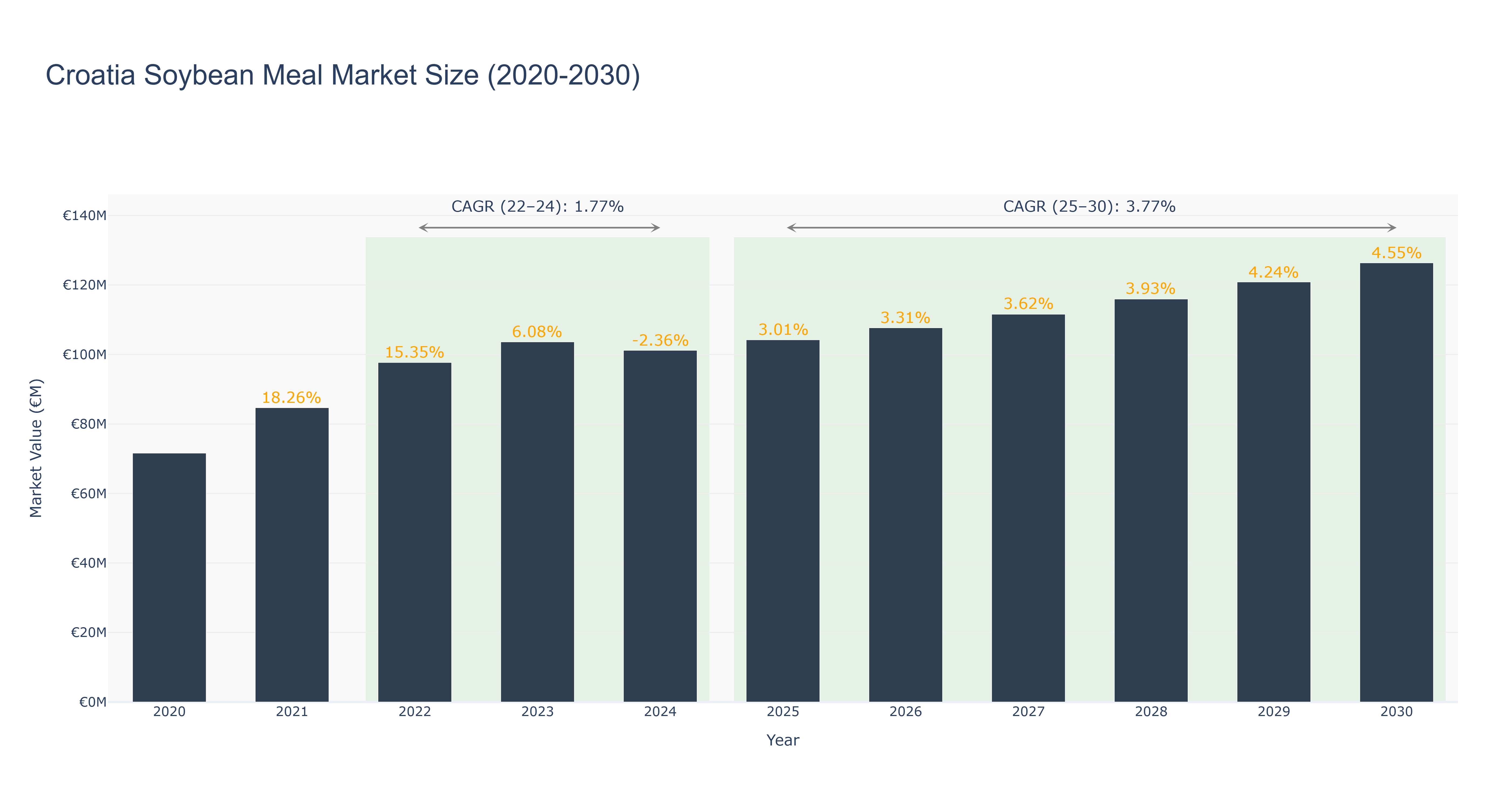
Croatia Soybean Meal Market has shown a fluctuating trend over the years. The peak market size of €126.38 million was achieved in 2030, with a steady growth rate. The actual market size from 2020 to 2024 ranged from €71.62 million to €101.20 million, experiencing both positive and negative growth. The forecasted market size from 2025 to 2030 is expected to continue growing, with a CAGR of 3.77% (2025-30) outpacing the earlier CAGR of 1.77% (2022-24). The market's growth can be attributed to increasing demand for soybean meal in livestock feed production, driven by the growing livestock industry in Croatia. Recent developments include plans for modernizing soybean meal processing facilities to enhance production efficiency and meet the rising demand for high-quality feed ingredients in the country.
Croatia Soybean Meal Market: Production & Trade Performance (2019-2025)
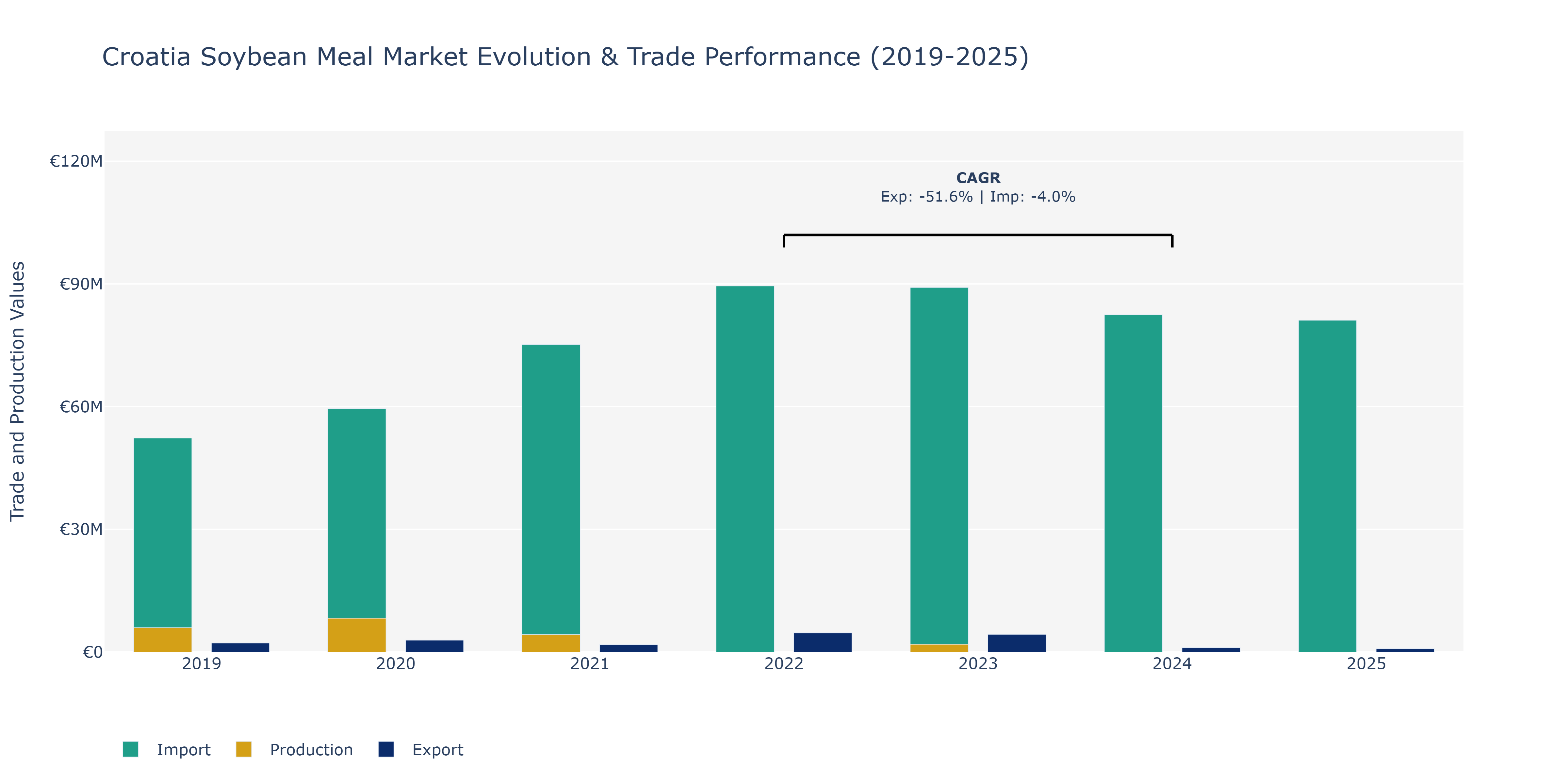
In the Croatia Soybean Meal Market, exports demonstrated notable fluctuations over the years, starting at €2.21 million in 2019, increasing to €2.91 million in 2020, and peaking at €4.69 million in 2022, before declining to €1.1 million in 2024 and further to €826.61 thousand in 2025. Imports, on the other hand, consistently rose from €52.31 million in 2019 to €89.52 million in 2023, with a slight decrease to €82.46 million in 2024 and €81.12 million in 2025. Production value fluctuated as well, reaching €5.95 million in 2019, peaking in 2020 at €8.27 million, and dropping significantly to €4.23 million in 2021, further plummeting to €1.90 million in 2023. The decrease in exports can be attributed to shifts in global demand, supply chain disruptions, and price volatility affecting trading patterns. The rise in imports may reflect increased domestic consumption, while the fluctuating production levels could be linked to weather conditions impacting crop yields and local processing capabilities, aligning with global agricultural market trends.
Key Highlights of the Report:
- Croatia Soybean Meal Market Outlook
- Market Size of Croatia Soybean Meal Market, 2025
- Forecast of Croatia Soybean Meal Market, 2032
- Historical Data and Forecast of Croatia Soybean Meal Revenues & Volume for the Period 2022 - 2032F
- Croatia Soybean Meal Market Trend Evolution
- Croatia Soybean Meal Market Drivers and Challenges
- Croatia Soybean Meal Price Trends
- Croatia Soybean Meal Porter`s Five Forces
- Croatia Soybean Meal Industry Life Cycle
- Historical Data and Forecast of Croatia Soybean Meal Market Revenues & Volume By Application for the Period 2022 - 2032F
- Historical Data and Forecast of Croatia Soybean Meal Market Revenues & Volume By Animal Feed for the Period 2022 - 2032F
- Historical Data and Forecast of Croatia Soybean Meal Market Revenues & Volume By Food Industry for the Period 2022 - 2032F
- Historical Data and Forecast of Croatia Soybean Meal Market Revenues & Volume By Beverage for the Period 2022 - 2032F
- Historical Data and Forecast of Croatia Soybean Meal Market Revenues & Volume By Healthcare Products for the Period 2022 - 2032F
- Croatia Soybean Meal Import Export Trade Statistics
- Market Opportunity Assessment By Application
- Croatia Soybean Meal Top Companies Market Share
- Croatia Soybean Meal Competitive Benchmarking By Technical and Operational Parameters
- Croatia Soybean Meal Company Profiles
- Croatia Soybean Meal Key Strategic Recommendations






































