Cyprus Cigarette Market Size (2020-2030)
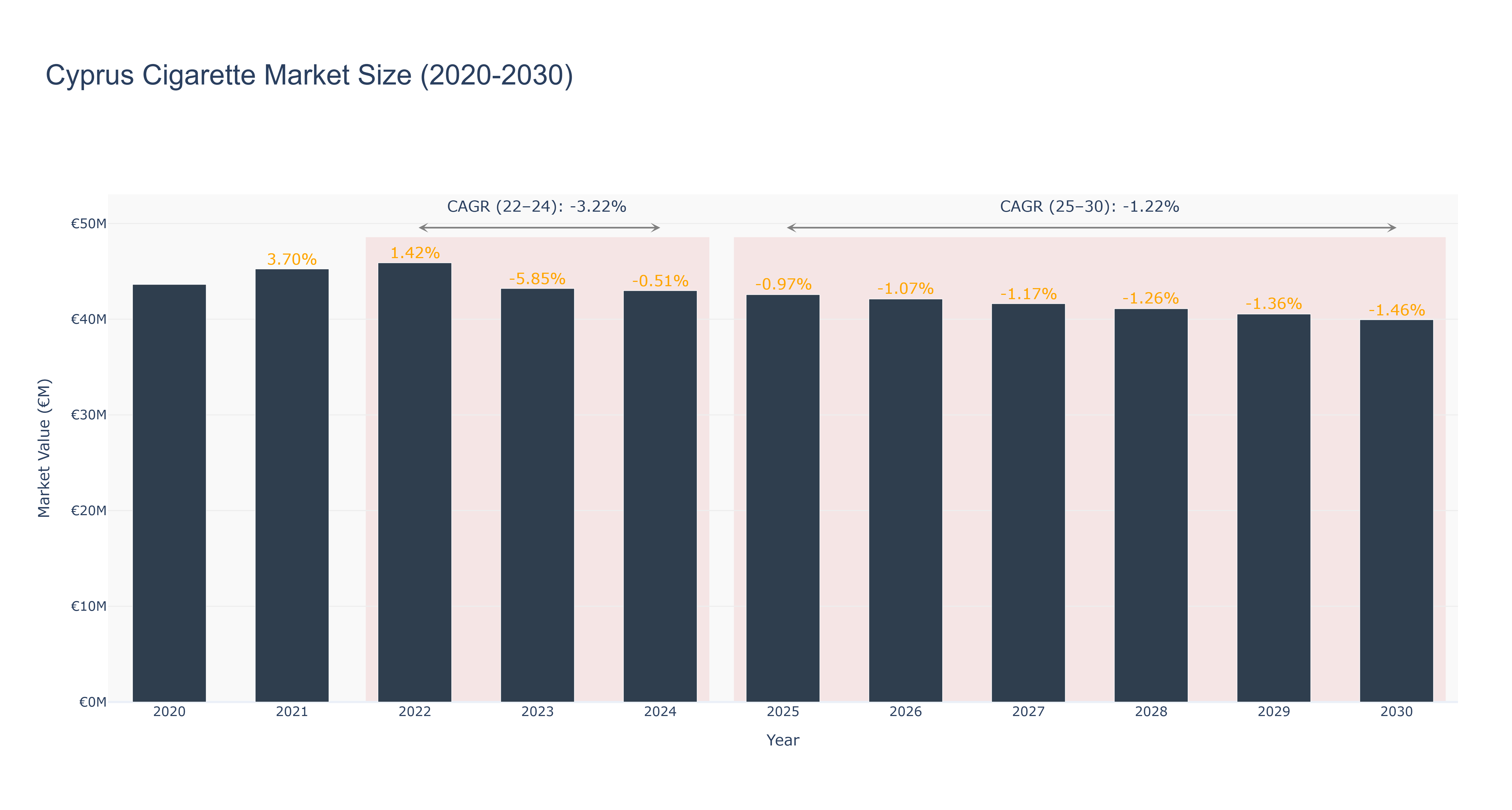
Cyprus Cigarette Market has experienced a notable decline in market size over the years. The peak market size of €45.89 million was recorded in 2022, followed by a steady decrease to €39.94 million in 2030. The CAGR from 2022 to 2024 was -3.22%, while the forecasted CAGR from 2025 to 2030 is -1.22%. This downward trend can be attributed to various factors such as increasing health awareness, stricter regulations on tobacco products, and a shift towards healthier lifestyles among consumers. Looking ahead, the market is expected to continue facing challenges, but potential developments in tobacco alternatives or innovative marketing strategies could potentially drive growth in the future. Keep an eye on potential collaborations with health organizations or the introduction of new smoking cessation programs to adapt to changing consumer preferences and regulatory environments.
Cyprus Cigarette Market: Production & Trade Performance (2019-2025)
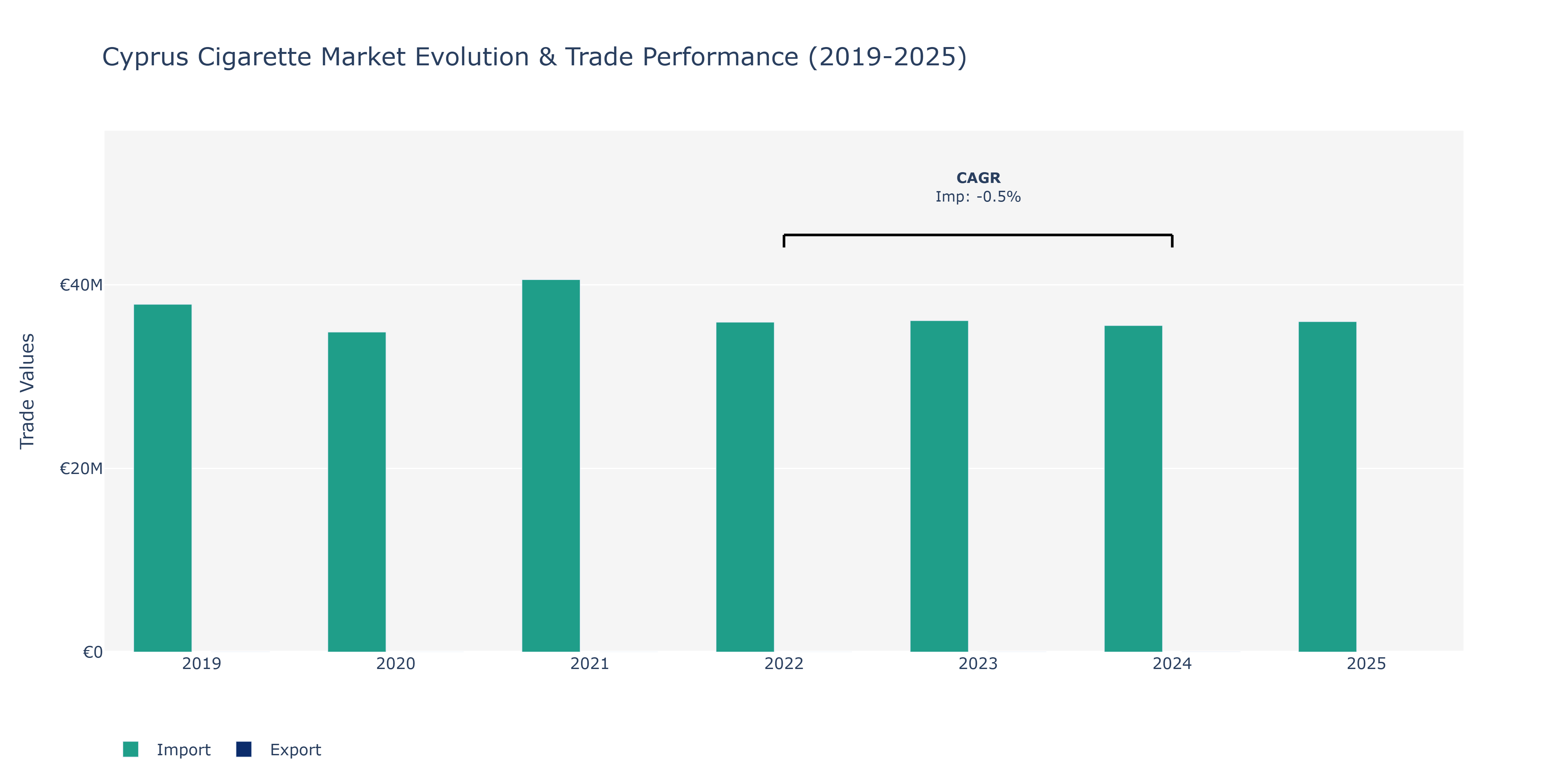
Between 2019 and 2025, Cyprus's Cigarette Market witnessed varying trends in Exports and Imports. The Exports started at €10.94 thousand in 2019, showing a significant increase to €27 million in 2020, then gradually recovering to €14.78 thousand in 2024. In 2023, there was a slight decline in Exports to €7.45 thousand. On the other hand, Imports maintained a relatively stable performance, starting at €37.88 million in 2019, dipping to €34.85 million in 2020, and then fluctuating around the €35-40 billion range from 2021 to 2025. A notable peak in Imports was observed in 2021 at €40.56 million. The fluctuations in Exports can be attributed to shifts in domestic production capacity, changing consumer preferences, and global market dynamics impacting demand. In contrast, the Import stability may be linked to consistent consumption patterns, government regulations, and international trade agreements affecting supply chains in the cigarette industry.
Cyprus Cigarette Market Overview
The cigarette market in Cyprus is affected by shifting consumer preferences, government regulations, and health campaigns. While smoking rates have declined due to health concerns, there is still a significant market for cigarettes, with local and international brands competing for market share.
Drivers of the market
The cigarette market in Cyprus is driven by both domestic consumption and tourist demand. However, increased health awareness and regulatory efforts to reduce smoking have led to a shift toward premium and low-tar cigarette varieties, as well as a rise in electronic alternatives.
Challenges of the market
The cigarette market in Cyprus faces significant challenges due to increasing health awareness and stringent regulations on tobacco advertising and sales. The declining number of smokers limits demand, making it difficult for manufacturers to sustain profitability. Additionally, competition from alternative tobacco products and nicotine delivery systems may hinder growth prospects. Manufacturers must adapt to changing consumer preferences and invest in harm-reduction strategies to maintain market share.
Government Policy of the market
The cigarette market in Cyprus is governed by government policies that regulate tobacco production, sales, and public health. The government enforces strict EU regulations on tobacco advertising, packaging, and taxation, aiming to reduce smoking rates and promote public health initiatives.
Key Highlights of the Report:
- Cyprus Cigarette Market Outlook
- Market Size of Cyprus Cigarette Market, 2024
- Forecast of Cyprus Cigarette Market, 2031
- Historical Data and Forecast of Cyprus Cigarette Revenues & Volume for the Period 2021-2031
- Cyprus Cigarette Market Trend Evolution
- Cyprus Cigarette Market Drivers and Challenges
- Cyprus Cigarette Price Trends
- Cyprus Cigarette Porter`s Five Forces
- Cyprus Cigarette Industry Life Cycle
- Historical Data and Forecast of Cyprus Cigarette Market Revenues & Volume By Type for the Period 2021-2031
- Historical Data and Forecast of Cyprus Cigarette Market Revenues & Volume By Light for the Period 2021-2031
- Historical Data and Forecast of Cyprus Cigarette Market Revenues & Volume By Medium for the Period 2021-2031
- Historical Data and Forecast of Cyprus Cigarette Market Revenues & Volume By Others for the Period 2021-2031
- Historical Data and Forecast of Cyprus Cigarette Market Revenues & Volume By Distribution Channel for the Period 2021-2031
- Historical Data and Forecast of Cyprus Cigarette Market Revenues & Volume By Tobacco Shops for the Period 2021-2031
- Historical Data and Forecast of Cyprus Cigarette Market Revenues & Volume By Supermarket and Hypermarkets for the Period 2021-2031
- Historical Data and Forecast of Cyprus Cigarette Market Revenues & Volume By Convenience Stores for the Period 2021-2031
- Historical Data and Forecast of Cyprus Cigarette Market Revenues & Volume By Online Stores for the Period 2021-2031
- Historical Data and Forecast of Cyprus Cigarette Market Revenues & Volume By Others for the Period 2021-2031
- Cyprus Cigarette Import Export Trade Statistics
- Market Opportunity Assessment By Type
- Market Opportunity Assessment By Distribution Channel
- Cyprus Cigarette Top Companies Market Share
- Cyprus Cigarette Competitive Benchmarking By Technical and Operational Parameters
- Cyprus Cigarette Company Profiles
- Cyprus Cigarette Key Strategic Recommendations






































