Cyprus Led Traffic Signs And Signals Market Size (2020-2030)
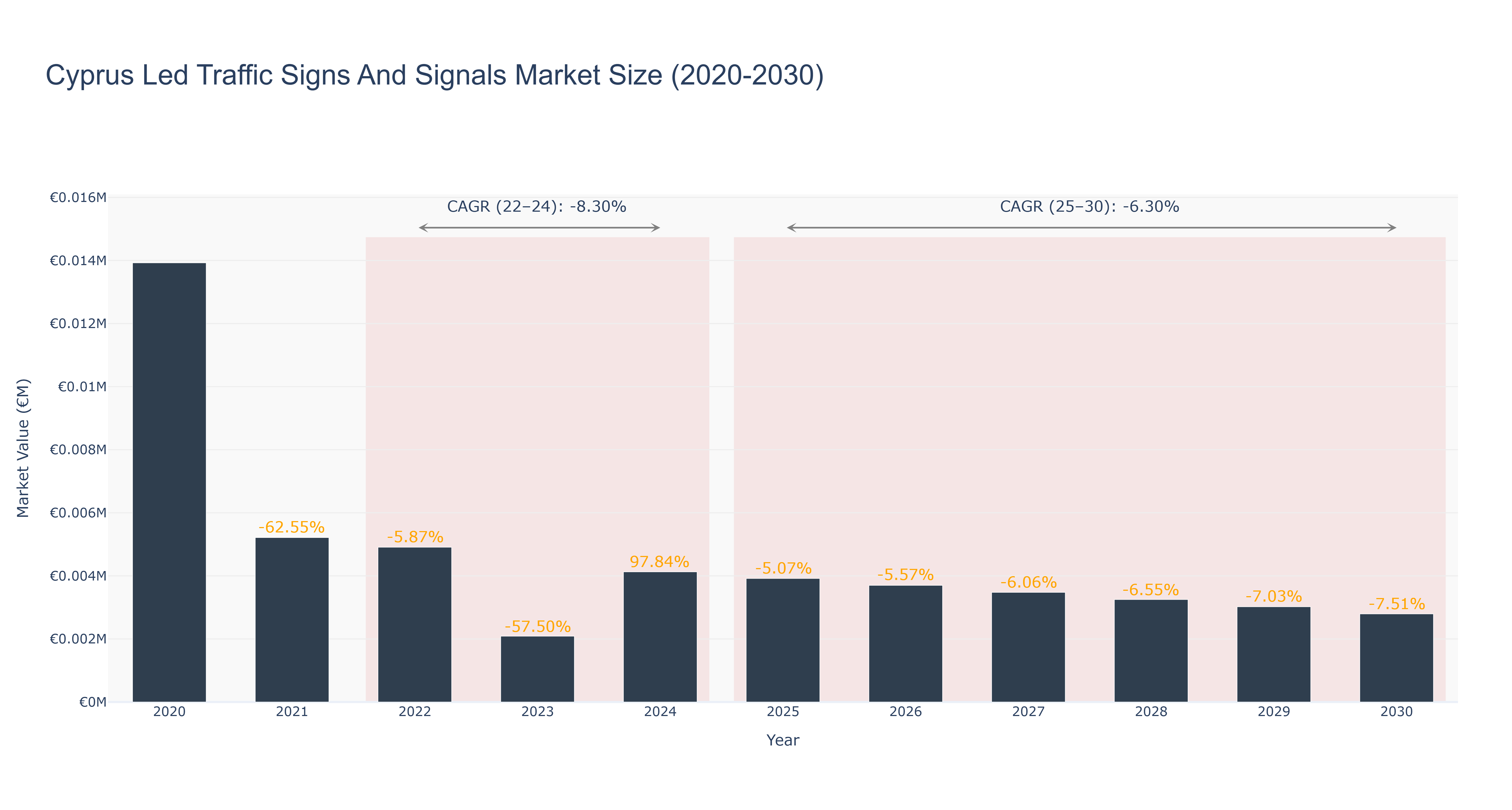
The Cyprus Led Traffic Signs And Signals Market has experienced a tumultuous trajectory, peaking at €13.93 thousand in 2020 before facing significant declines in subsequent years. Actual market sizes from 2021 to 2023 reveal a downward trend, with 2021 at €5.21 thousand, 2022 at €4.91 thousand, and a sharp drop to €2.09 thousand in 2023, resulting in a Compound Annual Growth Rate (CAGR) of -8.30% from 2022 to 2024. However, a rebound is projected for 2024, with the market size expected to reach €4.13 thousand, driven by increased infrastructure investments and a growing emphasis on road safety. The forecasted period from 2025 to 2030 sees a continued decline, with market sizes projected to decrease from €3.92 thousand in 2025 to €2.79 thousand in 2030, reflecting a CAGR of -6.30%. This outlook suggests ongoing challenges in market demand, emphasizing the need for innovation and adaptation within the industry.
Cyprus Led Traffic Signs And Signals Market: Production & Trade Performance (2019-2025)
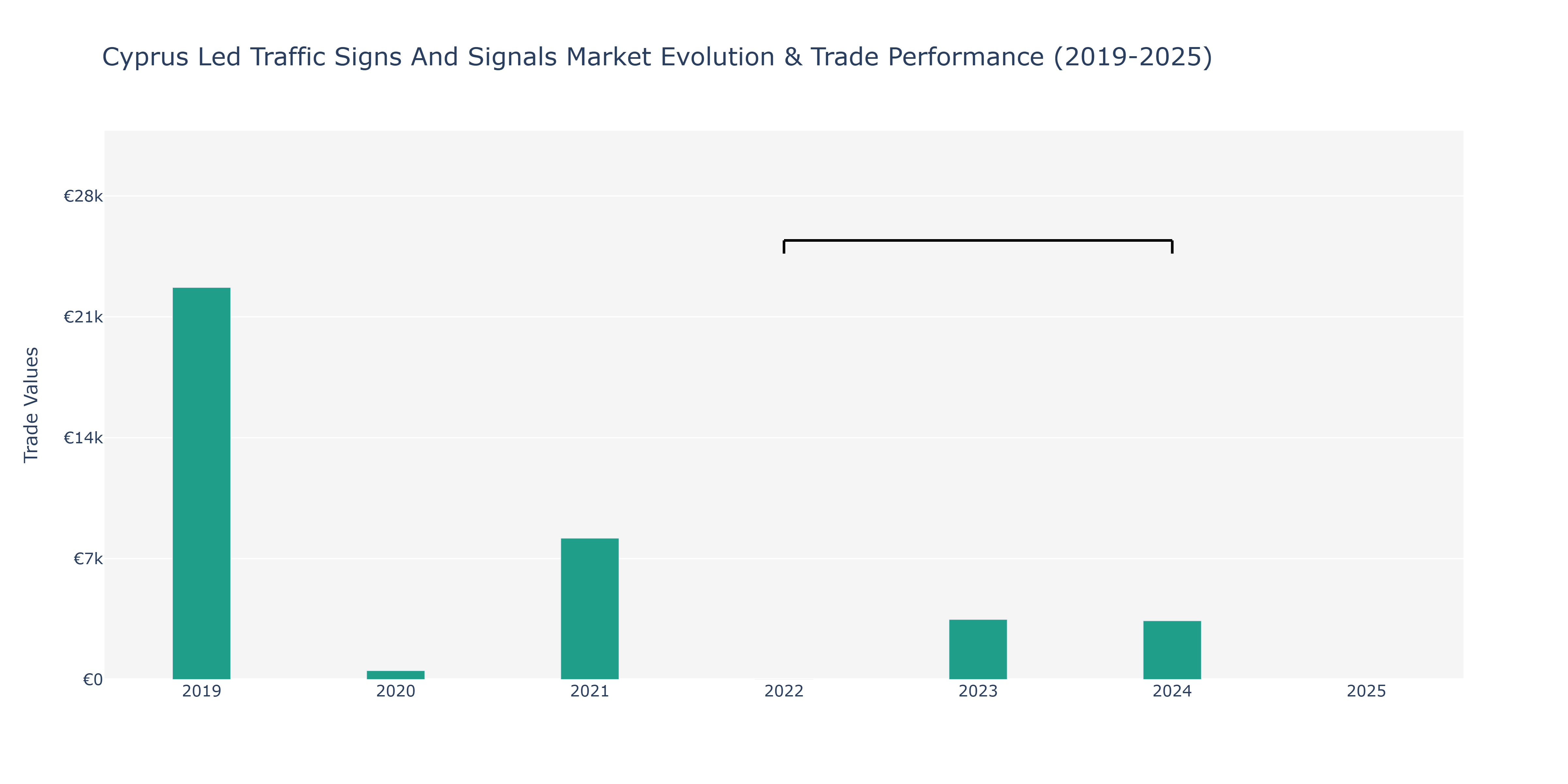
In the Cyprus LED traffic signs and signals market, imports experienced notable fluctuations over the years. In 2019, imports were at €22.7 thousand, significantly higher compared to the subsequent years. A substantial decline was observed in 2020, with imports dropping to €510 million, possibly due to the global economic downturn impacting trade activities. The market showed a partial recovery in 2021, with imports increasing to €8.18 thousand, indicating potential market stabilization. However, in 2023 and 2024, imports decreased to €3.48 thousand and €3.4 thousand, respectively. These declines could be attributed to evolving market demands, technological advancements, or changes in government regulations affecting procurement strategies. To enhance market resilience, stakeholders might consider diversifying suppliers, investing in innovative products, and closely monitoring global economic trends to capitalize on growth opportunities.
Key Highlights of the Report:
- Cyprus LED Traffic Signs and Signals Market Outlook
- Market Size of Cyprus LED Traffic Signs and Signals Market, 2024
- Forecast of Cyprus LED Traffic Signs and Signals Market, 2031
- Historical Data and Forecast of Cyprus LED Traffic Signs and Signals Revenues & Volume for the Period 2021-2031
- Cyprus LED Traffic Signs and Signals Market Trend Evolution
- Cyprus LED Traffic Signs and Signals Market Drivers and Challenges
- Cyprus LED Traffic Signs and Signals Price Trends
- Cyprus LED Traffic Signs and Signals Porter`s Five Forces
- Cyprus LED Traffic Signs and Signals Industry Life Cycle
- Historical Data and Forecast of Cyprus LED Traffic Signs and Signals Market Revenues & Volume By Product for the Period 2021-2031
- Historical Data and Forecast of Cyprus LED Traffic Signs and Signals Market Revenues & Volume By LED Traffic Signals for the Period 2021-2031
- Historical Data and Forecast of Cyprus LED Traffic Signs and Signals Market Revenues & Volume By LED Traffic Signs for the Period 2021-2031
- Cyprus LED Traffic Signs and Signals Import Export Trade Statistics
- Market Opportunity Assessment By Product
- Cyprus LED Traffic Signs and Signals Top Companies Market Share
- Cyprus LED Traffic Signs and Signals Competitive Benchmarking By Technical and Operational Parameters
- Cyprus LED Traffic Signs and Signals Company Profiles
- Cyprus LED Traffic Signs and Signals Key Strategic Recommendations






































