Oman LED Traffic Signs and Signals Market Size, Share & Growth Rate
The Oman LED Traffic Signs and Signals Market was estimated at USD 329 Million in 2025 and is projected to reach USD 432 Million by 2032, growing at a CAGR of 4.0% from 2026 to 2032. This growth trajectory is primarily driven by the Omani government's ongoing initiatives to modernize its transportation infrastructure and enhance overall road safety. Increasing urbanization, coupled with the rising demand for energy-efficient traffic management systems, is further propelling the adoption of LED technology across the nation.
Oman LED Traffic Signs and Signals Market Year-wise Growth Rate and Key Drivers
This graph highlights how the Oman LED Traffic Signs and Signals Market has steadily grown over the years, supported by major growth factors.
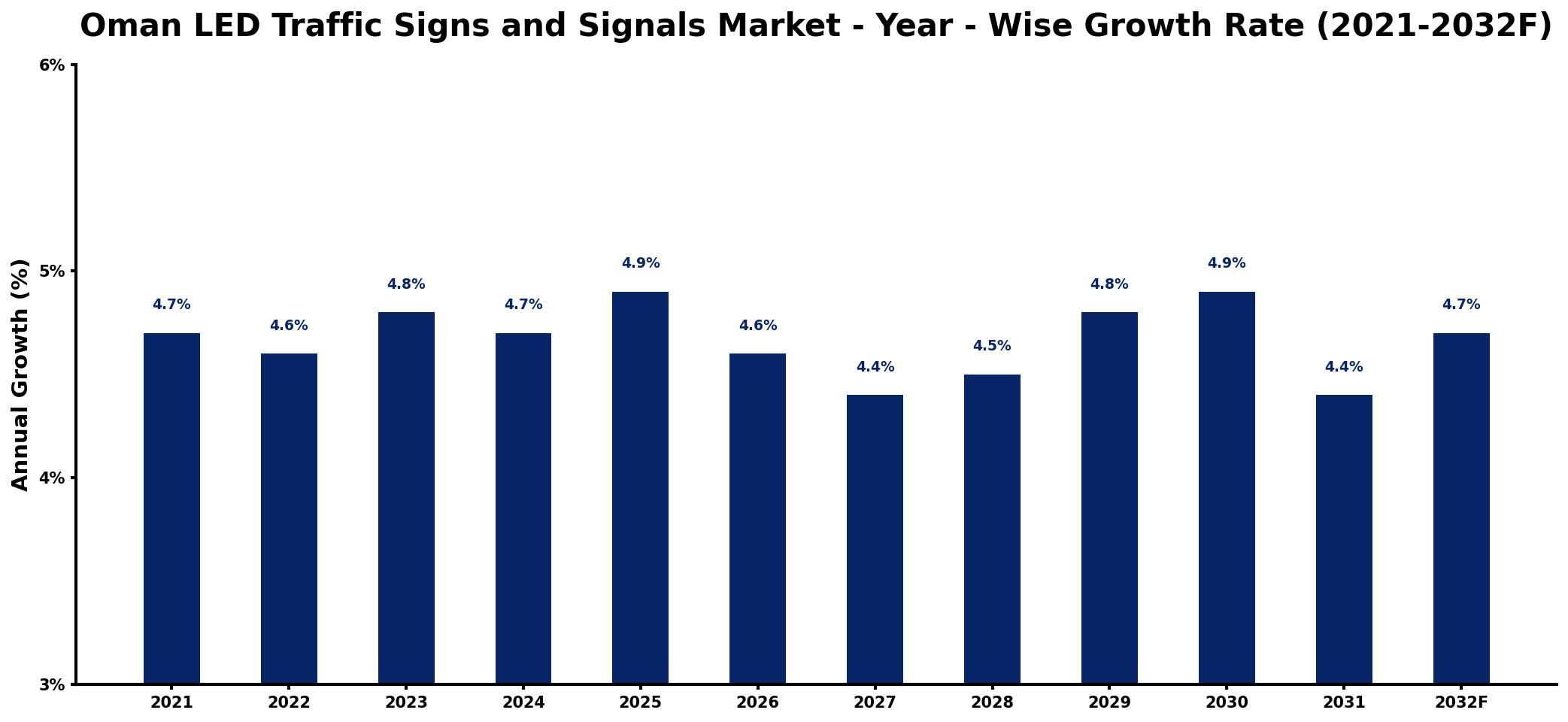
The table below presents the year‑wise growth rates along with the key drivers influencing the market
| Year | Growth Rate | Major Drivers |
| 2021 | 4.7% | Increased urban infrastructure development |
| 2022 | 4.6% | Government investment in modernization |
| 2023 | 4.8% | Rising focus on smart cities |
| 2024 | 4.7% | Growing public safety initiatives |
| 2025 | 4.9% | Expansion of renewable energy projects |
| 2026 | 4.6% | Technological advancements in automation |
| 2027 | 4.4% | Increase in road safety regulations |
| 2028 | 4.5% | Demand for eco-friendly solutions |
| 2029 | 4.8% | Rise in construction activities |
| 2030 | 4.9% | Enhanced public transport systems |
| 2031 | 4.4% | Growth in urban population density |
| 2032 | 4.7% | Investment in sustainable infrastructure |
Note: Market size estimations and growth projections presented in this report are based on 6Wresearch's proprietary forecasting methodology, utilizing the latest available industry data, government publications, and primary research inputs.
Oman LED Traffic Signs and Signals Market Synopsis
In Oman, the integration of LED traffic signs and signals is becoming increasingly crucial as the country embraces smart city concepts. The demand for such advanced solutions stems from the need for improved visibility and the reduction of energy consumption associated with traditional signage. Furthermore, Oman is positioning itself to leverage technology-driven solutions that not only streamline traffic management but also significantly bolster road safety.
The market is currently witnessing a robust push towards sustainable alternatives, exemplified by the rise in solar-powered LED traffic signs. This shift is not only in alignment with global sustainability trends but also reflects the government's commitment to innovative technologies that enhance operational efficiencies while reducing carbon footprints.
Oman LED Traffic Signs and Signals Market Key Takeaways
- The market is poised for significant growth, driven by government initiatives aimed at enhancing road safety.
- Adoption of LED technology is increasing due to its energy efficiency and superior visibility over traditional options.
- Smart city developments are reshaping traffic management approaches, fostering demand for innovative LED solutions.
- Investment opportunities are ripe, particularly in sustainable and advanced traffic management systems.
- Government regulations are supporting the integration of high-quality, energy-efficient traffic solutions.
Evaluation of Restraints in Oman LED Traffic Signs and Signals Market
Despite its promising outlook, the Oman LED Traffic Signs and Signals Market is impeded by certain constraints. One of the most significant challenges is the high initial investment required for LED infrastructure, which can deter adoption among smaller municipalities and private stakeholders. Furthermore, there's a notable lack of awareness regarding the long-term benefits of LED technology among key decision-makers, leading to hesitance in transitioning from traditional systems. The presence of cheaper alternatives also complicates market dynamics, as stakeholders may opt for lower-cost options despite the advantages of LED solutions. Additionally, the need for specialized maintenance and adaptation to extreme weather conditions poses ongoing operational challenges.
Oman LED Traffic Signs and Signals Market Trends
Current trends in the Oman LED Traffic Signs and Signals Market showcase a pronounced shift towards smart technologies. The incorporation of Internet of Things (IoT) capabilities and artificial intelligence in traffic management is emerging as a prominent driver of demand. These technologies enable real-time information sharing with motorists, enhancing traffic flow and safety. Furthermore, an increasing emphasis on urban sustainability is pushing authorities to consider solar-powered options, thus reducing the environmental impact of traffic management systems. The ongoing development of smart infrastructure across Oman's urban landscapes is expected to further accelerate the adoption of LED solutions.
Oman LED Traffic Signs and Signals Market Opportunities
The potential for investment in the Oman LED Traffic Signs and Signals Market is substantial, driven by government initiatives aimed at traffic management enhancement. Opportunities abound in the realm of smart city technologies, where innovative solutions can significantly improve infrastructure efficiency. Furthermore, as urbanization continues to rise, there is an increasing need for advanced traffic management systems that offer both sustainability and effectiveness. Collaborations with local manufacturers could also present a strategic avenue for investors looking to leverage regional expertise while tapping into the growing market.
Government Initiatives in the Oman LED Traffic Signs and Signals Market
Omans government has launched various initiatives that underpin the development of the LED traffic signs and signals market. These include policies aimed at improving road safety through the installation of energy-efficient traffic management systems. Regulations emphasize the use of durable materials that comply with international standards, ensuring that traffic signs are effective and long-lasting. Additionally, the government is focusing on the regular maintenance and upgrading of existing traffic management systems, which lays the foundation for incorporating more advanced, technology-driven solutions.
Future Insights of the Oman LED Traffic Signs and Signals Market
Looking ahead to the period from 2026 to 2032, the Oman LED Traffic Signs and Signals Market is projected to witness significant transformation. The integration of smart technologies, such as IoT and AI, is expected to be a key contributor to this evolution, providing enhanced traffic management capabilities. As urban infrastructure continues to modernize, the demand for durable, energy-efficient LED solutions will rise. This alignment of technological advancement and government support is set to create a dynamic environment for market growth, positioning Oman as a leader in smart traffic management within the region.
Oman LED Traffic Signs and Signals Market Latest Developments (2025 - 2026)
Recent developments in the Oman LED Traffic Signs and Signals Market indicate a strong focus on sustainable solutions and technological integration. As authorities explore new methods to enhance road safety and traffic efficiency, there is an increasing emphasis on the deployment of solar-powered and smart traffic signs. Concurrently, partnerships between government agencies and technology providers are emerging to accelerate the rollout of advanced traffic management systems throughout the country, aligning with Omans broader vision of modernizing its transportation infrastructure.
Oman LED Traffic Signs and Signals Market - Key Attractiveness of the Report
- 10 Years of Market Numbers
- Historical Data Starting from 2022 to 2025
- Base Year: 2025
- Forecast Data until 2032
- Key Performance Indicators Impacting the Market
- Major Upcoming Developments and Projects
Key Highlights of the Report:
- Oman LED Traffic Signs and Signals Market Outlook
- Market Size of Oman LED Traffic Signs and Signals Market, 2025
- Forecast of Oman LED Traffic Signs and Signals Market, 2032
- Historical Data and Forecast of Oman LED Traffic Signs and Signals Revenues & Volume for the Period 2022-2032F
- Oman LED Traffic Signs and Signals Market Trend Evolution
- Oman LED Traffic Signs and Signals Market Drivers and Challenges
- Oman LED Traffic Signs and Signals Price Trends
- Oman LED Traffic Signs and Signals Porter's Five Forces
- Oman LED Traffic Signs and Signals Industry Life Cycle
- Historical Data and Forecast of Oman LED Traffic Signs and Signals Market Revenues & Volume By Product for the Period 2022-2032F
- Historical Data and Forecast of Oman LED Traffic Signs and Signals Market Revenues & Volume By LED Traffic Signals for the Period 2022-2032F
- Historical Data and Forecast of Oman LED Traffic Signs and Signals Market Revenues & Volume By LED Traffic Signs for the Period 2022-2032F
- Oman LED Traffic Signs and Signals Import Export Trade Statistics
- Market Opportunity Assessment By Product
- Oman LED Traffic Signs and Signals Top Companies Market Share
- Oman LED Traffic Signs and Signals Competitive Benchmarking By Technical and Operational Parameters
- Oman LED Traffic Signs and Signals Company Profiles
- Oman LED Traffic Signs and Signals Key Strategic Recommendations






































