Cyprus Pasta And Noodles Market Size (2020-2030)
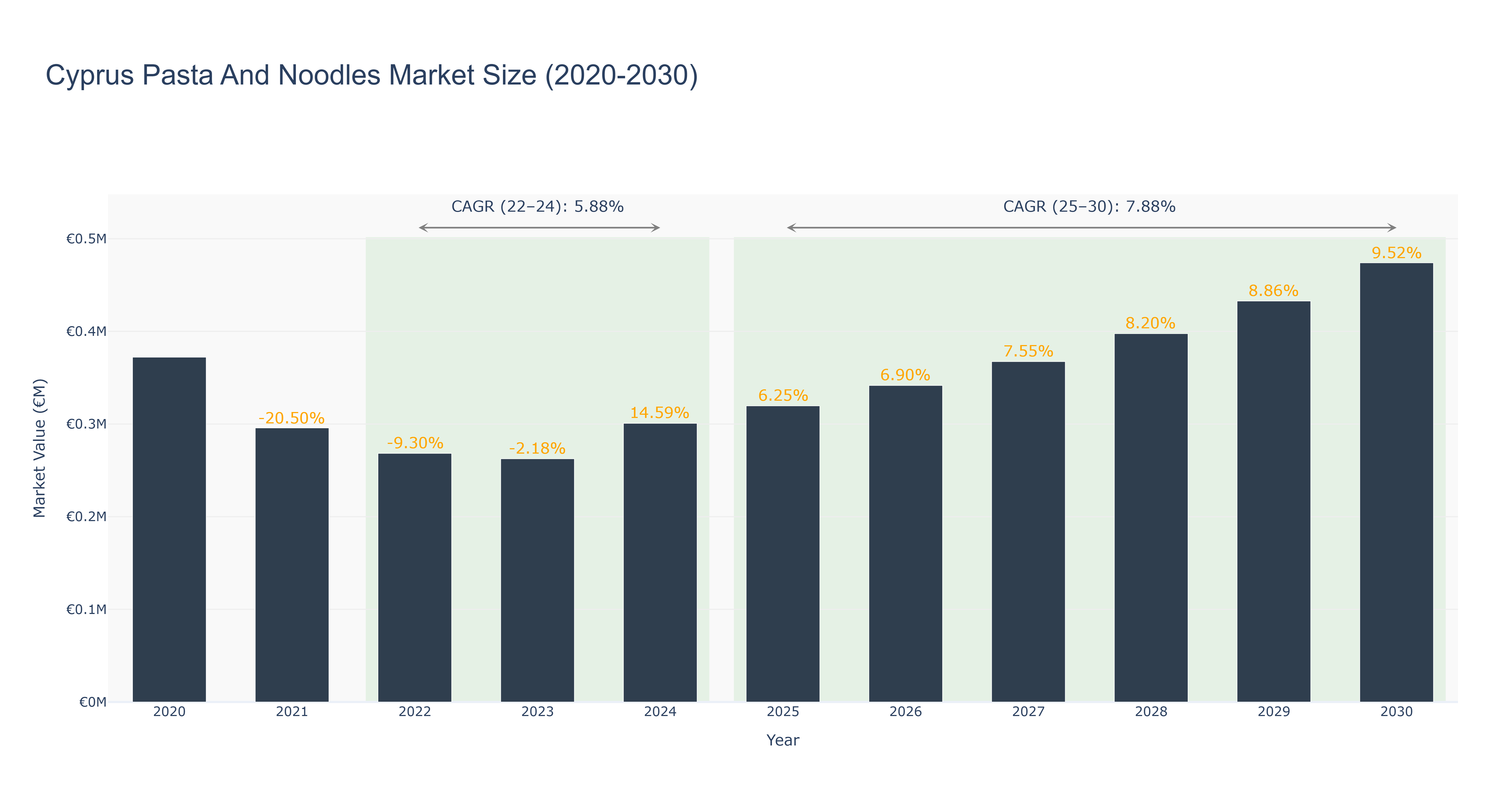
Cyprus Pasta And Noodles Market has shown a fluctuating trend in market size over the years. The peak market size was €0.47 million in 2030, with a steady growth rate. From 2020 to 2024, the market size decreased from €0.37 million to €0.30 million due to negative growth rates, but rebounded with a significant 14.59% growth in 2024. Forecasted market size from 2025 to 2030 is expected to continue growing steadily, with a Compound Annual Growth Rate (CAGR) of 7.88% post-2025. The market's growth can be attributed to evolving consumer preferences towards convenience foods and the increasing popularity of pasta and noodles in Cyprus. Looking ahead, upcoming investments in modernizing production facilities and expanding distribution networks are set to further boost the market's growth trajectory.
Cyprus Pasta And Noodles Market: Production & Trade Performance (2019-2025)
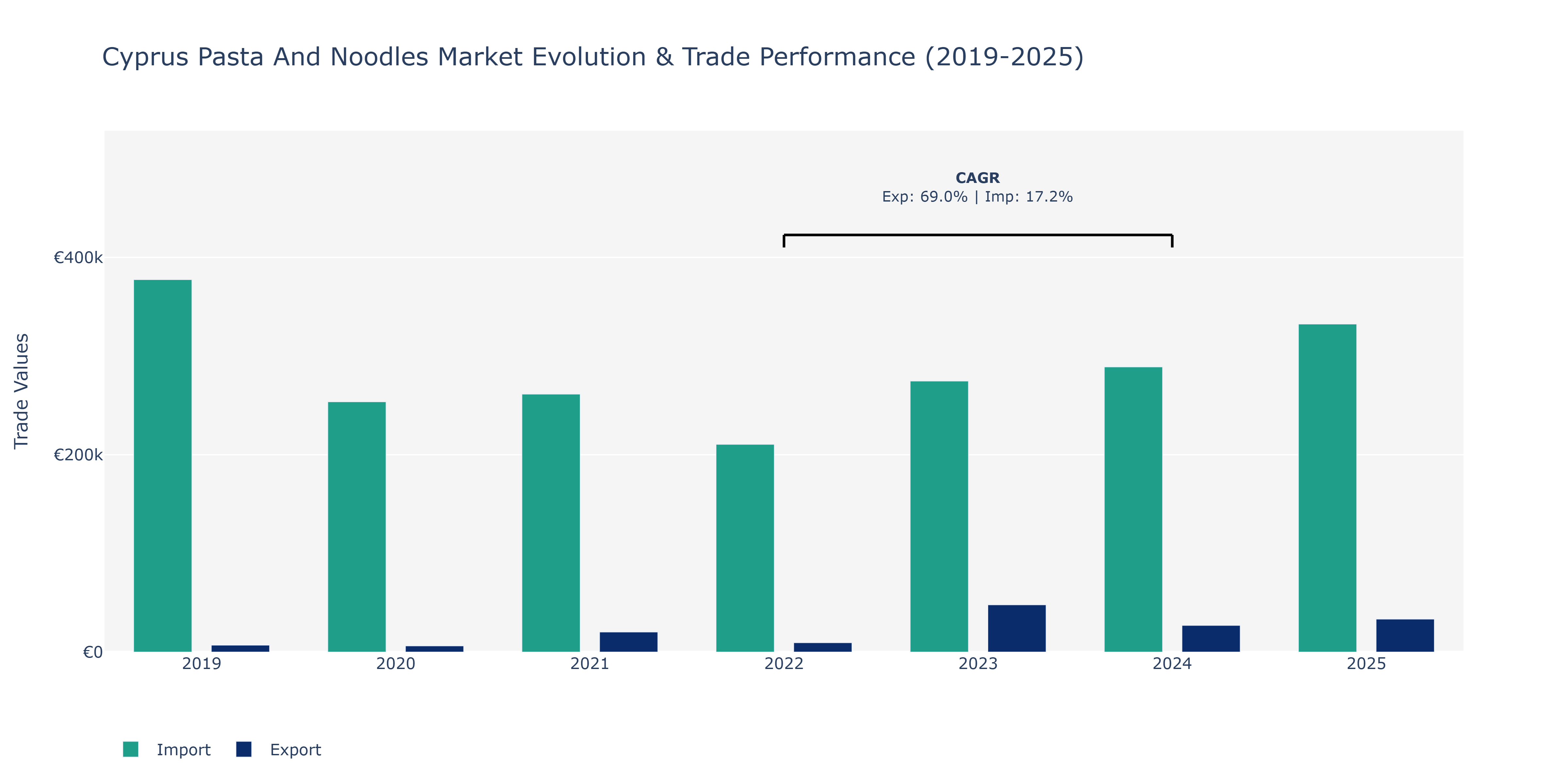
Between 2019 and 2025, Cyprus's Pasta and Noodles Market witnessed noteworthy shifts in both Exports and Imports. In 2019, Exports stood at €6.94 thousand, showing a decline to €6.22 thousand in 2020 before rebounding significantly to €20.26 thousand in 2021. This surge continued with peaks in 2023 at €47.85 thousand and in 2024 at €27.02 thousand, indicating a fluctuating yet overall ascending trend. Imports followed a similar pattern, decreasing from €377.47 thousand in 2019 to €253.64 thousand in 2020, before rising to €332.48 thousand in 2025. These fluctuations can be attributed to various factors such as changes in consumer preferences, global economic conditions impacting trade patterns, and shifts in domestic production capabilities. The CAGR for exports of 69.02% from 2022 to 2024 suggests strong market growth potential, while the imports CAGR of 17.16% indicates a steady increase in foreign pasta and noodles consumption. Real-world developments like increased health consciousness driving demand for diverse and international cuisines could have contributed to these trends, aligning with global food market shifts towards healthier and convenient meal options.
Key Highlights of the Report:
- Cyprus Pasta and Noodles Market Outlook
- Market Size of Cyprus Pasta and Noodles Market, 2024
- Forecast of Cyprus Pasta and Noodles Market, 2031
- Historical Data and Forecast of Cyprus Pasta and Noodles Revenues & Volume for the Period 2021-2031
- Cyprus Pasta and Noodles Market Trend Evolution
- Cyprus Pasta and Noodles Market Drivers and Challenges
- Cyprus Pasta and Noodles Price Trends
- Cyprus Pasta and Noodles Porter`s Five Forces
- Cyprus Pasta and Noodles Industry Life Cycle
- Historical Data and Forecast of Cyprus Pasta and Noodles Market Revenues & Volume By Product for the Period 2021-2031
- Historical Data and Forecast of Cyprus Pasta and Noodles Market Revenues & Volume By Ambient for the Period 2021-2031
- Historical Data and Forecast of Cyprus Pasta and Noodles Market Revenues & Volume By Dried for the Period 2021-2031
- Historical Data and Forecast of Cyprus Pasta and Noodles Market Revenues & Volume By Chilled for the Period 2021-2031
- Cyprus Pasta and Noodles Import Export Trade Statistics
- Market Opportunity Assessment By Product
- Cyprus Pasta and Noodles Top Companies Market Share
- Cyprus Pasta and Noodles Competitive Benchmarking By Technical and Operational Parameters
- Cyprus Pasta and Noodles Company Profiles
- Cyprus Pasta and Noodles Key Strategic Recommendations






































