Cyprus Tea Market Size (2020-2030)
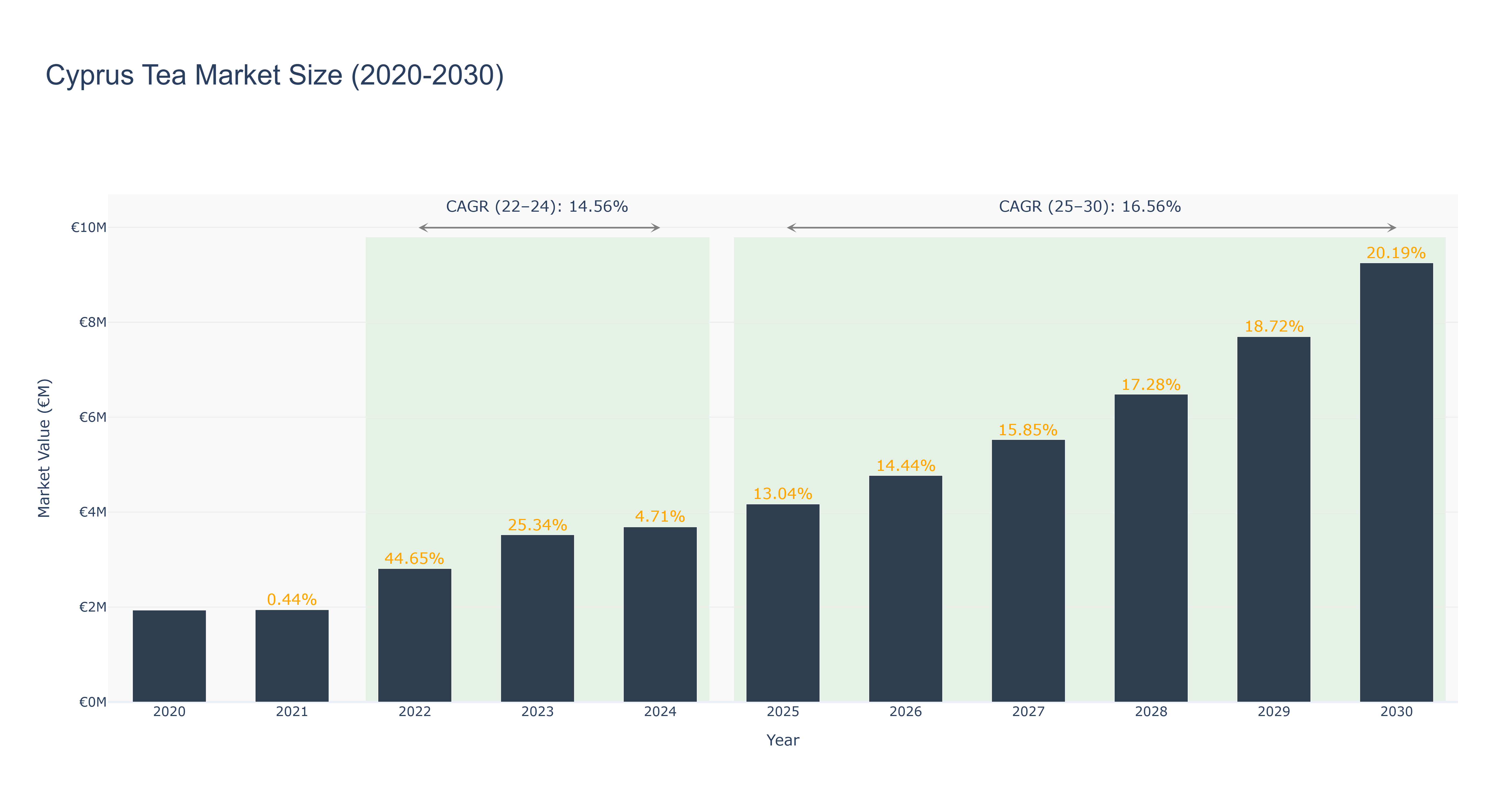
Cyprus Tea Market has shown a steady growth trajectory over the years. The peak market size of €9.25 million is forecasted for 2030, reflecting a positive trend in market expansion. From 2020 to 2024, the market size increased gradually from €1.93 million to €3.69 million, driven by rising consumer demand and strategic marketing initiatives. The forecasted market size from 2025 to 2030 is expected to reach €9.25 million, showcasing a robust CAGR of 16.56%. The market experienced a notable CAGR of 14.56% from 2022 to 2024, indicating sustained growth and market potential. Looking ahead, upcoming developments in sustainable tea production practices and innovative product offerings are poised to further fuel market growth in the Cyprus Tea Market.
Cyprus Tea Market: Production & Trade Performance (2019-2025)
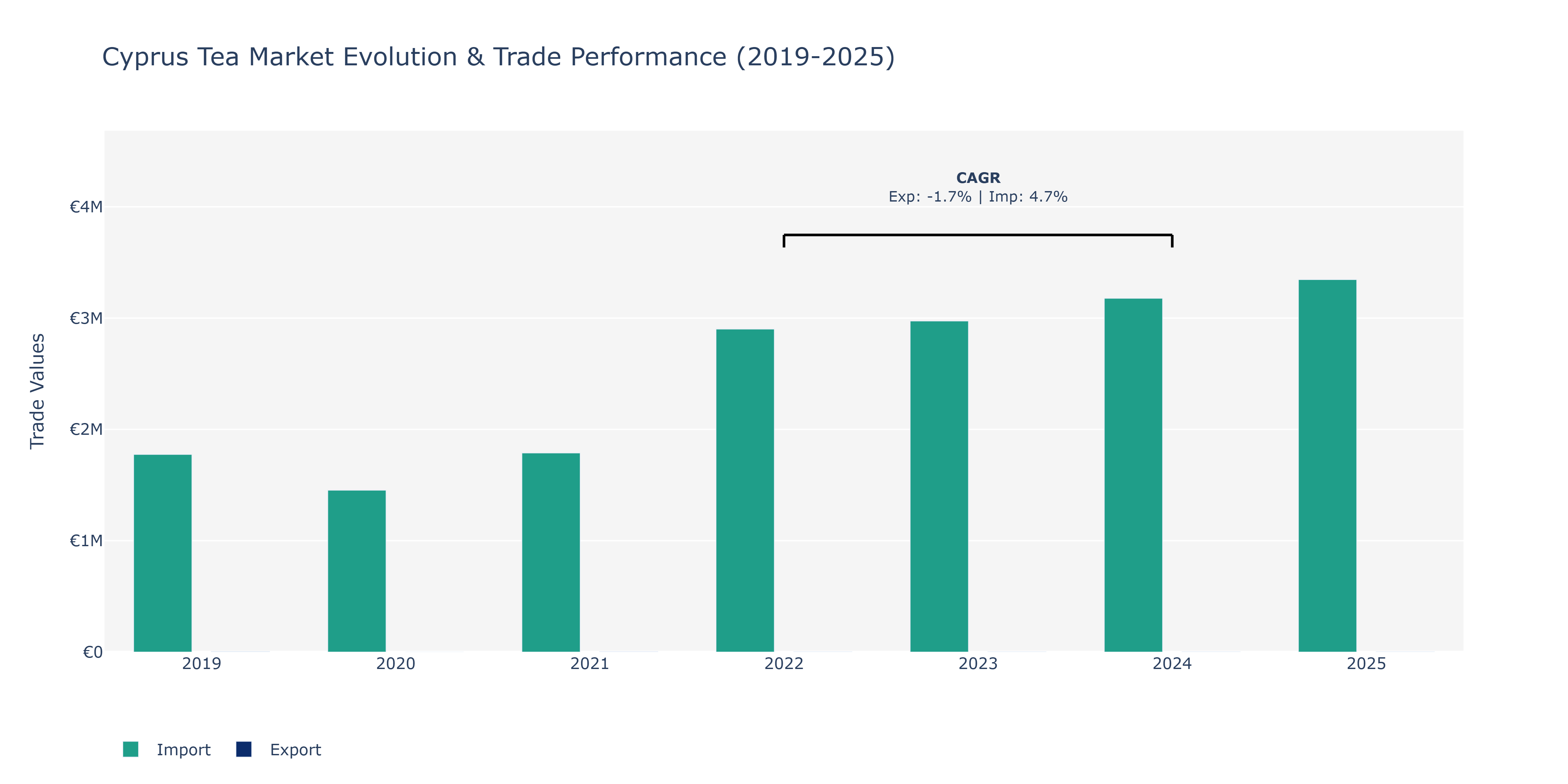
The Cyprus Tea Market experienced notable fluctuations in both Exports and Imports during the period under review. In 2019, Imports reached a peak of €1.77 million, significantly higher than Exports at €4.87 thousand. However, in 2020, Exports saw a substantial decrease to €36, while Imports also declined to €1.45 million. The market rebounded in 2021 with Exports totaling €3.73 thousand and Imports rising to €1.79 million. Interestingly, there was a slight decrease in Exports in 2022 to €2.35 thousand, while Imports surged to €2.9 million, marking a notable uptrend. By 2025, both Exports and Imports continued to rise, reaching €2.27 thousand and €3.35 million, respectively. The market dynamics could be attributed to shifts in consumer preferences, global trade patterns, and economic conditions affecting demand and supply chains within the tea industry.
Key Highlights of the Report:
- Cyprus Tea Market Outlook
- Market Size of Cyprus Tea Market, 2024
- Forecast of Cyprus Tea Market, 2031
- Historical Data and Forecast of Cyprus Tea Revenues & Volume for the Period 2021-2031
- Cyprus Tea Market Trend Evolution
- Cyprus Tea Market Drivers and Challenges
- Cyprus Tea Price Trends
- Cyprus Tea Porter`s Five Forces
- Cyprus Tea Industry Life Cycle
- Historical Data and Forecast of Cyprus Tea Market Revenues & Volume By Type for the Period 2021-2031
- Historical Data and Forecast of Cyprus Tea Market Revenues & Volume By Green Tea for the Period 2021-2031
- Historical Data and Forecast of Cyprus Tea Market Revenues & Volume By Black Tea for the Period 2021-2031
- Historical Data and Forecast of Cyprus Tea Market Revenues & Volume By Oolong Tea for the Period 2021-2031
- Historical Data and Forecast of Cyprus Tea Market Revenues & Volume By Fruit/Herbal Tea for the Period 2021-2031
- Historical Data and Forecast of Cyprus Tea Market Revenues & Volume By Others for the Period 2021-2031
- Historical Data and Forecast of Cyprus Tea Market Revenues & Volume By Packaging for the Period 2021-2031
- Historical Data and Forecast of Cyprus Tea Market Revenues & Volume By Plastic Containers for the Period 2021-2031
- Historical Data and Forecast of Cyprus Tea Market Revenues & Volume By Loose Tea for the Period 2021-2031
- Historical Data and Forecast of Cyprus Tea Market Revenues & Volume By Paperboards for the Period 2021-2031
- Historical Data and Forecast of Cyprus Tea Market Revenues & Volume By Aluminum Tins for the Period 2021-2031
- Historical Data and Forecast of Cyprus Tea Market Revenues & Volume By Tea Bags for the Period 2021-2031
- Historical Data and Forecast of Cyprus Tea Market Revenues & Volume By Distribution Channel for the Period 2021-2031
- Historical Data and Forecast of Cyprus Tea Market Revenues & Volume By Supermarkets/Hypermarkets for the Period 2021-2031
- Historical Data and Forecast of Cyprus Tea Market Revenues & Volume By Specialty Stores for the Period 2021-2031
- Historical Data and Forecast of Cyprus Tea Market Revenues & Volume By Convenience Stores for the Period 2021-2031
- Historical Data and Forecast of Cyprus Tea Market Revenues & Volume By Online Stores for the Period 2021-2031
- Historical Data and Forecast of Cyprus Tea Market Revenues & Volume By Others for the Period 2021-2031
- Historical Data and Forecast of Cyprus Tea Market Revenues & Volume By Application for the Period 2021-2031
- Historical Data and Forecast of Cyprus Tea Market Revenues & Volume By Residential for the Period 2021-2031
- Historical Data and Forecast of Cyprus Tea Market Revenues & Volume By Commercial for the Period 2021-2031
- Cyprus Tea Import Export Trade Statistics
- Market Opportunity Assessment By Type
- Market Opportunity Assessment By Packaging
- Market Opportunity Assessment By Distribution Channel
- Market Opportunity Assessment By Application
- Cyprus Tea Top Companies Market Share
- Cyprus Tea Competitive Benchmarking By Technical and Operational Parameters
- Cyprus Tea Company Profiles
- Cyprus Tea Key Strategic Recommendations






































