Cyprus Toaster Market Size (2020-2030)
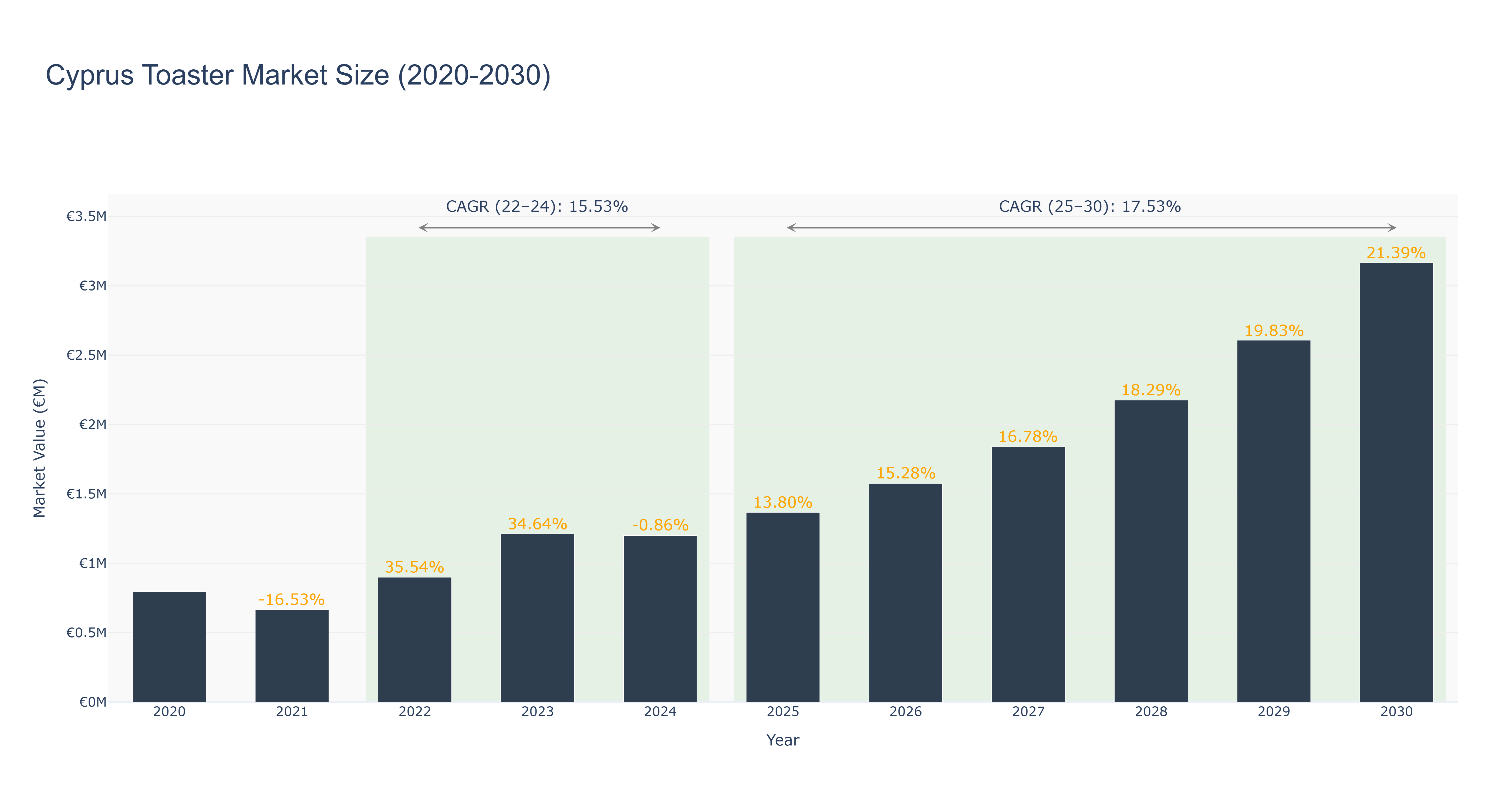
Cyprus Toaster Market has shown a steady growth trajectory over the years. The market peaked at €3.17 million in 2030, with a notable increase in market size from €0.80 million in 2020 to €1.20 million in 2024. The forecasted market size is expected to continue this upward trend, reaching €3.17 million by 2030. The CAGR values for the periods 2022-24 and 2025-30 are 15.53% and 17.53% respectively. The growth can be attributed to increasing consumer demand for convenient and time-saving kitchen appliances. Looking ahead, Cyprus is set to introduce energy-efficient toaster models in response to sustainability concerns, which is expected to further drive market growth. This market trend indicates a promising future for the Cyprus Toaster Market, with opportunities for innovation and expansion.
Cyprus Toaster Market: Production & Trade Performance (2019-2025)
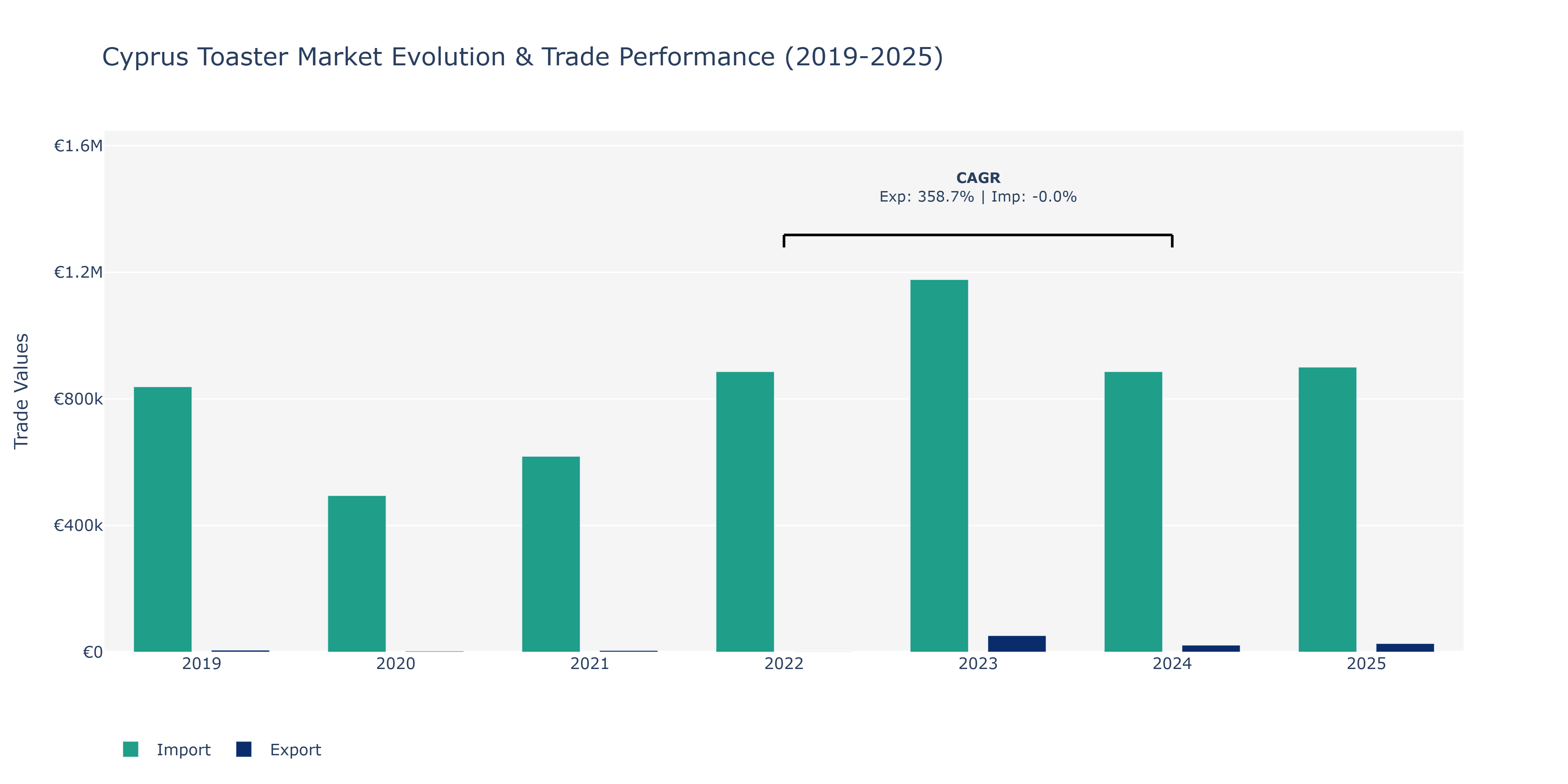
In the Cyprus Toaster Market, exports showed a fluctuating pattern from 2019 to 2025. Starting at €6.02 thousand in 2019, exports sharply declined to €2.72 thousand in 2020, followed by a notable recovery to €4.78 thousand in 2021. A significant peak was observed in 2023 at €51.83 thousand before decreasing to €21.82 thousand in 2024 and further to €26.91 thousand in 2025. In contrast, imports displayed a more consistent trend, steadily increasing from €838.33 thousand in 2019 to €900.03 thousand in 2025. The fluctuations in exports could be attributed to changing consumer preferences, global economic conditions affecting disposable income, and emerging competitors in the toaster market. The consistent rise in imports may reflect a growing demand for foreign toaster technologies or raw materials not locally available. To sustain growth, companies in the Cyprus Toaster Market may need to focus on innovation, cost-efficiency, and market diversification strategies based on consumer insights.
Key Highlights of the Report:
- Cyprus Toaster Market Outlook
- Market Size of Cyprus Toaster Market, 2024
- Forecast of Cyprus Toaster Market, 2031
- Historical Data and Forecast of Cyprus Toaster Revenues & Volume for the Period 2021-2031
- Cyprus Toaster Market Trend Evolution
- Cyprus Toaster Market Drivers and Challenges
- Cyprus Toaster Price Trends
- Cyprus Toaster Porter`s Five Forces
- Cyprus Toaster Industry Life Cycle
- Historical Data and Forecast of Cyprus Toaster Market Revenues & Volume By Product for the Period 2021-2031
- Historical Data and Forecast of Cyprus Toaster Market Revenues & Volume By Pop-up Toasters for the Period 2021-2031
- Historical Data and Forecast of Cyprus Toaster Market Revenues & Volume By Toaster Oven for the Period 2021-2031
- Historical Data and Forecast of Cyprus Toaster Market Revenues & Volume By Conveyor Toasters for the Period 2021-2031
- Historical Data and Forecast of Cyprus Toaster Market Revenues & Volume By Application for the Period 2021-2031
- Historical Data and Forecast of Cyprus Toaster Market Revenues & Volume By Commercial for the Period 2021-2031
- Historical Data and Forecast of Cyprus Toaster Market Revenues & Volume By Residential for the Period 2021-2031
- Cyprus Toaster Import Export Trade Statistics
- Market Opportunity Assessment By Product
- Market Opportunity Assessment By Application
- Cyprus Toaster Top Companies Market Share
- Cyprus Toaster Competitive Benchmarking By Technical and Operational Parameters
- Cyprus Toaster Company Profiles
- Cyprus Toaster Key Strategic Recommendations






































