Cyprus Wood Charcoal Market Size (2020-2030)
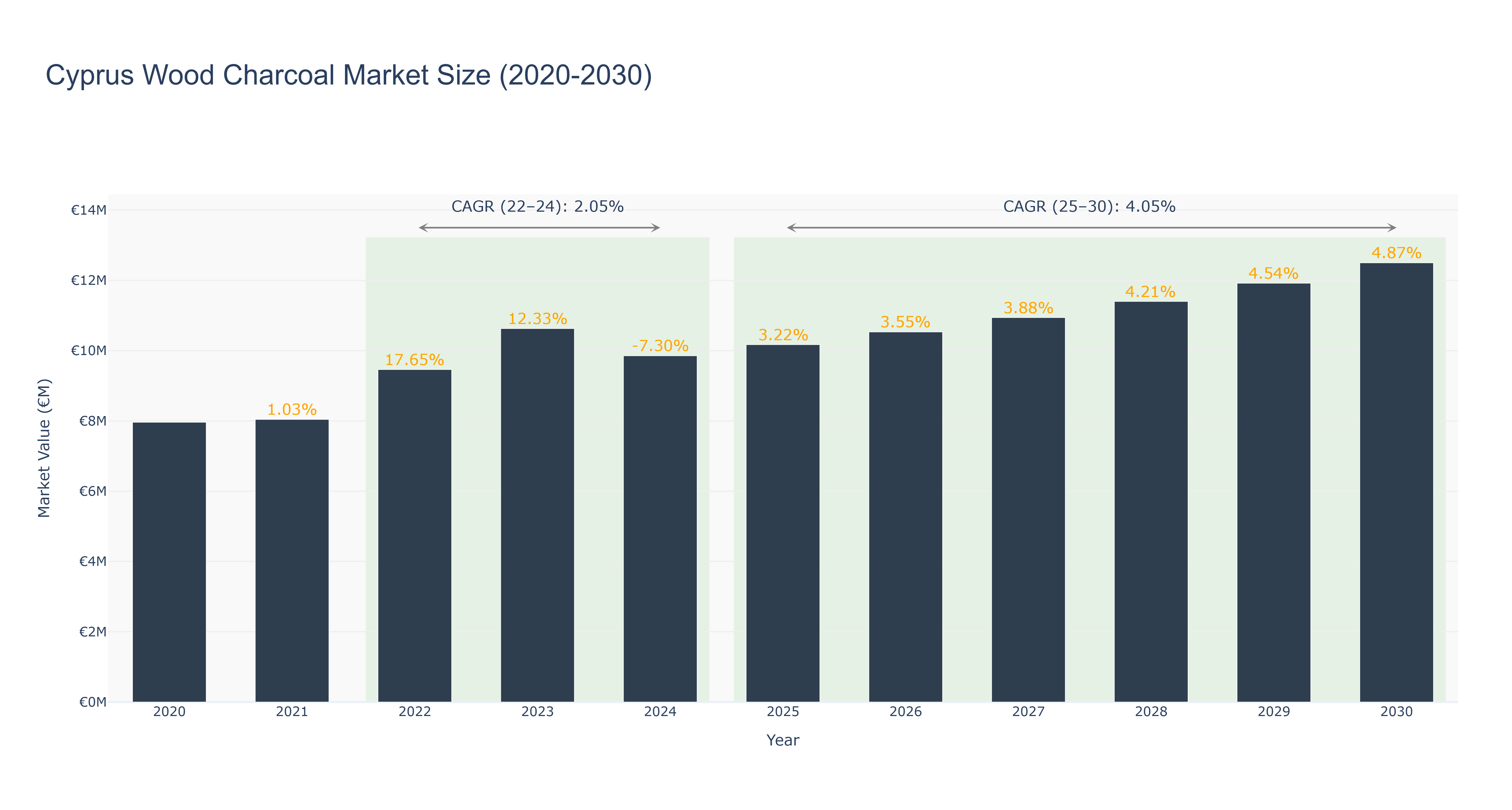
Cyprus Wood Charcoal Market has shown a steady growth trajectory over the years. The market peaked at €10.63 million in 2023, driven by a CAGR of 12.33% from 2020 to 2023. However, a slight decline was observed in 2024, with the market size dropping to €9.85 million due to a negative growth rate of -7.30%. Looking ahead, the market is forecasted to continue its upward trend, reaching €12.50 million by 2030, supported by a CAGR of 4.87% from 2025 to 2030. The market's growth can be attributed to increasing consumer demand for eco-friendly and sustainable products, driving the demand for wood charcoal. In the near future, Cyprus is planning to invest in sustainable forestry practices to ensure a stable supply of raw materials for the wood charcoal industry, further boosting market growth.
Cyprus Wood Charcoal Market: Production & Trade Performance (2019-2025)
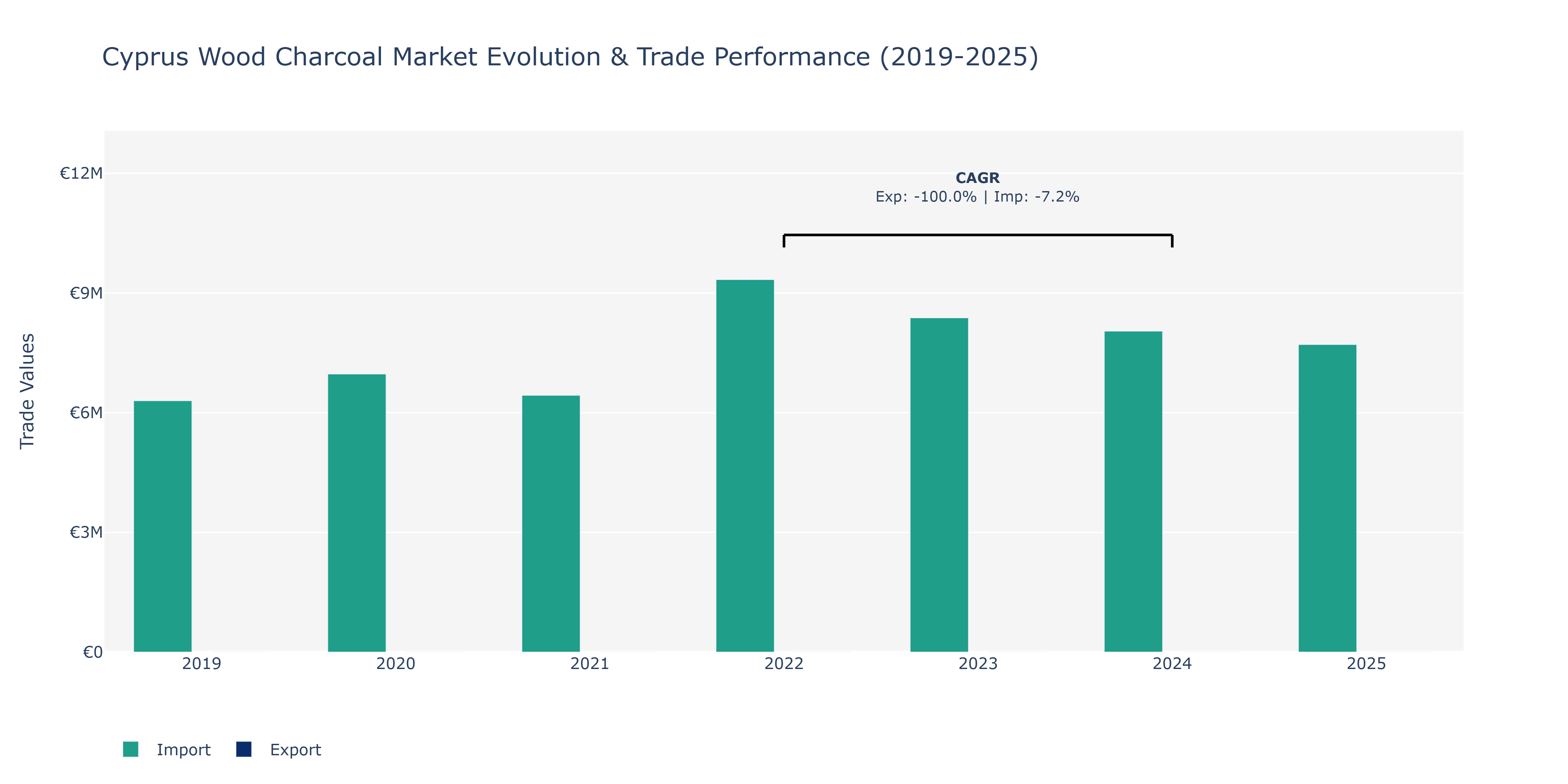
Between 2019 and 2025, the Cyprus Wood Charcoal Market experienced notable fluctuations in its exports and imports. In 2019, imports stood at €6.3 million, with a subsequent decrease in 2020 to €6.97 million, coinciding with a decline in exports from €0.56 million to €0.3 million. This downward trend continued through 2021 as exports decreased to €0.3 million, while imports rose to €6.43 million. However, there was a slight uptick in exports in 2022 to €0.42 million alongside a significant surge in imports to €9.33 million, marking a peak point. The subsequent years saw a consistent decline in imports to €7.71 million in 2025. These fluctuations can be attributed to various factors such as changes in global demand for wood charcoal products, fluctuations in raw material prices, and potentially evolving trade agreements impacting Cyprus' market dynamics.
Cyprus Wood Charcoal Market Overview
The wood charcoal market in Cyprus is characterized by the production and export of high-quality charcoal, primarily derived from hardwood species. Charcoal is widely used in various applications, including cooking, heating, and as a key ingredient in the production of activated carbon. With a growing trend towards eco-friendly and sustainable products, the demand for natural wood charcoal is on the rise. Cyprus`s favorable climate and rich forestry resources provide an ideal environment for charcoal production. However, the market faces challenges related to sustainability practices and regulations aimed at preserving forest resources.
Drivers of the market
The wood charcoal market in Cyprus is propelled by the increasing consumption of charcoal for various purposes, including cooking, heating, and industrial applications. The trend toward sustainable and eco-friendly products has led to a rise in demand for natural wood charcoal, particularly among environmentally conscious consumers. Moreover, the growth of the tourism and hospitality sectors, which often utilize charcoal for outdoor cooking and grilling, boosts market demand. The availability of locally sourced wood and the expansion of distribution channels also contribute to the market`s growth.
Challenges of the market
The wood charcoal market in Cyprus is encountering several challenges that affect its sustainability and growth. One of the primary issues is the increasing competition from alternative energy sources, which are often seen as more environmentally friendly. The demand for sustainably sourced charcoal is rising, putting pressure on producers to adopt eco-friendly practices. Additionally, regulatory measures aimed at reducing deforestation can limit access to raw materials for charcoal production. Market players must also contend with price volatility due to fluctuations in demand and supply, which can affect profitability and long-term viability.
Government Policy of the market
Cyprus has a tradition of charcoal production, primarily from locally sourced wood. The government has implemented policies promoting sustainable forestry practices to prevent deforestation and promote environmental conservation. Regulations require proper licensing for charcoal production, and there are efforts to enhance the efficiency of production processes. Additionally, initiatives to support local producers through grants and training programs aim to improve product quality and market competitiveness.
Key Highlights of the Report:
- Cyprus Wood Charcoal Market Outlook
- Market Size of Cyprus Wood Charcoal Market, 2024
- Forecast of Cyprus Wood Charcoal Market, 2031
- Historical Data and Forecast of Cyprus Wood Charcoal Revenues & Volume for the Period 2021-2031
- Cyprus Wood Charcoal Market Trend Evolution
- Cyprus Wood Charcoal Market Drivers and Challenges
- Cyprus Wood Charcoal Price Trends
- Cyprus Wood Charcoal Porter`s Five Forces
- Cyprus Wood Charcoal Industry Life Cycle
- Historical Data and Forecast of Cyprus Wood Charcoal Market Revenues & Volume By Product for the Period 2021-2031
- Historical Data and Forecast of Cyprus Wood Charcoal Market Revenues & Volume By Charcoal Lumps for the Period 2021-2031
- Historical Data and Forecast of Cyprus Wood Charcoal Market Revenues & Volume By Charcoal Briquettes for the Period 2021-2031
- Historical Data and Forecast of Cyprus Wood Charcoal Market Revenues & Volume By Charcoal Powder for the Period 2021-2031
- Historical Data and Forecast of Cyprus Wood Charcoal Market Revenues & Volume By Wood for the Period 2021-2031
- Historical Data and Forecast of Cyprus Wood Charcoal Market Revenues & Volume By Softwood for the Period 2021-2031
- Historical Data and Forecast of Cyprus Wood Charcoal Market Revenues & Volume By Hardwood for the Period 2021-2031
- Historical Data and Forecast of Cyprus Wood Charcoal Market Revenues & Volume By Application for the Period 2021-2031
- Historical Data and Forecast of Cyprus Wood Charcoal Market Revenues & Volume By Fuel Feedstock for the Period 2021-2031
- Historical Data and Forecast of Cyprus Wood Charcoal Market Revenues & Volume By Reducing Agent for the Period 2021-2031
- Historical Data and Forecast of Cyprus Wood Charcoal Market Revenues & Volume By Filtration Agent & Gas Masking for the Period 2021-2031
- Historical Data and Forecast of Cyprus Wood Charcoal Market Revenues & Volume By Decolorizing Agent for the Period 2021-2031
- Historical Data and Forecast of Cyprus Wood Charcoal Market Revenues & Volume By Gastric Medicine for the Period 2021-2031
- Historical Data and Forecast of Cyprus Wood Charcoal Market Revenues & Volume By Sketches & Paints for the Period 2021-2031
- Historical Data and Forecast of Cyprus Wood Charcoal Market Revenues & Volume By Soil Conditioning for the Period 2021-2031
- Historical Data and Forecast of Cyprus Wood Charcoal Market Revenues & Volume By Others for the Period 2021-2031
- Historical Data and Forecast of Cyprus Wood Charcoal Market Revenues & Volume By End Use for the Period 2021-2031
- Historical Data and Forecast of Cyprus Wood Charcoal Market Revenues & Volume By Residential for the Period 2021-2031
- Historical Data and Forecast of Cyprus Wood Charcoal Market Revenues & Volume By Cooking Fuel for the Period 2021-2031
- Historical Data and Forecast of Cyprus Wood Charcoal Market Revenues & Volume By Gardening for the Period 2021-2031
- Historical Data and Forecast of Cyprus Wood Charcoal Market Revenues & Volume By Commercial Paints & Sketches for the Period 2021-2031
- Historical Data and Forecast of Cyprus Wood Charcoal Market Revenues & Volume By Water Treatment for the Period 2021-2031
- Historical Data and Forecast of Cyprus Wood Charcoal Market Revenues & Volume By Industrial for the Period 2021-2031
- Cyprus Wood Charcoal Import Export Trade Statistics
- Market Opportunity Assessment By Product
- Market Opportunity Assessment By Wood
- Market Opportunity Assessment By Application
- Market Opportunity Assessment By End Use
- Cyprus Wood Charcoal Top Companies Market Share
- Cyprus Wood Charcoal Competitive Benchmarking By Technical and Operational Parameters
- Cyprus Wood Charcoal Company Profiles
- Cyprus Wood Charcoal Key Strategic Recommendations






































