Czech Republic Actuators Market Size, Share & Growth Rate
The Czech Republic Actuators Market was estimated at USD 185 Million in 2025 and is projected to reach USD 249 Million by 2032, growing at a CAGR of 4.3% from 2026 to 2032. This growth is largely driven by the increasing pace of industrial automation, particularly in sectors like automotive, aerospace, and manufacturing. The rising demand for electric actuators, thanks to their energy efficiency and precision control, complements the broader trend of digital transformation across the industrial landscape.
Czech Republic Actuators Market Year-wise Growth Rate and Key Drivers
This graph highlights how the Czech Republic Actuators Market has steadily grown over the years, supported by major growth factors.
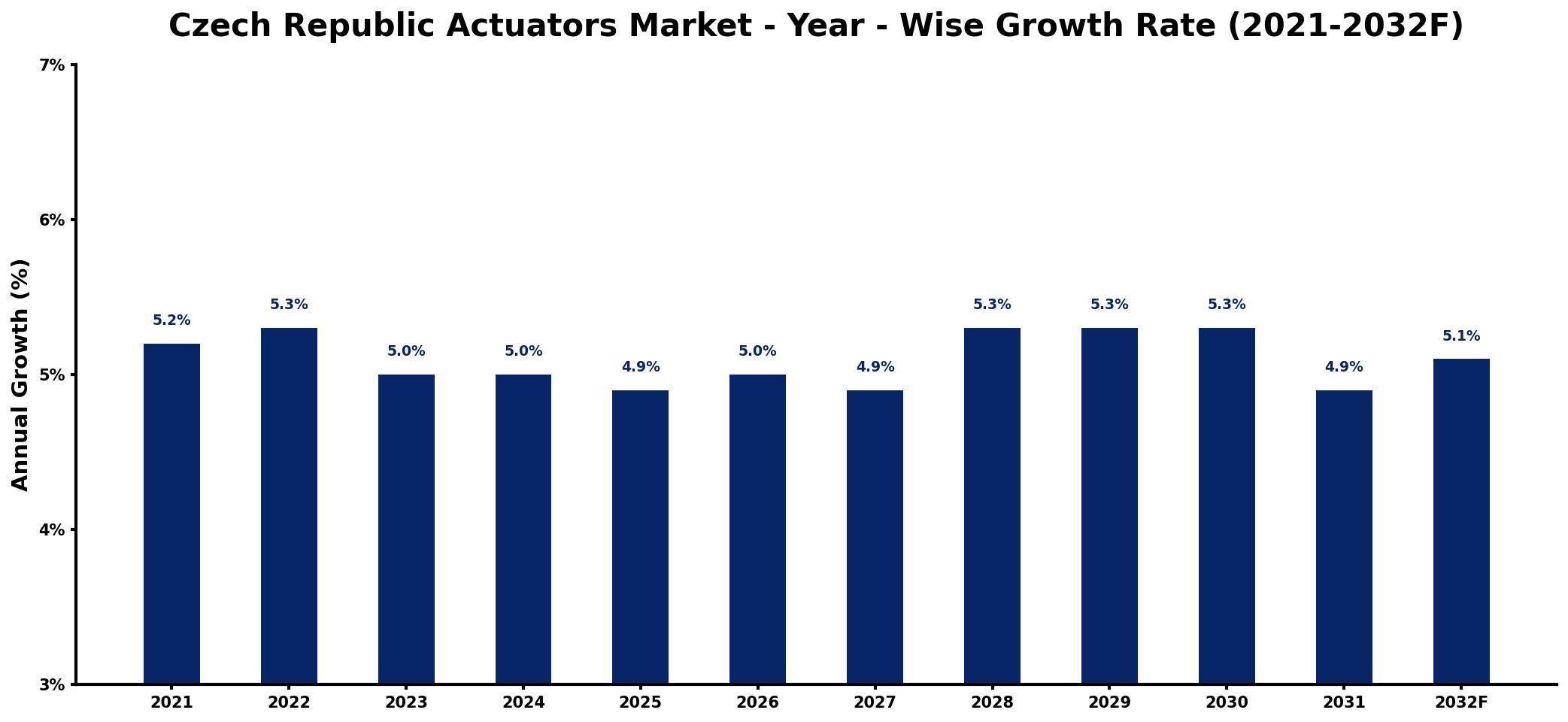
The table below presents the year‑wise growth rates along with the key drivers influencing the market
| Year | Growth Rate | Major Drivers |
| 2021 | 5.2% | Rising automation in manufacturing sector |
| 2022 | 5.3% | Increased investment in renewable energy |
| 2023 | 5.0% | Growth in smart home technology |
| 2024 | 5.0% | Expansion of automotive production facilities |
| 2025 | 4.9% | Surge in industrial robotics adoption |
| 2026 | 5.0% | Enhancements in aerospace engineering projects |
| 2027 | 4.9% | Development of advanced manufacturing techniques |
| 2028 | 5.3% | increased capital investment inflows |
| 2029 | 5.3% | Increased demand in healthcare applications |
| 2030 | 5.3% | growing emerging market penetration |
| 2031 | 4.9% | Investment in infrastructure modernization projects |
| 2032 | 5.1% | Rise in electric vehicle production |
Note: Market size estimations and growth projections presented in this report are based on 6Wresearch's proprietary forecasting methodology, utilizing the latest available industry data, government publications, and primary research inputs.
Czech Republic Actuators Market Synopsis
Recently, the Czech Republic actuators market has enjoyed robust growth, propelled by advancements in automation technologies and heightened efficiency demands. Looking forward, the market is poised for sustained expansion, with innovations in smart actuators and IoT integration further elevating operational capabilities.
The landscape is shifting significantly, as the demand for sustainable solutions continues to shape purchasing decisions. As companies increasingly prioritize energy efficiency and compliance with environmental standards, the market's growth trajectory is expected to reflect these pivotal changes.
Czech Republic Actuators Market Key Takeaways
- Significant growth driven by the rising adoption of automation across various industrial sectors.
- Increasing demand for electric and smart actuators that enhance efficiency and reduce maintenance costs.
- Environmental regulations are pushing the market towards eco-friendly actuator solutions.
- The shift from traditional hydraulic and pneumatic actuators to electric actuators is gaining momentum.
- Government support for innovation and energy efficiency is bolstering market attractiveness.
Evaluation of Restraints in Czech Republic Actuators Market
The Czech Republic actuators market faces a few notable challenges that could hinder its growth. One significant restraint is the increasing competition from international manufacturers offering lower-priced alternatives. This competitive pressure necessitates that local firms continuously innovate while ensuring high standards of quality. Furthermore, economic fluctuations and political uncertainties can impact investment decisions, leading to unpredictable demand. Stricter compliance requirements imposed by the EU also create complexities for manufacturers, compelling them to navigate a multifaceted regulatory landscape.
Czech Republic Actuators Market Trends
A notable trend within the Czech Republic actuators market is the growing preference for smart and energy-efficient solutions, influenced by the adoption of Industry 4.0 technologies. As companies look to enhance operational efficiency, actuators with features such as remote monitoring and wireless connectivity are becoming increasingly sought after. There is also an emphasis on sustainability, leading to heightened demand for actuators that comply with environmental standards, catering to both regulatory and consumer expectations.
Czech Republic Actuators Market Opportunities
The actuators market in the Czech Republic offers substantial opportunities for investment, particularly due to its robust industrial sector. The persistent demand for actuators in manufacturing, automotive, and healthcare applications signifies a fertile ground for growth. Businesses looking to enter this market can capitalize on the region's skilled workforce and supportive business climate. Additionally, the government's push for technological advancement and innovation creates an advantageous backdrop for stakeholders eager to establish a presence in Central Europe.
Government Initiatives in the Czech Republic Actuators Market
In the Czech Republic, government initiatives are primarily focused on enhancing energy efficiency and sustainability within the actuators market. Regulations have been introduced to ensure that actuators meet specific energy efficiency standards, which serve to reduce overall consumption. The government also provides incentives and subsidies to companies investing in environmentally friendly technologies, aligning with broader European Union directives. This regulatory environment aims to foster innovation while promoting compliance and quality in the market.
Future Insights of the Czech Republic Actuators Market
The future of the Czech Republic actuators market appears optimistic, underpinned by increasing industrial automation and a shift towards advanced technological solutions. As sectors such as automotive and manufacturing continue to embrace automation, the demand for efficient and precise control systems is set to rise. Additionally, trends emphasizing sustainability and energy efficiency will likely drive product development, encouraging key players to innovate continuously. As a result, the market is expected to evolve significantly, aligning with the country's broader industrial growth narrative.
Czech Republic Actuators Market Latest Developments (2025 - 2026)
Recent developments in the Czech Republic actuators market highlight a concerted effort towards innovation and sustainability. Industry stakeholders are increasingly focusing on integrating IoT capabilities into actuators for enhanced functionality. Furthermore, advancements in materials and design are facilitating the production of more efficient actuator systems. Collaborations between technology companies and manufacturers are becoming more prevalent, aiming to push the boundaries of actuator performance and reliability.
Czech Republic Actuators Market - Key Attractiveness of the Report
- 10 Years of Market Numbers
- Historical Data Starting from 2022 to 2025
- Base Year: 2025
- Forecast Data until 2032
- Key Performance Indicators Impacting the Market
- Major Upcoming Developments and Projects
Key Highlights of the Report:
- Czech Republic Actuators Market Outlook
- Market Size of Czech Republic Actuators Market, 2025
- Forecast of Czech Republic Actuators Market, 2032
- Historical Data and Forecast of Czech Republic Actuators Revenues & Volume for the Period 2022-2032F
- Czech Republic Actuators Market Trend Evolution
- Czech Republic Actuators Market Drivers and Challenges
- Czech Republic Actuators Price Trends
- Czech Republic Actuators Porter's Five Forces
- Czech Republic Actuators Industry Life Cycle
- Historical Data and Forecast of Czech Republic Actuators Market Revenues & Volume By Actuation for the Period 2022-2032F
- Historical Data and Forecast of Czech Republic Actuators Market Revenues & Volume By Electrical for the Period 2022-2032F
- Historical Data and Forecast of Czech Republic Actuators Market Revenues & Volume By Pneumatic for the Period 2022-2032F
- Historical Data and Forecast of Czech Republic Actuators Market Revenues & Volume By Hydraulic for the Period 2022-2032F
- Historical Data and Forecast of Czech Republic Actuators Market Revenues & Volume By Others for the Period 2022-2032F
- Historical Data and Forecast of Czech Republic Actuators Market Revenues & Volume By Application for the Period 2022-2032F
- Historical Data and Forecast of Czech Republic Actuators Market Revenues & Volume By Industrial automation for the Period 2022-2032F
- Historical Data and Forecast of Czech Republic Actuators Market Revenues & Volume By Robotics for the Period 2022-2032F
- Historical Data and Forecast of Czech Republic Actuators Market Revenues & Volume By Vehicles and Equipment for the Period 2022-2032F
- Historical Data and Forecast of Czech Republic Actuators Market Revenues & Volume By Type for the Period 2022-2032F
- Historical Data and Forecast of Czech Republic Actuators Market Revenues & Volume By Linear Actuator for the Period 2022-2032F
- Historical Data and Forecast of Czech Republic Actuators Market Revenues & Volume By Rotary Actuator for the Period 2022-2032F
- Historical Data and Forecast of Czech Republic Actuators Market Revenues & Volume By Vertical for the Period 2022-2032F
- Historical Data and Forecast of Czech Republic Actuators Market Revenues & Volume By Food & Beverages for the Period 2022-2032F
- Historical Data and Forecast of Czech Republic Actuators Market Revenues & Volume By Oil & Gas for the Period 2022-2032F
- Historical Data and Forecast of Czech Republic Actuators Market Revenues & Volume By Metals, Mining, and Machinery for the Period 2022-2032F
- Historical Data and Forecast of Czech Republic Actuators Market Revenues & Volume By Power Generation for the Period 2022-2032F
- Historical Data and Forecast of Czech Republic Actuators Market Revenues & Volume By Chemicals, Paper, and Plastics for the Period 2022-2032F
- Historical Data and Forecast of Czech Republic Actuators Market Revenues & Volume By Pharmaceutical & Healthcare for the Period 2022-2032F
- Historical Data and Forecast of Czech Republic Actuators Market Revenues & Volume By Automotive for the Period 2022-2032F
- Czech Republic Actuators Import Export Trade Statistics
- Market Opportunity Assessment By Actuation
- Market Opportunity Assessment By Application
- Market Opportunity Assessment By Type
- Market Opportunity Assessment By Vertical
- Czech Republic Actuators Top Companies Market Share
- Czech Republic Actuators Competitive Benchmarking By Technical and Operational Parameters
- Czech Republic Actuators Company Profiles
- Czech Republic Actuators Key Strategic Recommendations






































