Czech Republic Polypropylene Market Size (2020-2030)
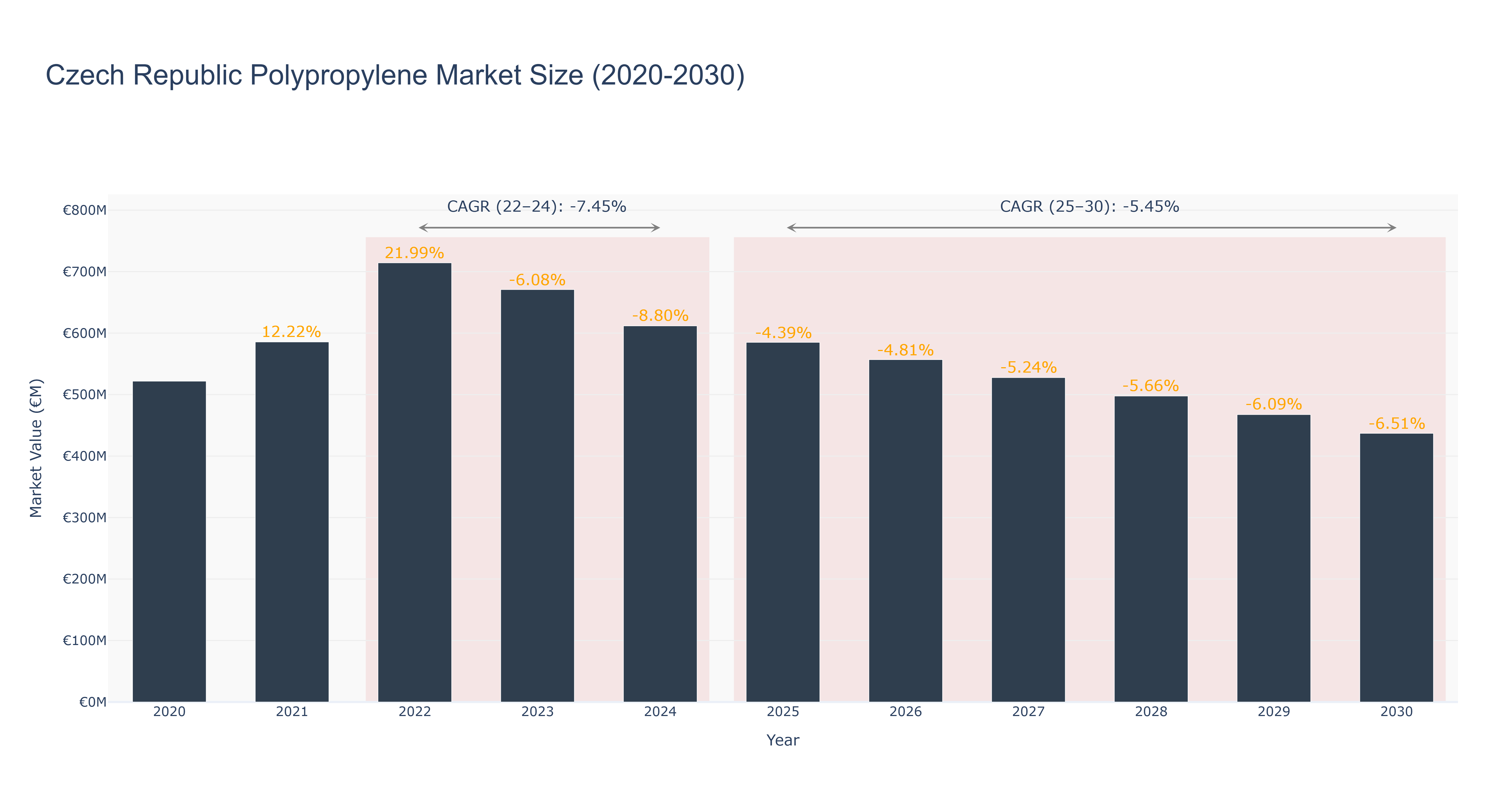
Czech Republic Polypropylene Market has witnessed fluctuating trends in recent years. The market peaked in 2022 with a size of €714.33 million, followed by a decline to €611.82 million in 2024. The forecasted market size from 2025 to 2030 indicates a continued downward trend, with an expected size of €437.03 million in 2030. The CAGR for the period 2022-24 stands at -7.45%, while for 2025-30, it is projected at -5.45%. The market's downturn can be attributed to global economic uncertainties impacting demand, supply chain disruptions, and evolving regulatory landscapes. Looking ahead, industry drivers such as technological advancements in polypropylene production processes and increasing demand from the packaging sector are expected to drive market growth. Additionally, upcoming investments in eco-friendly polypropylene solutions and recycling initiatives are poised to shape the market's future landscape in the Czech Republic.
Czech Republic Polypropylene Market: Production & Trade Performance (2019-2025)
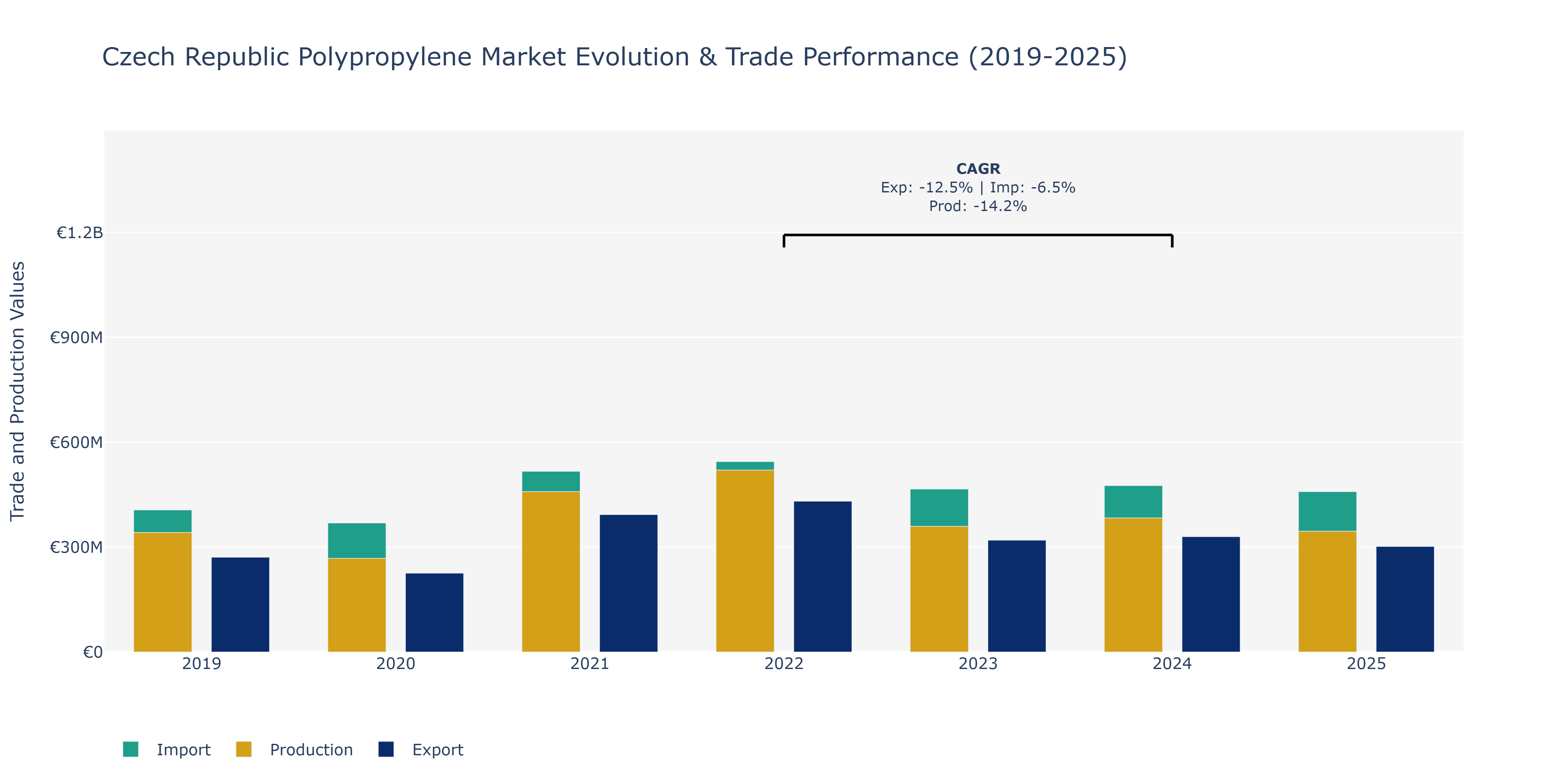
In the Czech Republic Polypropylene Market, exports experienced fluctuations over the analyzed period. Starting at €271.14 million in 2019, exports declined in 2020 to €225.67 million, rebounded strongly in 2021 to €393.09 million, peaked in 2022 at €431.48 million, and then decreased to €302.04 million in 2025. This volatility may be attributed to varying global demand, price fluctuations, and shifts in market dynamics impacting export volumes. On the other hand, imports followed a similar trend, starting at €406.36 million in 2019, decreasing to €369.07 million in 2020, and gradually increasing to €458.72 million in 2025. Production levels mirrored export trends, declining from €341.91 million in 2019 to €268.03 million in 2020, before recovering to €459.68 million in 2021 and peaking at €520.47 million in 2022. The subsequent decline to €345.76 million in 2025 could be influenced by production capacity adjustments, technological advancements, and market competition. To sustain growth, industry players may focus on enhancing production efficiencies, exploring new export markets, and adapting to evolving consumer preferences.
Czech Republic Polypropylene Market Overview
The polypropylene market in the Czech Republic is experiencing significant growth, primarily driven by its applications in packaging, automotive, and consumer goods. Polypropylene is favored for its lightweight, chemical resistance, and versatility. The increasing demand for sustainable materials and the rise of the e-commerce sector are propelling market growth. As industries seek innovative solutions, the polypropylene market is expected to flourish.
Drivers of the market
The polypropylene market is experiencing growth due to its widespread applications in packaging, automotive, and consumer goods. Polypropylene is valued for its durability, chemical resistance, and lightweight nature, making it a preferred choice for various products. The ongoing trend towards sustainable and recyclable materials is further driving the demand for polypropylene.
Challenges of the market
The polypropylene market faces challenges concerning raw material price volatility and competition from alternative materials. As a widely used polymer, fluctuations in the prices of crude oil and natural gas can impact production costs and profitability. Additionally, the growing interest in sustainable materials necessitates ongoing innovation to develop eco-friendly polypropylene solutions, adding complexity to market dynamics.
Government Policy of the market
The Czech Republic aligns with EU environmental standards, which impact the polypropylene market. Government regulations encouraging the recycling of plastics and sustainable production methods support the growth of the polypropylene market in various industries.
Key Highlights of the Report:
- Czech Republic Polypropylene Market Outlook
- Market Size of Czech Republic Polypropylene Market, 2024
- Forecast of Czech Republic Polypropylene Market, 2031
- Historical Data and Forecast of Czech Republic Polypropylene Revenues & Volume for the Period 2018 - 2031
- Czech Republic Polypropylene Market Trend Evolution
- Czech Republic Polypropylene Market Drivers and Challenges
- Czech Republic Polypropylene Price Trends
- Czech Republic Polypropylene Porter's Five Forces
- Czech Republic Polypropylene Industry Life Cycle
- Historical Data and Forecast of Czech Republic Polypropylene Market Revenues & Volume By Type for the Period 2018 - 2031
- Historical Data and Forecast of Czech Republic Polypropylene Market Revenues & Volume By Homopolymer for the Period 2018 - 2031
- Historical Data and Forecast of Czech Republic Polypropylene Market Revenues & Volume By Copolymer for the Period 2018 - 2031
- Historical Data and Forecast of Czech Republic Polypropylene Market Revenues & Volume By Application for the Period 2018 - 2031
- Historical Data and Forecast of Czech Republic Polypropylene Market Revenues & Volume By Injection Molding for the Period 2018 - 2031
- Historical Data and Forecast of Czech Republic Polypropylene Market Revenues & Volume By Fiber & Raffia for the Period 2018 - 2031
- Historical Data and Forecast of Czech Republic Polypropylene Market Revenues & Volume By Film & Sheet for the Period 2018 - 2031
- Historical Data and Forecast of Czech Republic Polypropylene Market Revenues & Volume By Blow Molding for the Period 2018 - 2031
- Historical Data and Forecast of Czech Republic Polypropylene Market Revenues & Volume By End-use Industry for the Period 2018 - 2031
- Historical Data and Forecast of Czech Republic Polypropylene Market Revenues & Volume By Packaging for the Period 2018 - 2031
- Historical Data and Forecast of Czech Republic Polypropylene Market Revenues & Volume By Automotive for the Period 2018 - 2031
- Historical Data and Forecast of Czech Republic Polypropylene Market Revenues & Volume By Building & Construction for the Period 2018 - 2031
- Historical Data and Forecast of Czech Republic Polypropylene Market Revenues & Volume By Electrical & Electronics for the Period 2018 - 2031
- Historical Data and Forecast of Czech Republic Polypropylene Market Revenues & Volume By Medical for the Period 2018 - 2031
- Czech Republic Polypropylene Import Export Trade Statistics
- Market Opportunity Assessment By Type
- Market Opportunity Assessment By Application
- Market Opportunity Assessment By End-use Industry
- Czech Republic Polypropylene Top Companies Market Share
- Czech Republic Polypropylene Competitive Benchmarking By Technical and Operational Parameters
- Czech Republic Polypropylene Company Profiles
- Czech Republic Polypropylene Key Strategic Recommendations






































