Denmark Ascorbic Acid Market Size (2020-2030)
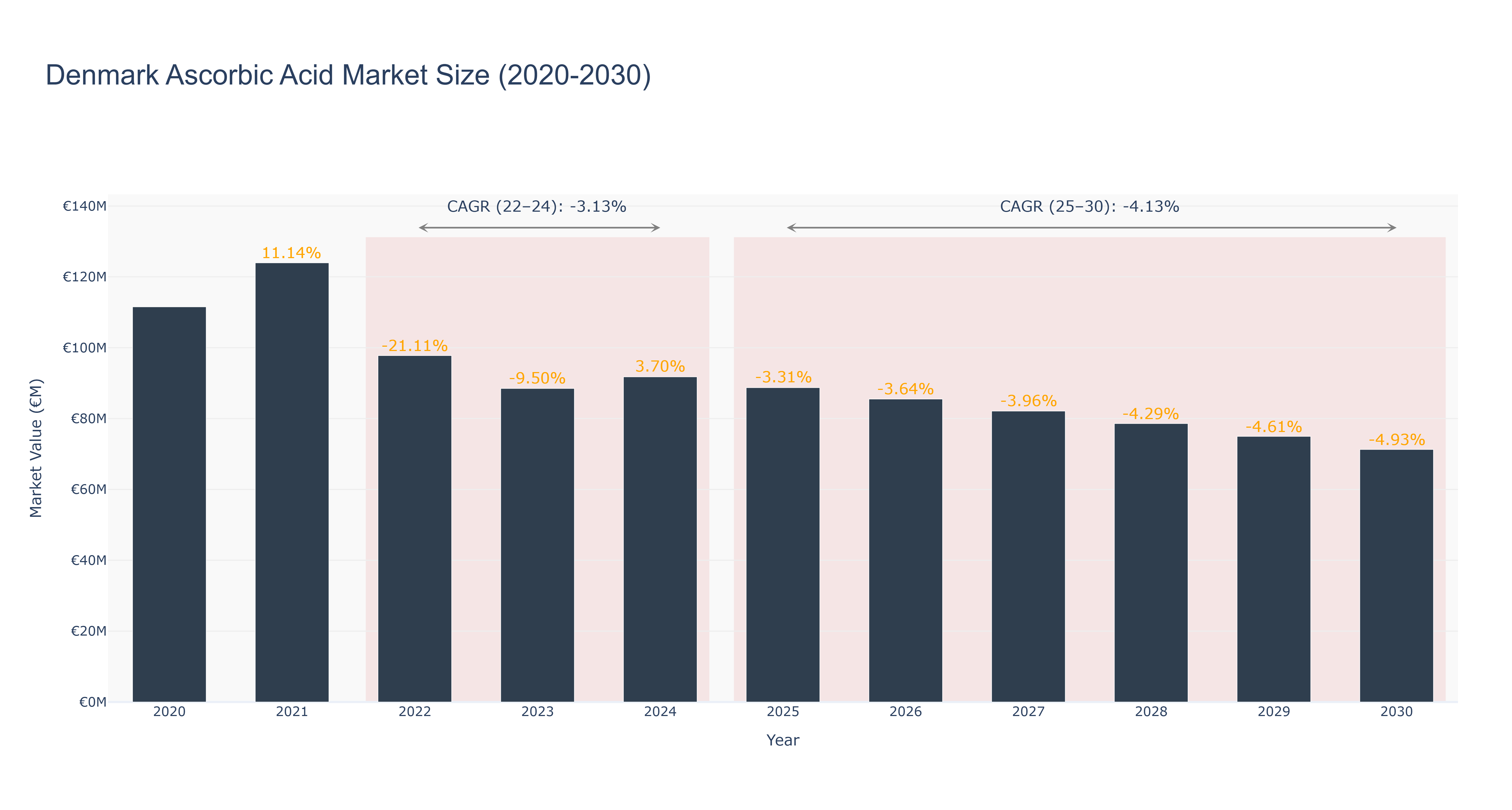
Denmark's Ascorbic Acid Market experienced a peak market size of €123.95 million in 2021, showing steady growth. However, from 2022 to 2024, the market size saw a decline to €91.76 million, attributed to a CAGR of -3.13%. The forecasted market size from 2025 to 2030 is expected to continue shrinking, with a CAGR of -4.13%. This downward trend can be attributed to factors such as increased competition, changing consumer preferences, and evolving regulatory landscape impacting the demand for ascorbic acid in various industries. Looking ahead, Denmark's Ascorbic Acid Market may benefit from ongoing research and development projects focused on enhancing product quality and expanding applications in the food and pharmaceutical sectors, ensuring long-term sustainability in a competitive market environment.
Denmark Ascorbic Acid Market: Production & Trade Performance (2019-2025)
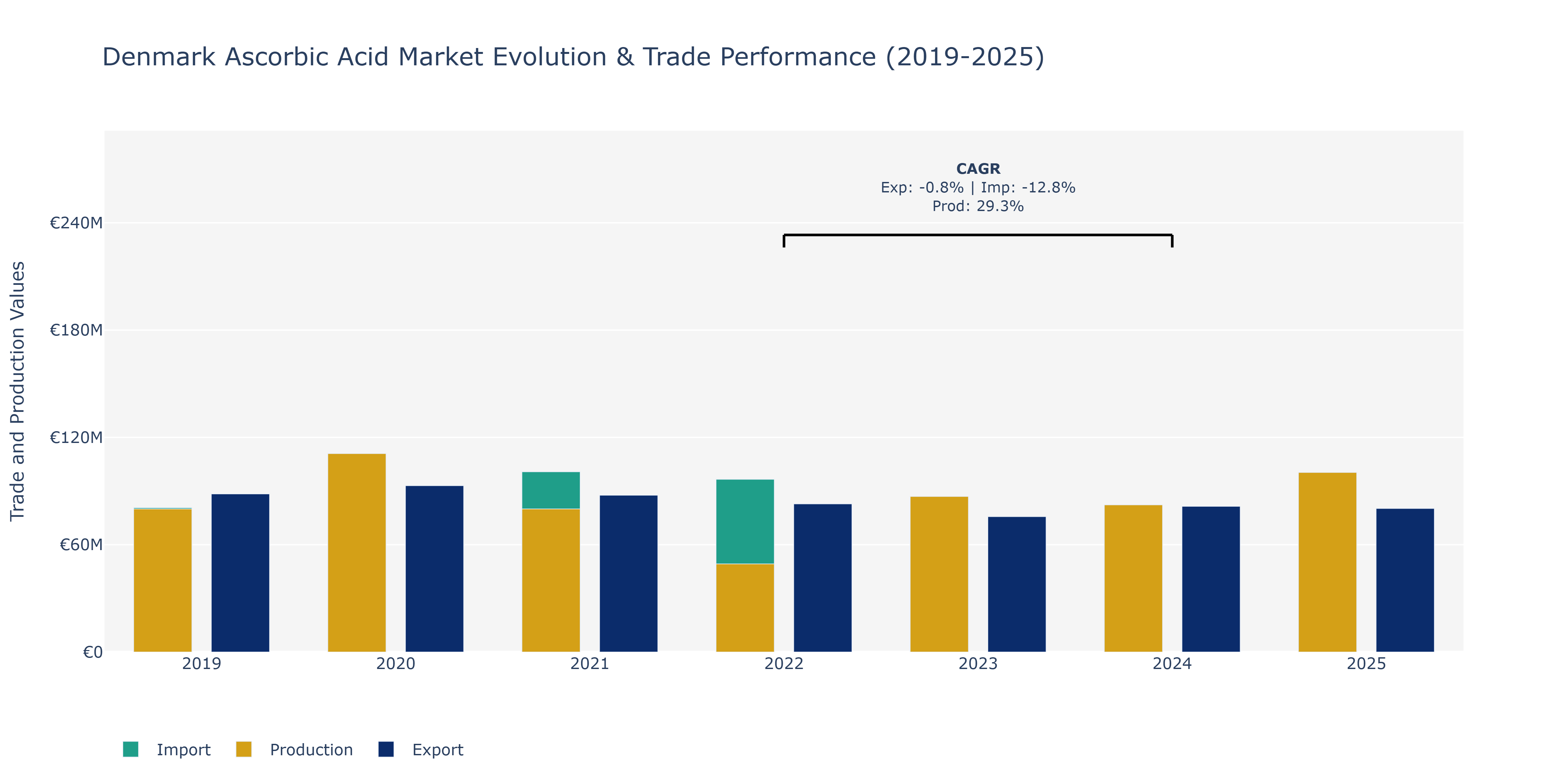
In the Denmark Ascorbic Acid Market, from 2019 to 2025, exports experienced fluctuations, starting at €88.38 million in 2019, peaking at €93.03 million in 2020, and gradually declining to €80.28 million in 2025. Imports followed a similar pattern, starting at €80.7 million in 2019, reaching €100.77 million in 2021, and decreasing to €65.1 million in 2025. Production saw a substantial increase from €79.97 million in 2019 to €110.94 million in 2020, before decreasing to €100.42 million in 2025. The fluctuations in exports and imports could be attributed to global market demand shifts, trade agreements, and currency exchange rates affecting prices. The significant production increase in 2020 could be due to enhanced manufacturing processes, increased domestic consumption, and possibly market expansion strategies. To sustain growth, companies might consider diversifying export markets, investing in innovative production technologies, and monitoring global trade policies impacting imports.
Key Highlights of the Report:
- Denmark Ascorbic Acid Market Outlook
- Market Size of Denmark Ascorbic Acid Market, 2025
- Forecast of Denmark Ascorbic Acid Market, 2032
- Historical Data and Forecast of Denmark Ascorbic Acid Revenues & Volume for the Period 2022 - 2032F
- Denmark Ascorbic Acid Market Trend Evolution
- Denmark Ascorbic Acid Market Drivers and Challenges
- Denmark Ascorbic Acid Price Trends
- Denmark Ascorbic Acid Porter`s Five Forces
- Denmark Ascorbic Acid Industry Life Cycle
- Historical Data and Forecast of Denmark Ascorbic Acid Market Revenues & Volume By Grade for the Period 2022 - 2032F
- Historical Data and Forecast of Denmark Ascorbic Acid Market Revenues & Volume By Food & Pharmaceutical for the Period 2022 - 2032F
- Historical Data and Forecast of Denmark Ascorbic Acid Market Revenues & Volume By Industrial for the Period 2022 - 2032F
- Historical Data and Forecast of Denmark Ascorbic Acid Market Revenues & Volume By Application for the Period 2022 - 2032F
- Historical Data and Forecast of Denmark Ascorbic Acid Market Revenues & Volume By Food & Beverages for the Period 2022 - 2032F
- Historical Data and Forecast of Denmark Ascorbic Acid Market Revenues & Volume By Pharmaceutical for the Period 2022 - 2032F
- Historical Data and Forecast of Denmark Ascorbic Acid Market Revenues & Volume By Cosmetics for the Period 2022 - 2032F
- Historical Data and Forecast of Denmark Ascorbic Acid Market Revenues & Volume By Chemicals for the Period 2022 - 2032F
- Historical Data and Forecast of Denmark Ascorbic Acid Market Revenues & Volume By Agriculture for the Period 2022 - 2032F
- Historical Data and Forecast of Denmark Ascorbic Acid Market Revenues & Volume By Others for the Period 2022 - 2032F
- Denmark Ascorbic Acid Import Export Trade Statistics
- Market Opportunity Assessment By Grade
- Market Opportunity Assessment By Application
- Denmark Ascorbic Acid Top Companies Market Share
- Denmark Ascorbic Acid Competitive Benchmarking By Technical and Operational Parameters
- Denmark Ascorbic Acid Company Profiles
- Denmark Ascorbic Acid Key Strategic Recommendations






































