Denmark Modular Kitchen Market Top 5 Importing Countries and Market Competition (HHI) Analysis
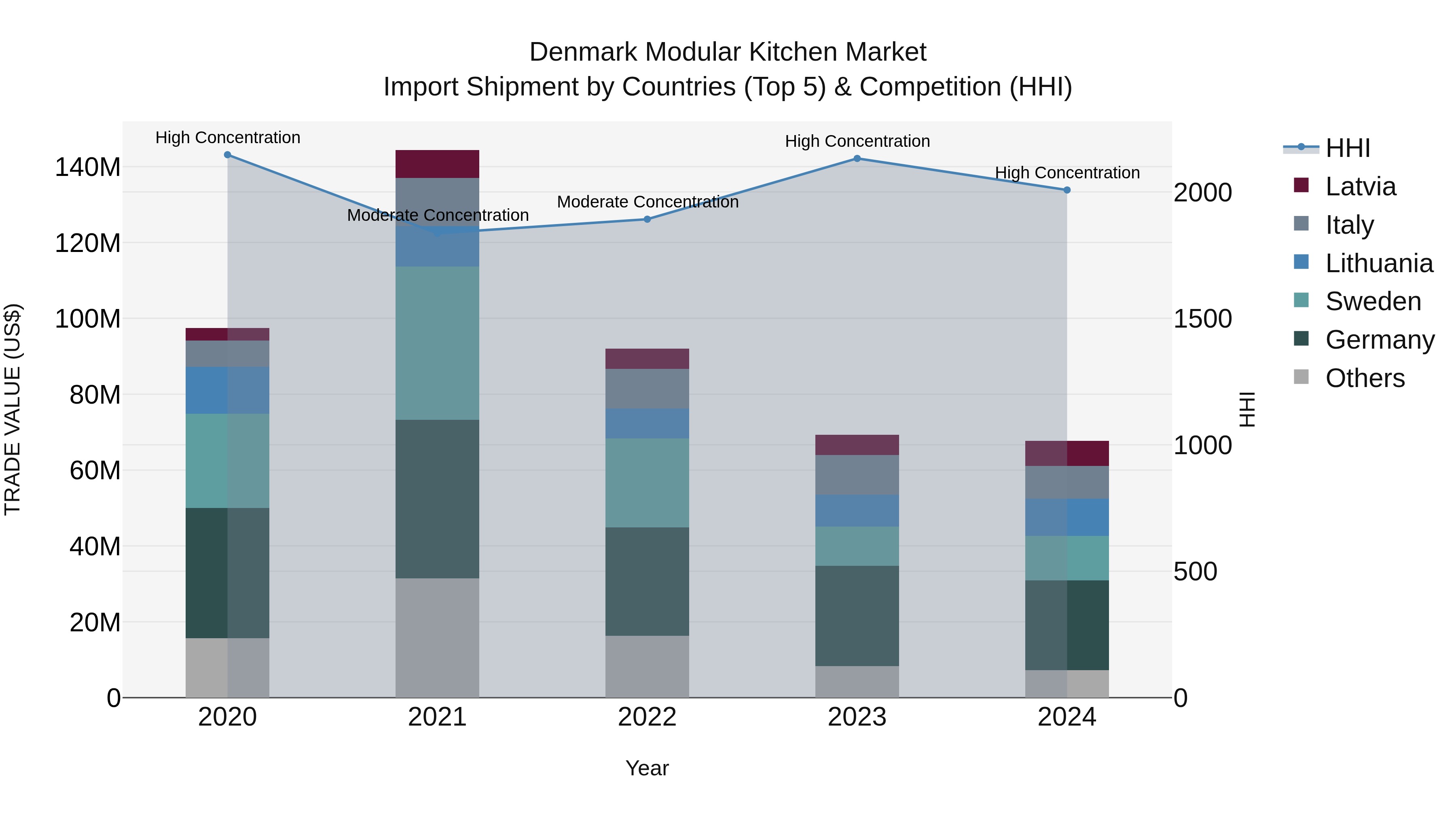
Denmark modular kitchen import market in 2024 saw top shipments coming from Germany, Sweden, Lithuania, Italy, and Latvia, indicating a diverse sourcing network. Despite a high Herfindahl-Hirschman Index (HHI) reflecting market concentration, the industry experienced a negative compound annual growth rate (CAGR) of -8.68% from 2020 to 2024. The growth rate in 2024 also remained negative at -2.28%, suggesting challenges in the market that importers and suppliers need to address to stimulate growth and innovation in the coming years.
Denmark Modular Kitchen Market Overview
The modular kitchen market in Denmark is experiencing growth as consumers prioritize customization, convenience, and aesthetics in home design. Modular kitchens offer flexibility in layout and functionality, making them a popular choice for modern homes. The market benefits from increasing urbanization and a rising preference for minimalist, space-efficient designs.
Drivers of the market
The Modular Kitchen Market in Denmark is driven by the increasing demand for customizable and space-efficient kitchen solutions. As consumers seek to enhance the functionality and aesthetics of their homes, the adoption of modular kitchen designs becomes essential. The growing trend towards open-plan living and smart home technologies supports market expansion, encouraging innovation in kitchen products.
Challenges of the market
The modular kitchen market grapples with challenges related to changing consumer preferences and trends in home design. As consumers increasingly seek customized and functional kitchen solutions, manufacturers must adapt their offerings to meet diverse needs. Additionally, ensuring quality and sustainability in materials adds complexity to product development and supply chain management. The competitive landscape, characterized by numerous players offering similar products, necessitates continuous innovation to differentiate offerings and capture market share.
Government Policy of the market
The modular kitchen market is expanding as consumers seek customizable and space-efficient kitchen solutions. The Danish government promotes sustainability in furniture manufacturing, influencing the production of modular kitchen designs. Policies that encourage innovation in kitchen design and efficiency contribute to the growth of this market.
Key Highlights of the Report:
- Denmark Modular Kitchen Market Outlook
- Market Size of Denmark Modular Kitchen Market, 2024
- Forecast of Denmark Modular Kitchen Market, 2031
- Historical Data and Forecast of Denmark Modular Kitchen Revenues & Volume for the Period 2021-2031
- Denmark Modular Kitchen Market Trend Evolution
- Denmark Modular Kitchen Market Drivers and Challenges
- Denmark Modular Kitchen Price Trends
- Denmark Modular Kitchen Porter`s Five Forces
- Denmark Modular Kitchen Industry Life Cycle
- Historical Data and Forecast of Denmark Modular Kitchen Market Revenues & Volume By Product for the Period 2021-2031
- Historical Data and Forecast of Denmark Modular Kitchen Market Revenues & Volume By Floor Cabinet & Wall Cabinets for the Period 2021-2031
- Historical Data and Forecast of Denmark Modular Kitchen Market Revenues & Volume By Tall Storage Cabinets for the Period 2021-2031
- Historical Data and Forecast of Denmark Modular Kitchen Market Revenues & Volume By Others for the Period 2021-2031
- Historical Data and Forecast of Denmark Modular Kitchen Market Revenues & Volume By End-User for the Period 2021-2031
- Historical Data and Forecast of Denmark Modular Kitchen Market Revenues & Volume By Residential for the Period 2021-2031
- Historical Data and Forecast of Denmark Modular Kitchen Market Revenues & Volume By Commercial for the Period 2021-2031
- Historical Data and Forecast of Denmark Modular Kitchen Market Revenues & Volume By Distribution Channel for the Period 2021-2031
- Historical Data and Forecast of Denmark Modular Kitchen Market Revenues & Volume By Offline (Contractors, Builders, and Others) for the Period 2021-2031
- Historical Data and Forecast of Denmark Modular Kitchen Market Revenues & Volume By Online for the Period 2021-2031
- Denmark Modular Kitchen Import Export Trade Statistics
- Market Opportunity Assessment By Product
- Market Opportunity Assessment By End-User
- Market Opportunity Assessment By Distribution Channel
- Denmark Modular Kitchen Top Companies Market Share
- Denmark Modular Kitchen Competitive Benchmarking By Technical and Operational Parameters
- Denmark Modular Kitchen Company Profiles
- Denmark Modular Kitchen Key Strategic Recommendations






































