Denmark Naphtha Market Top 5 Importing Countries and Market Competition (HHI) Analysis
Denmark naphtha import market saw significant growth in 2024, with top exporting countries being Sweden, Netherlands, Belgium, Germany, and Metropolitan France. The market concentration, as measured by the Herfindahl-Hirschman Index (HHI), remained very high in 2024. The compound annual growth rate (CAGR) from 2020 to 2024 was an impressive 39.6%, indicating a strong upward trend in imports. The growth rate from 2023 to 2024 surged by 111.24%, reflecting a rapid acceleration in naphtha shipments to Denmark.
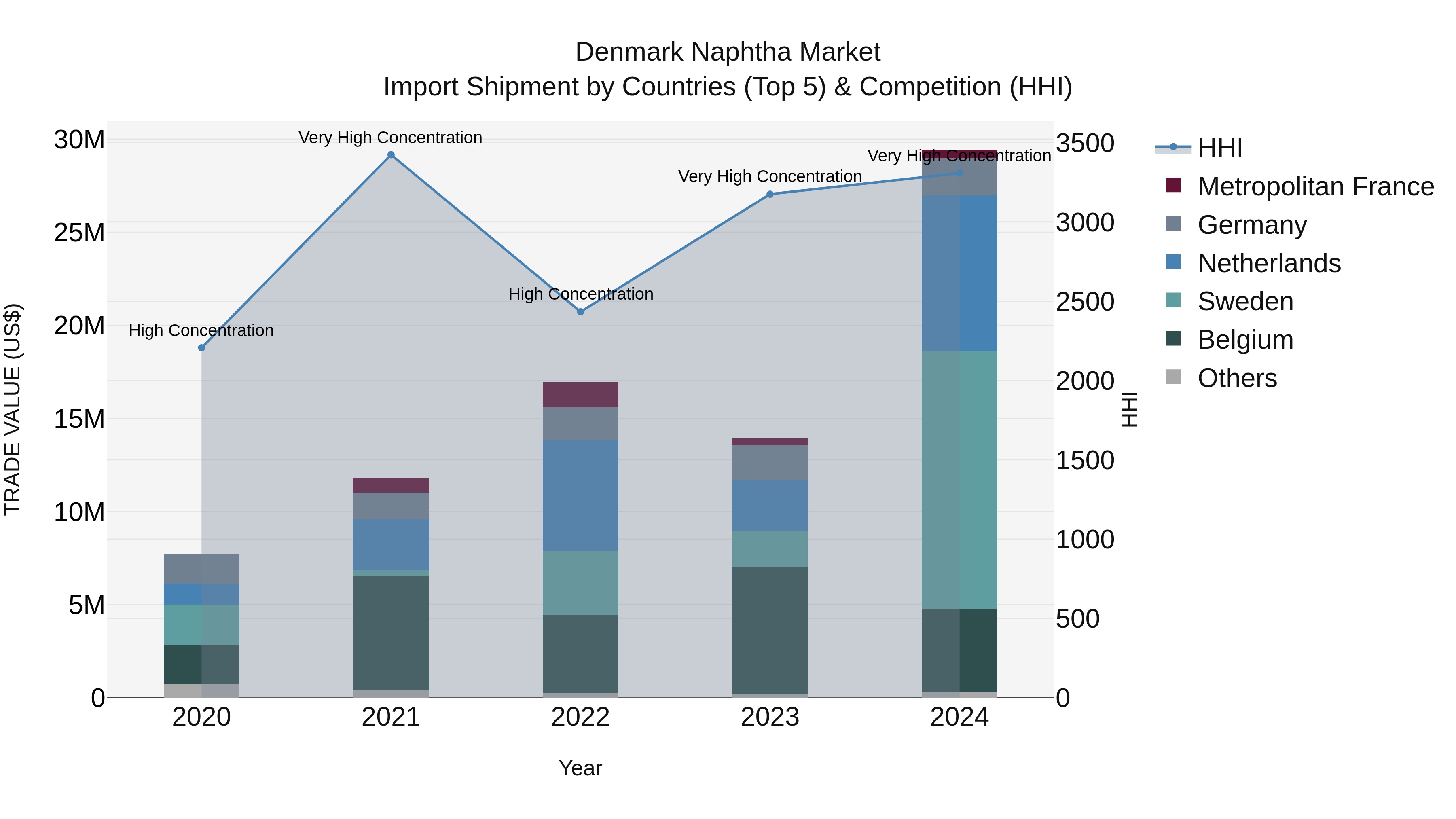
Denmark Naphtha Market Synopsis
The Denmark Naphtha Market is primarily driven by the country`s petrochemical industry, which relies on naphtha as a feedstock for various chemical processes. Naphtha is a key component in the production of plastics, solvents, and other petrochemical products. The market is influenced by global crude oil prices, as naphtha is typically produced during the refining of crude oil. Denmark`s strategic location in Europe allows for easy access to naphtha imports from other countries, contributing to the market`s stability. Additionally, the country`s stringent environmental regulations and focus on sustainability are driving the demand for cleaner naphtha production methods. Overall, the Denmark Naphtha Market is expected to continue growing steadily, supported by the country`s strong industrial base and commitment to environmental responsibility.
Denmark Naphtha Market Trends
The Denmark naphtha market is experiencing growth driven by increasing demand from the petrochemical industry for the production of plastics, resins, and solvents. The shift towards cleaner energy sources and the rising popularity of electric vehicles are creating opportunities for naphtha as a feedstock for the production of petrochemicals used in various industries. Additionally, the focus on sustainable practices and circular economy principles is encouraging the development of bio-based naphtha as an alternative to traditional fossil fuel-derived naphtha. Companies in the Denmark naphtha market are investing in research and development to innovate and capitalize on these trends, as well as exploring partnerships and collaborations to enhance their market presence and meet the evolving needs of the industry.
Denmark Naphtha Market Challenges
In the Denmark Naphtha Market, one of the key challenges faced is the volatility in crude oil prices, as naphtha is a product derived from crude oil refining. Fluctuations in oil prices can impact the cost of naphtha, affecting the margins of companies involved in its production and distribution. Another challenge is the increasing focus on sustainability and environmental regulations, which are pushing companies to seek alternative sources of energy and reduce their reliance on fossil fuels like naphtha. Additionally, competition from other petrochemical feedstocks and the changing demand patterns in the global market can also pose challenges for the Denmark Naphtha Market in terms of pricing and market share. Overall, navigating these uncertainties while adapting to changing market dynamics will be crucial for stakeholders in the Denmark Naphtha Market.
Denmark Naphtha Market Investment Opportunities
The Denmark Naphtha Market is primarily driven by factors such as the growth of the petrochemical industry, increasing demand for transportation fuels, and the development of new technologies for naphtha processing. The petrochemical industry is a significant consumer of naphtha in Denmark, using it as a feedstock for the production of various chemicals and plastics. Additionally, the demand for transportation fuels, such as gasoline and diesel, also contributes to the consumption of naphtha in the country. The continuous research and development in naphtha processing technologies, aimed at improving efficiency and reducing environmental impact, are further driving the market growth in Denmark. Overall, the increasing industrial activities and technological advancements play a crucial role in shaping the Denmark Naphtha Market.
Denmark Naphtha Market Government Polices
In Denmark, government policies related to the naphtha market focus on ensuring environmental sustainability and promoting renewable energy sources. The government has implemented measures to reduce greenhouse gas emissions, including strict regulations on emissions from industrial processes that involve naphtha. Additionally, Denmark has set ambitious targets for increasing the share of renewable energy in its overall energy consumption, which may impact the demand for naphtha as a fossil fuel. Government incentives and subsidies are also in place to support the development and adoption of alternative fuels and technologies, with a particular emphasis on reducing dependence on traditional petroleum-based products like naphtha. Overall, the Danish government`s policies aim to transition towards a more sustainable and environmentally friendly energy sector, which could have implications for the naphtha market in the country.
Denmark Naphtha Market Future Outlook
The future outlook for the Denmark Naphtha Market appears positive, with steady growth expected in the coming years. Factors such as the increasing demand for petrochemical products, rising investments in refinery infrastructure, and the shift towards cleaner energy sources are likely to drive the market forward. Additionally, Denmark`s strong emphasis on sustainability and renewable energy initiatives could encourage the adoption of naphtha as a feedstock for the production of bio-based chemicals and fuels. However, challenges such as volatile crude oil prices and regulatory uncertainties may pose some risks to market growth. Overall, the Denmark Naphtha Market is expected to expand, driven by evolving industry dynamics and a focus on sustainable energy solutions.
Key Highlights of the Report:
- Denmark Naphtha Market Outlook
- Market Size of Denmark Naphtha Market, 2024
- Forecast of Denmark Naphtha Market, 2031
- Historical Data and Forecast of Denmark Naphtha Revenues & Volume for the Period 2021- 2031
- Denmark Naphtha Market Trend Evolution
- Denmark Naphtha Market Drivers and Challenges
- Denmark Naphtha Price Trends
- Denmark Naphtha Porter's Five Forces
- Denmark Naphtha Industry Life Cycle
- Historical Data and Forecast of Denmark Naphtha Market Revenues & Volume By Application for the Period 2021- 2031
- Historical Data and Forecast of Denmark Naphtha Market Revenues & Volume By Chemicals for the Period 2021- 2031
- Historical Data and Forecast of Denmark Naphtha Market Revenues & Volume By Energy/Fuel for the Period 2021- 2031
- Historical Data and Forecast of Denmark Naphtha Market Revenues & Volume By Others for the Period 2021- 2031
- Denmark Naphtha Import Export Trade Statistics
- Market Opportunity Assessment By Application
- Denmark Naphtha Top Companies Market Share
- Denmark Naphtha Competitive Benchmarking By Technical and Operational Parameters
- Denmark Naphtha Company Profiles
- Denmark Naphtha Key Strategic Recommendations






































