Denmark Rolling Mill Components And Ancillary Equipment Market Size (2020-2030)
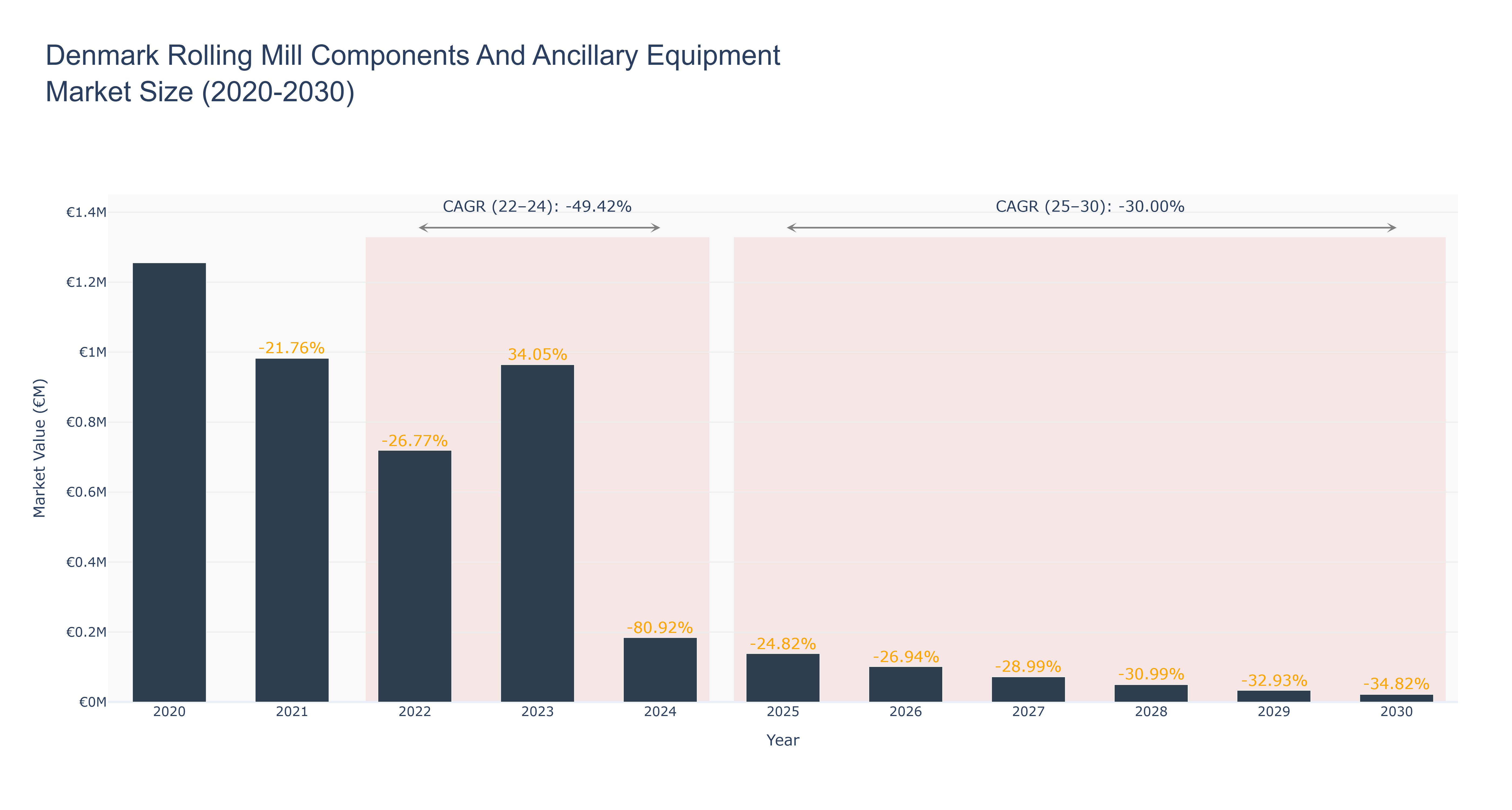
The Denmark Rolling Mill Components and Ancillary Equipment Market experienced its peak in 2020, with a market size of €1.26 million before witnessing a significant decline in subsequent years. Actual data for 2021 and 2022 indicates a decrease in market size to €982.27 thousand and €719.32 thousand, respectively, reflecting growth rates of -21.76% and -26.77%. A brief recovery occurred in 2023, with market size rebounding to €964.27 thousand, driven by potential increases in manufacturing activities. However, the outlook for 2025-2030 is concerning, with forecasted market sizes declining further to €21.65 thousand by 2030, representing a CAGR of -30.00%. This decline may be attributed to reduced investment in rolling mill technologies and broader economic challenges. The market's future will hinge on macroeconomic factors, including potential advancements in automation and sustainability initiatives, which could reshape demand patterns if leveraged effectively.
Denmark Rolling Mill Components And Ancillary Equipment Market: Production & Trade Performance (2019-2025)
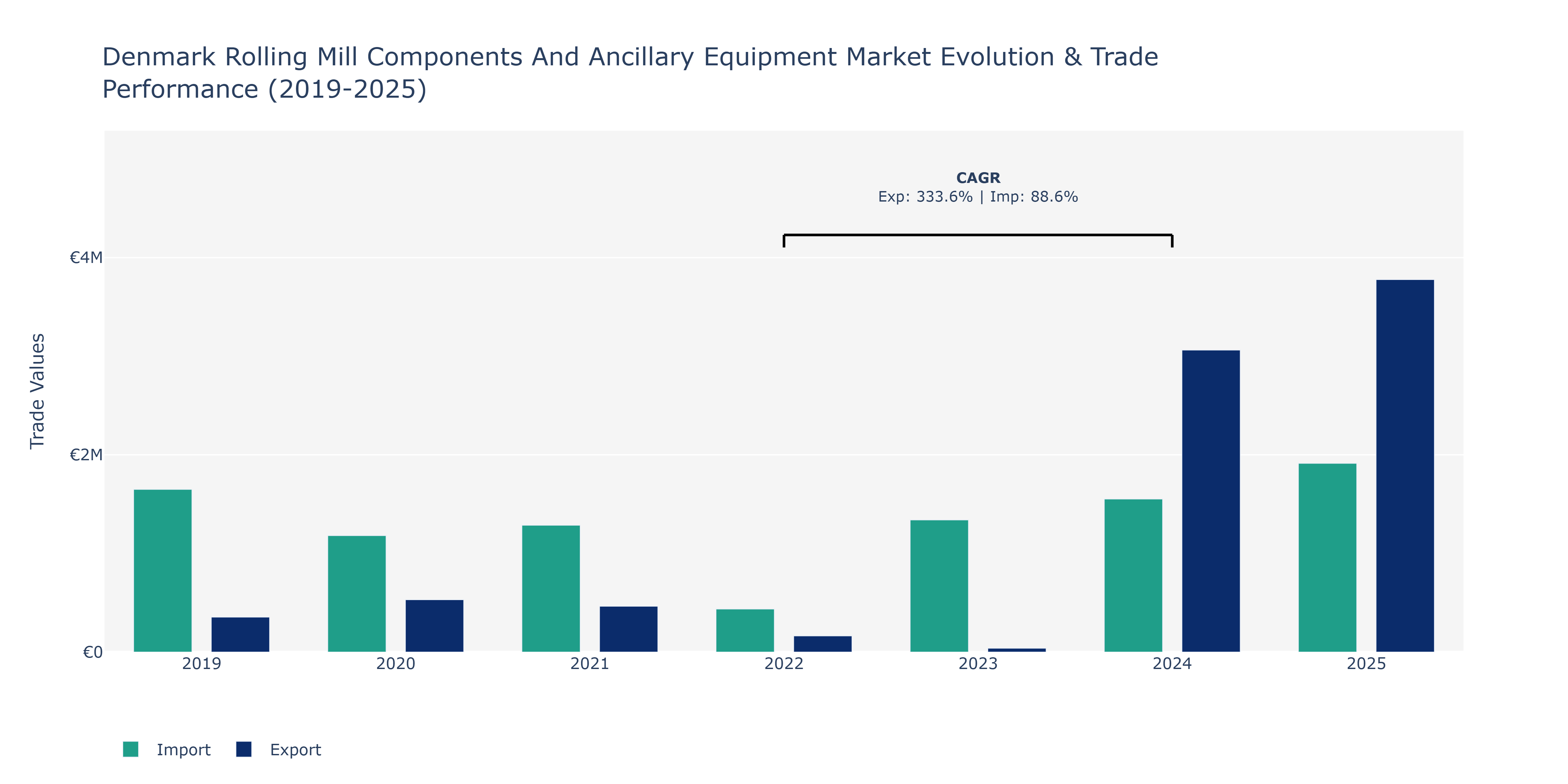
The Denmark Rolling Mill Components And Ancillary Equipment Market witnessed fluctuations in both exports and imports from 2019 to 2025. Exports saw a notable increase from €353.96 thousand in 2019 to €3.78 million in 2025, with a peak in 2025. In contrast, imports fluctuated, reaching a peak of €1.55 million in 2024 after a gradual decline from 2019. The surge in exports can be attributed to the growing demand for advanced rolling mill components globally, driven by industries seeking improved operational efficiency and cost-effectiveness. On the other hand, the fluctuating import trend could be influenced by changes in global trade policies, currency fluctuations, and advancements in domestic production capabilities. The contrasting export and import trends highlight Denmark's evolving role in the global supply chain for rolling mill components, emphasizing the need for strategic market positioning and competitiveness in the sector.
Key Highlights of the Report:
- Denmark Rolling Mill Components and Ancillary Equipment Market Outlook
- Market Size of Denmark Rolling Mill Components and Ancillary Equipment Market, 2025
- Forecast of Denmark Rolling Mill Components and Ancillary Equipment Market, 2032
- Historical Data and Forecast of Denmark Rolling Mill Components and Ancillary Equipment Revenues & Volume for the Period 2022 - 2032F
- Denmark Rolling Mill Components and Ancillary Equipment Market Trend Evolution
- Denmark Rolling Mill Components and Ancillary Equipment Market Drivers and Challenges
- Denmark Rolling Mill Components and Ancillary Equipment Price Trends
- Denmark Rolling Mill Components and Ancillary Equipment Porter`s Five Forces
- Denmark Rolling Mill Components and Ancillary Equipment Industry Life Cycle
- Historical Data and Forecast of Denmark Rolling Mill Components and Ancillary Equipment Market Revenues & Volume By Product for the Period 2022 - 2032F
- Historical Data and Forecast of Denmark Rolling Mill Components and Ancillary Equipment Market Revenues & Volume By Iron Rolls for the Period 2022 - 2032F
- Historical Data and Forecast of Denmark Rolling Mill Components and Ancillary Equipment Market Revenues & Volume By Steel Rolls for the Period 2022 - 2032F
- Historical Data and Forecast of Denmark Rolling Mill Components and Ancillary Equipment Market Revenues & Volume By Others for the Period 2022 - 2032F
- Historical Data and Forecast of Denmark Rolling Mill Components and Ancillary Equipment Market Revenues & Volume By End User for the Period 2022 - 2032F
- Historical Data and Forecast of Denmark Rolling Mill Components and Ancillary Equipment Market Revenues & Volume By Oil & Gas for the Period 2022 - 2032F
- Historical Data and Forecast of Denmark Rolling Mill Components and Ancillary Equipment Market Revenues & Volume By Industrial for the Period 2022 - 2032F
- Historical Data and Forecast of Denmark Rolling Mill Components and Ancillary Equipment Market Revenues & Volume By Automotive for the Period 2022 - 2032F
- Historical Data and Forecast of Denmark Rolling Mill Components and Ancillary Equipment Market Revenues & Volume By Mining for the Period 2022 - 2032F
- Historical Data and Forecast of Denmark Rolling Mill Components and Ancillary Equipment Market Revenues & Volume By Others for the Period 2022 - 2032F
- Denmark Rolling Mill Components and Ancillary Equipment Import Export Trade Statistics
- Market Opportunity Assessment By Product
- Market Opportunity Assessment By End User
- Denmark Rolling Mill Components and Ancillary Equipment Top Companies Market Share
- Denmark Rolling Mill Components and Ancillary Equipment Competitive Benchmarking By Technical and Operational Parameters
- Denmark Rolling Mill Components and Ancillary Equipment Company Profiles
- Denmark Rolling Mill Components and Ancillary Equipment Key Strategic Recommendations






































