Denmark Whiskey Market Size (2020-2030)
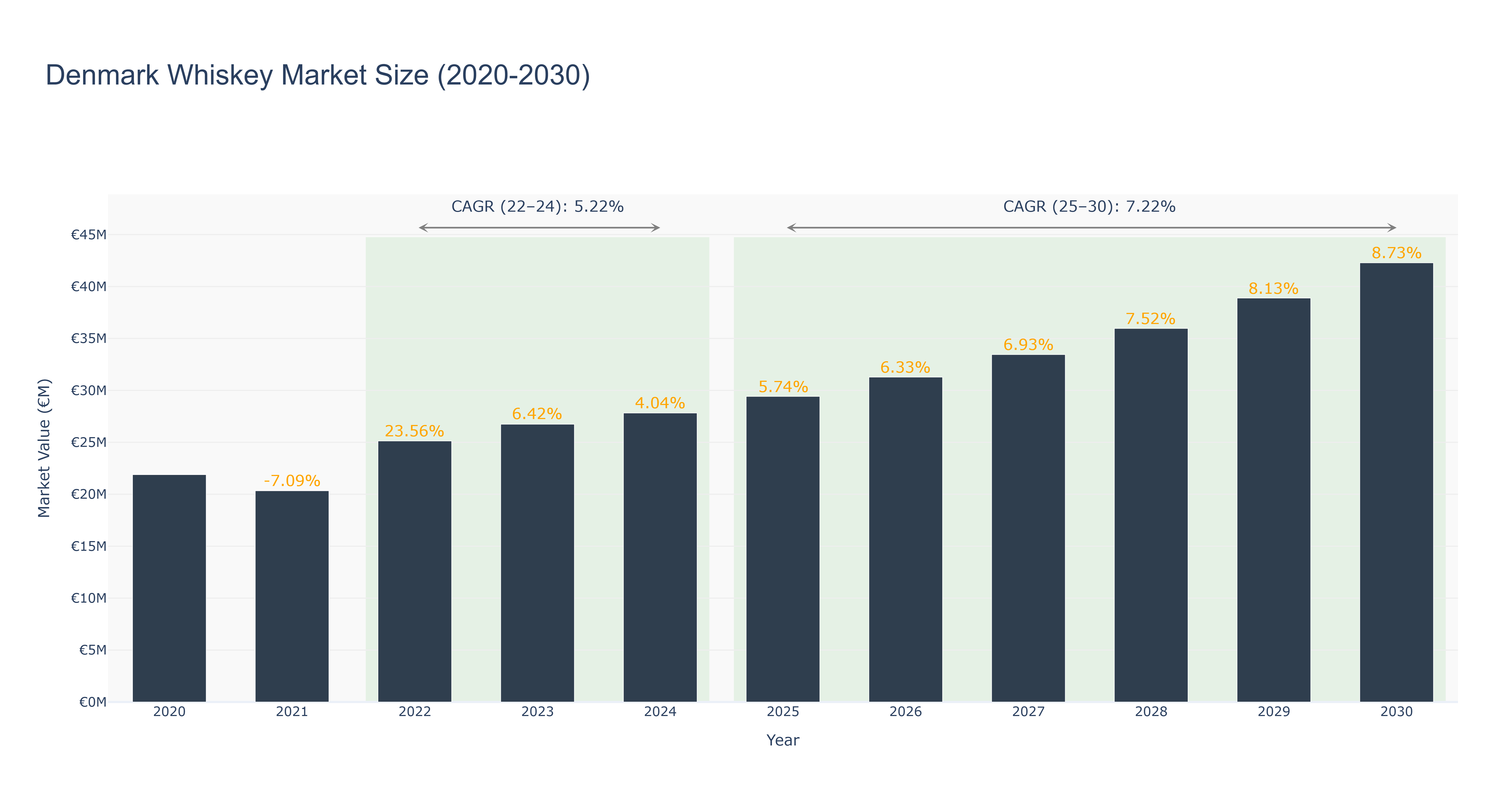
Denmark Whiskey Market has shown a fluctuating trend in recent years. The peak market size was observed in 2030 at €42.28 million. From 2020 to 2024, the market size decreased from €21.89 million to €27.82 million, attributed to economic uncertainties and changing consumer preferences. However, a positive growth trajectory is forecasted from 2025 to 2030, with the market size expected to reach €42.28 million by 2030. The CAGR for the period 2022-24 is 5.22%, and for 2025-30 is 7.22%. Industry drivers such as increasing demand for premium spirits and growing interest in craft distilleries are expected to propel market growth. In the near future, Denmark is set to introduce sustainable packaging initiatives to align with environmental concerns, enhancing the market's appeal to eco-conscious consumers.
Denmark Whiskey Market: Production & Trade Performance (2019-2025)
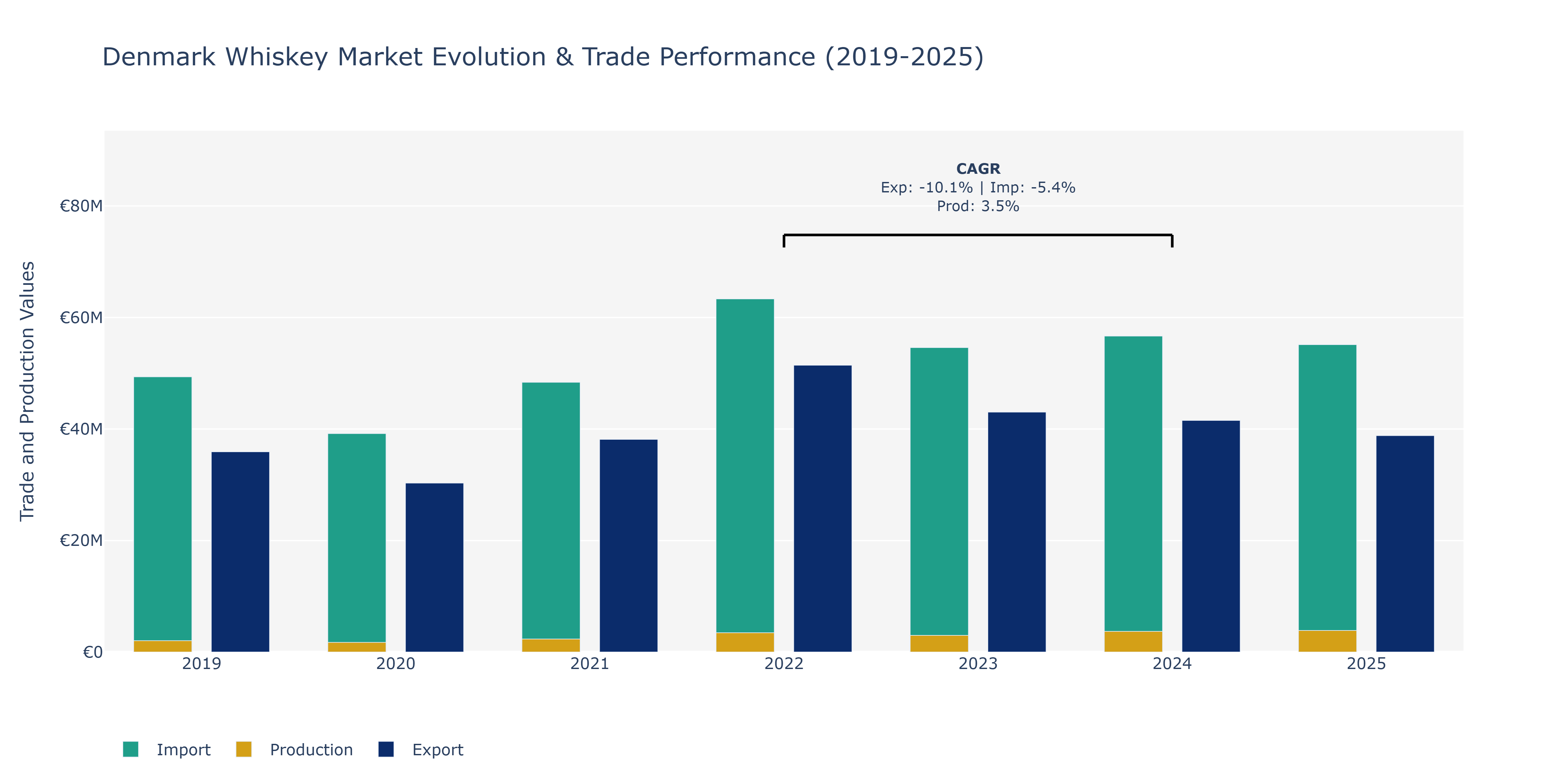
In the Denmark Whiskey Market, from 2019 to 2025, Exports experienced fluctuations, with a peak in 2022 at approximately €51.45 million, followed by a decrease in subsequent years, hitting around €38.82 million in 2025. Imports showed a similar trend, peaking in 2022 at about €63.33 million and then declining to about €55.13 million in 2025. Production witnessed a steady increase from 2019 to 2025, reaching its highest point in 2024 at approximately €3.71 billion. The fluctuations in Exports and Imports could be attributed to various factors such as changes in consumer preferences, international trade agreements, and economic conditions impacting purchasing power. The consistent rise in Production may indicate increased domestic demand, improved production efficiency, and possibly a growing export market for Danish whiskey brands. Real-world developments like the rising global interest in craft spirits and the popularity of Scandinavian products could have influenced these trends, driving market dynamics in the Denmark Whiskey Market.
Denmark Whiskey Market Overview
The whiskey market in Denmark has seen significant growth, driven by a rising interest in premium and craft spirits. Danish consumers are increasingly exploring a variety of whiskey types, including Scotch, Irish, and local brands, contributing to a diversified market. The growing trend of whiskey tastings and appreciation for artisanal production methods has further enhanced consumer engagement. Denmarks unique market landscape includes a burgeoning craft distillery sector, where local producers create innovative and high-quality whiskey offerings. The Danish governments regulations on alcohol production and sales, along with promotional efforts for local distilleries, continue to shape this evolving market.
Drivers of the market
The whiskey market in Denmark is experiencing robust growth due to a combination of factors, including the rising trend of premiumization and the growing interest in craft spirits. Consumers are increasingly willing to pay a premium for high-quality, artisanal whiskey, leading to a surge in demand for both domestic and imported brands. The increasing popularity of whiskey tasting events and distillery tours also enhances consumer engagement and education about different whiskey varieties. Additionally, the rise of cocktail culture and the incorporation of whiskey in innovative drink recipes contribute to market growth. The growing appreciation for whiskey among younger demographics further fuels the demand for diverse whiskey options.
Challenges of the market
The Denmark whiskey market faces significant challenges from both domestic and international competition. With a growing number of craft distilleries emerging, the market is becoming increasingly saturated. This saturation can make it difficult for new entrants to establish themselves and gain market share. Additionally, changing consumer tastes toward premium and artisanal products require distilleries to continually innovate and enhance the quality of their offerings. Moreover, regulatory challenges related to labeling and taxation can impact production costs and market access for whiskey brands.
Government Policy of the market
The whiskey market in Denmark has witnessed a surge in both domestic production and consumption, with local distilleries gaining recognition. The government supports this industry through regulations that promote quality and authenticity, including adherence to geographical indications. Additionally, policies that encourage tourism and local production contribute to the growth of the whiskey market. The Danish government also collaborates with producers to create favorable export conditions, boosting the international presence of Danish whiskey.
Key Highlights of the Report:
- Denmark Whiskey Market Outlook
- Market Size of Denmark Whiskey Market, 2024
- Forecast of Denmark Whiskey Market, 2031
- Historical Data and Forecast of Denmark Whiskey Revenues & Volume for the Period 2021-2031
- Denmark Whiskey Market Trend Evolution
- Denmark Whiskey Market Drivers and Challenges
- Denmark Whiskey Price Trends
- Denmark Whiskey Porter`s Five Forces
- Denmark Whiskey Industry Life Cycle
- Historical Data and Forecast of Denmark Whiskey Market Revenues & Volume By Product Type for the Period 2021-2031
- Historical Data and Forecast of Denmark Whiskey Market Revenues & Volume By American Whisky for the Period 2021-2031
- Historical Data and Forecast of Denmark Whiskey Market Revenues & Volume By Irish Whisky for the Period 2021-2031
- Historical Data and Forecast of Denmark Whiskey Market Revenues & Volume By Scotch Whisky for the Period 2021-2031
- Historical Data and Forecast of Denmark Whiskey Market Revenues & Volume By Canadian Whisky for the Period 2021-2031
- Historical Data and Forecast of Denmark Whiskey Market Revenues & Volume By Others for the Period 2021-2031
- Historical Data and Forecast of Denmark Whiskey Market Revenues & Volume By Distribution Channel for the Period 2021-2031
- Historical Data and Forecast of Denmark Whiskey Market Revenues & Volume By On-trade for the Period 2021-2031
- Historical Data and Forecast of Denmark Whiskey Market Revenues & Volume By Off-trade for the Period 2021-2031
- Denmark Whiskey Import Export Trade Statistics
- Market Opportunity Assessment By Product Type
- Market Opportunity Assessment By Distribution Channel
- Denmark Whiskey Top Companies Market Share
- Denmark Whiskey Competitive Benchmarking By Technical and Operational Parameters
- Denmark Whiskey Company Profiles
- Denmark Whiskey Key Strategic Recommendations






































