Saudi Arabia Whiskey Market Size, Share & Growth Rate
The Saudi Arabia Whiskey Market was estimated at USD 342 Million in 2025 and is projected to reach USD 437 Million by 2032, growing at a CAGR of 3.6% from 2026 to 2032. This steady growth trajectory reflects a burgeoning appreciation for premium spirits among a growing demographic of affluent consumers. As whiskey's status as a refined beverage solidifies in the nation's social fabric, its demand is further buoyed by luxury experiences, a rising cocktail culture, and the desire for high-quality, crafted products.
Saudi Arabia Whiskey Market Year-wise Growth Rate and Key Drivers
This graph highlights how the Saudi Arabia Whiskey Market has steadily grown over the years, supported by major growth factors.
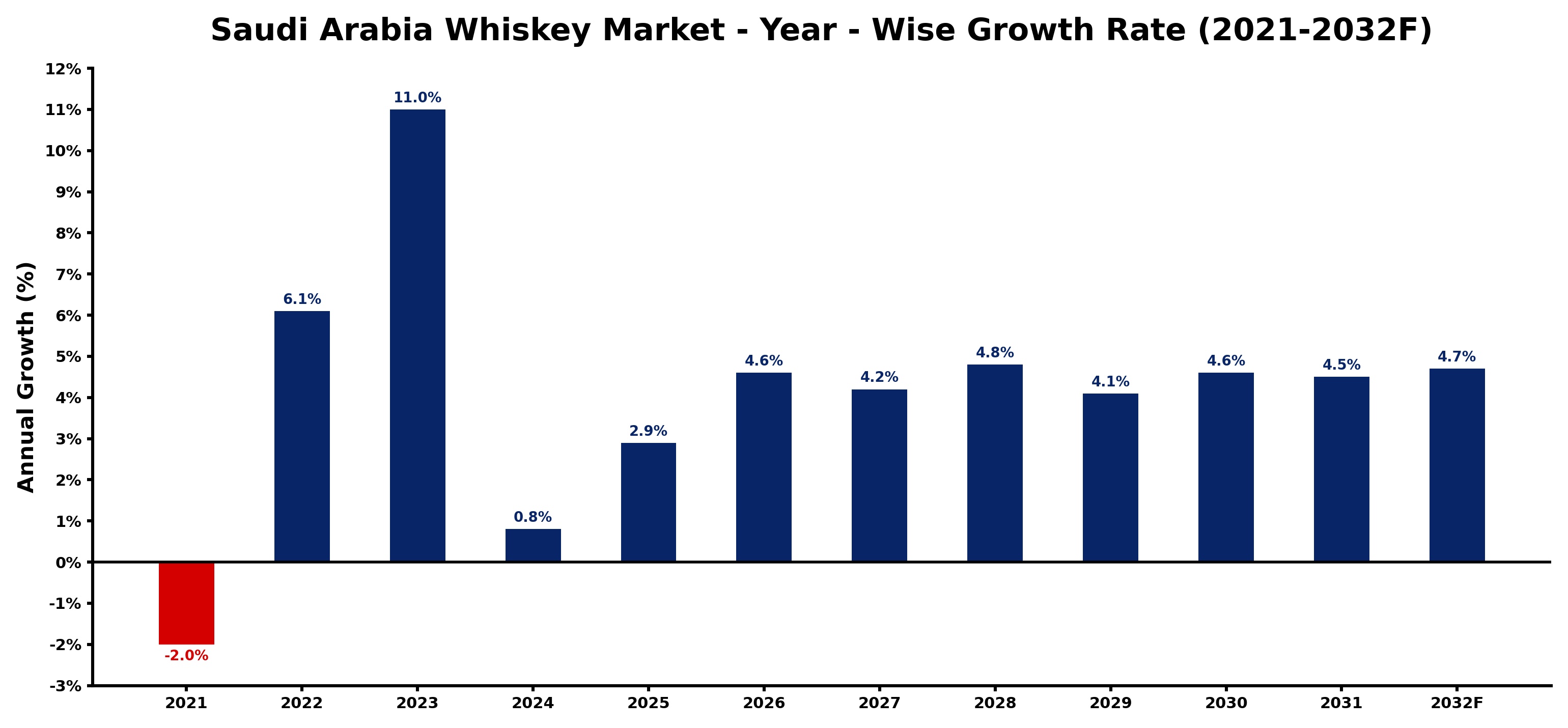
The table below presents the year‑wise growth rates along with the key drivers influencing the market
| Year | Growth Rate | Major Drivers |
| 2021 | -2.0% | Cultural restrictions limited consumption |
| 2022 | 6.1% | Increased tourism boosted demand |
| 2023 | 11.0% | Local production expanded offerings |
| 2024 | 0.8% | New brands entered market space |
| 2025 | 2.9% | Social events increased consumption rates |
| 2026 | 4.6% | E-commerce platforms enhanced sales |
| 2027 | 4.2% | Craft whiskey popularity surged |
| 2028 | 4.8% | Tasting events attracted new consumers |
| 2029 | 4.1% | Collaborations with local distilleries |
| 2030 | 4.6% | Whiskey education programs gained traction |
| 2031 | 4.5% | Luxury whiskey segment flourished |
| 2032 | 4.7% | Sustainability initiatives attracted consumers |
Note - Market size estimations and growth projections presented in this report are based on 6Wresearch's advanced forecasting approach, validated with industry datasets as of June 2026.
Saudi Arabia Whiskey Market Synopsis
The Saudi Arabia whiskey market has recently witnessed a significant surge in interest, driven by an increasing inclination towards premium alcoholic beverages. As the market evolves, it stands on the cusp of gradual expansion, fueled by a growing number of enthusiasts who value the craftsmanship behind aged whiskey.
Looking ahead, the market is expected to harness the demand for quality spirits during social gatherings and celebrations. Notably, the increase in exposure to diverse whiskey varieties positions the Saudi market as a promising landscape for connoisseurs, allowing the market to flourish.
Saudi Arabia Whiskey Market Key Takeaways
- The market is anticipated to grow steadily, driven by a rising preference for premium whiskey experiences.
- Cultural acceptance of whiskey as a luxury beverage is gradually increasing among affluent consumers.
- New cocktail trends and events are fostering a deeper appreciation for whiskey craftsmanship.
- The growth of local distributors is enhancing the availability of premium whiskey varieties.
- Increased consumer education on whiskey appreciation will play a vital role in market expansion.
Evaluation of Restraints in Saudi Arabia Whiskey Market
Despite the positive outlook, the Saudi Arabia whiskey market faces significant constraints. Cultural and regulatory limitations surrounding alcohol consumption impose challenges on market players, necessitating a nuanced approach to marketing and education. Moreover, the general public's awareness of whiskey and its appreciation remains at a nascent stage. Competition from non-alcoholic beverages, local wines, and international whiskey brands further complicates the landscape, mandating innovative strategies to capture consumer interest.
Saudi Arabia Whiskey Market Trends
A key trend in the Saudi Arabia whiskey market is the rising cocktail culture, with mixology gaining traction among younger consumers. This shift not only enhances whiskey's visibility in social settings but also encourages innovative uses of whiskey in craft cocktails. Additionally, the demand for premium, aged whiskey continues to grow as consumers become more discerning, leading to a stronger focus on quality over quantity. Craftsmanship and sourcing are increasingly important, aligning with the broader global trend of valuing artisanal products.
Saudi Arabia Whiskey Market Opportunities
As the Saudi Arabia whiskey market develops, opportunities abound for brands willing to engage with local culture while respecting existing norms. Expanding luxury hotel and restaurant offerings can create an enticing environment for whiskey tastings and events, directly targeting affluent consumers. Furthermore, partnerships with local distributors can enhance product availability, facilitating broader exposure. Investing in consumer education initiatives around whiskey culture can also yield long-term dividends, fostering a more knowledgeable and engaged customer base.
Government Initiatives in the Saudi Arabia Whiskey Market
While the Saudi government maintains strict regulations regarding the sale and consumption of alcohol, recent policies aimed at diversifying the economy may provide a conducive environment for premium spirits. There has been a noted increase in dialogues concerning cultural engagement, which could lead to more nuanced regulations around alcohol that acknowledge consumer interests. Any shifts in public spending towards tourism and luxury experiences may further support market growth.
Future Insights of the Saudi Arabia Whiskey Market
Looking forward to 2026-2032, the Saudi Arabia whiskey market appears poised for promising growth. As affluent consumers increasingly seek premium experiences, there is likely to be a burgeoning appetite for high-quality whiskey products. The gradual shift in cultural perceptions, combined with the rise of cocktail culture, may encourage a vibrant whiskey scene that resonates with both local and expatriate populations. The potential for innovation in product offerings and marketing strategies will be critical in capitalizing on this growth.
Saudi Arabia Whiskey Market Latest Developments (May 2025 - June 2026)
Recent developments indicate a gradual but notable shift in the Saudi Arabia whiskey market, marked by emerging local brands aiming to capture consumer attention. Additionally, there is a rising trend of whiskey-themed events that are gaining popularity, enhancing consumer engagement and interest. This evolving landscape suggests a community actively exploring whiskey culture, thus setting the stage for a more vibrant market.
Saudi Arabia Whiskey Market - Key Attractiveness of the Report
- 10 Years of Market Numbers
- Historical Data Starting from 2022 to 2025
- Base Year: 2025
- Forecast Data until 2032
- Key Performance Indicators Impacting the Market
- Major Upcoming Developments and Projects
Key Highlights of the Report:
- Saudi Arabia Whiskey Market Outlook
- Market Size of Saudi Arabia Whiskey Market, 2025
- Forecast of Saudi Arabia Whiskey Market, 2032
- Historical Data and Forecast of Saudi Arabia Whiskey Revenues & Volume for the Period 2022-2032F
- Saudi Arabia Whiskey Market Trend Evolution
- Saudi Arabia Whiskey Market Drivers and Challenges
- Saudi Arabia Whiskey Price Trends
- Saudi Arabia Whiskey Porter's Five Forces
- Saudi Arabia Whiskey Industry Life Cycle
- Historical Data and Forecast of Saudi Arabia Whiskey Market Revenues & Volume By Product Type for the Period 2022-2032F
- Historical Data and Forecast of Saudi Arabia Whiskey Market Revenues & Volume By American Whisky for the Period 2022-2032F
- Historical Data and Forecast of Saudi Arabia Whiskey Market Revenues & Volume By Irish Whisky for the Period 2022-2032F
- Historical Data and Forecast of Saudi Arabia Whiskey Market Revenues & Volume By Scotch Whisky for the Period 2022-2032F
- Historical Data and Forecast of Saudi Arabia Whiskey Market Revenues & Volume By Canadian Whisky for the Period 2022-2032F
- Historical Data and Forecast of Saudi Arabia Whiskey Market Revenues & Volume By Others for the Period 2022-2032F
- Historical Data and Forecast of Saudi Arabia Whiskey Market Revenues & Volume By Distribution Channel for the Period 2022-2032F
- Historical Data and Forecast of Saudi Arabia Whiskey Market Revenues & Volume By On-trade for the Period 2022-2032F
- Historical Data and Forecast of Saudi Arabia Whiskey Market Revenues & Volume By Off-trade for the Period 2022-2032F
- Saudi Arabia Whiskey Import Export Trade Statistics
- Market Opportunity Assessment By Product Type
- Market Opportunity Assessment By Distribution Channel
- Saudi Arabia Whiskey Top Companies Market Share
- Saudi Arabia Whiskey Competitive Benchmarking By Technical and Operational Parameters
- Saudi Arabia Whiskey Company Profiles
- Saudi Arabia Whiskey Key Strategic Recommendations






































