Ecuador Oyster Market Growth Rate Analysis (2025 - 2031)
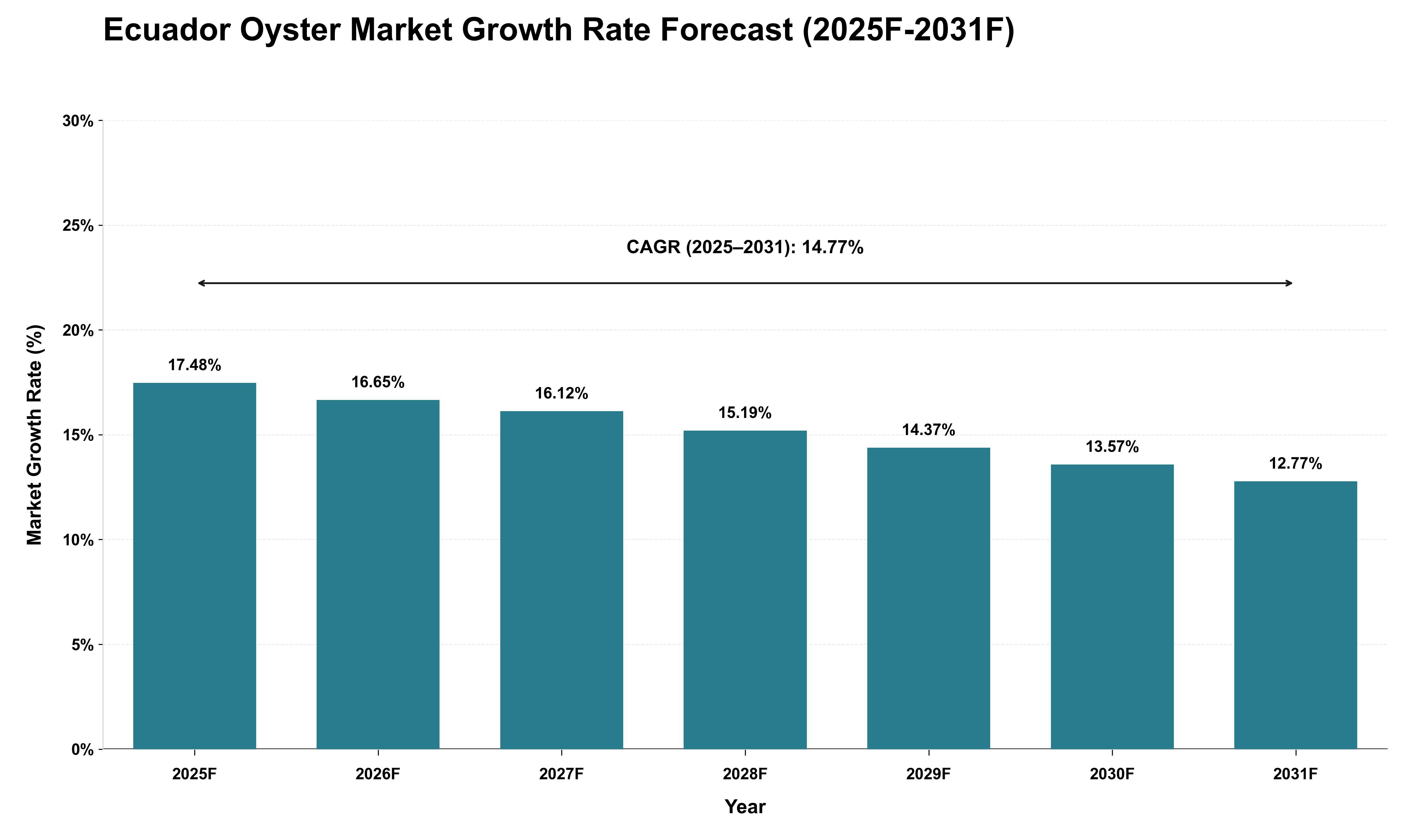
The forecasted growth trajectory for the Ecuador oyster market will exhibit a notable deceleration from 2025 to 2031, with the initial annual growth rate of 17.48% in 2025 tapering to 12.77% by 2031. This trend suggests an evolving landscape influenced by technological advancements in aquaculture and product substitution dynamics, where innovations in farming techniques may enhance yield efficiency and reduce costs. As consumer preferences shift towards sustainable seafood options, the demand for oysters is likely to remain robust, albeit at a gradually diminishing growth rate as market penetration increases. Additionally, import dependencies may play a critical role; fluctuations in global supply chains could impact local pricing and availability, further shaping consumption patterns. Overall, while the CAGR of 14.77% indicates strong potential, the anticipated cyclical trends will necessitate adaptive strategies within the sector to maintain competitiveness amidst changing economic conditions.
Key Highlights of the Report:
- Ecuador Oyster Market Outlook
- Market Size of Ecuador Oyster Market, 2024
- Forecast of Ecuador Oyster Market, 2031
- Historical Data and Forecast of Ecuador Oyster Revenues & Volume for the Period 2021-2031
- Ecuador Oyster Market Trend Evolution
- Ecuador Oyster Market Drivers and Challenges
- Ecuador Oyster Price Trends
- Ecuador Oyster Porter`s Five Forces
- Ecuador Oyster Industry Life Cycle
- Historical Data and Forecast of Ecuador Oyster Market Revenues & Volume By Oyster Type for the Period 2021-2031
- Historical Data and Forecast of Ecuador Oyster Market Revenues & Volume By Cupped Oyster for the Period 2021-2031
- Historical Data and Forecast of Ecuador Oyster Market Revenues & Volume By Pacific Cupped Oyster for the Period 2021-2031
- Historical Data and Forecast of Ecuador Oyster Market Revenues & Volume By American Cupped Oyster for the Period 2021-2031
- Historical Data and Forecast of Ecuador Oyster Market Revenues & Volume By Penguin Wing Oyster for the Period 2021-2031
- Historical Data and Forecast of Ecuador Oyster Market Revenues & Volume By Others for the Period 2021-2031
- Historical Data and Forecast of Ecuador Oyster Market Revenues & Volume By End User for the Period 2021-2031
- Historical Data and Forecast of Ecuador Oyster Market Revenues & Volume By Foodservice for the Period 2021-2031
- Historical Data and Forecast of Ecuador Oyster Market Revenues & Volume By Retail for the Period 2021-2031
- Historical Data and Forecast of Ecuador Oyster Market Revenues & Volume By Packaging Form for the Period 2021-2031
- Historical Data and Forecast of Ecuador Oyster Market Revenues & Volume By Fresh for the Period 2021-2031
- Historical Data and Forecast of Ecuador Oyster Market Revenues & Volume By Frozen for the Period 2021-2031
- Historical Data and Forecast of Ecuador Oyster Market Revenues & Volume By Canned for the Period 2021-2031
- Historical Data and Forecast of Ecuador Oyster Market Revenues & Volume By Others for the Period 2021-2031
- Ecuador Oyster Import Export Trade Statistics
- Market Opportunity Assessment By Oyster Type
- Market Opportunity Assessment By End User
- Market Opportunity Assessment By Packaging Form
- Ecuador Oyster Top Companies Market Share
- Ecuador Oyster Competitive Benchmarking By Technical and Operational Parameters
- Ecuador Oyster Company Profiles
- Ecuador Oyster Key Strategic Recommendations






































