Egypt Automotive Drive Shaft Market Size, Share & Growth Rate
The Egypt Automotive Drive Shaft Market was estimated at USD 299 Million in 2025 and is projected to reach USD 394 Million by 2032, growing at a CAGR of 4.0% from 2026 to 2032. This upward trajectory is primarily driven by the robust expansion of the automotive sector, propelled by increased vehicle production and a rising demand for personal mobility. Government initiatives aimed at bolstering local manufacturing and improving infrastructure further solidify the market's growth prospects.
Egypt Automotive Drive Shaft Market Year-wise Growth Rate and Key Drivers
This graph highlights how the Egypt Automotive Drive Shaft Market has steadily grown over the years, supported by major growth factors.
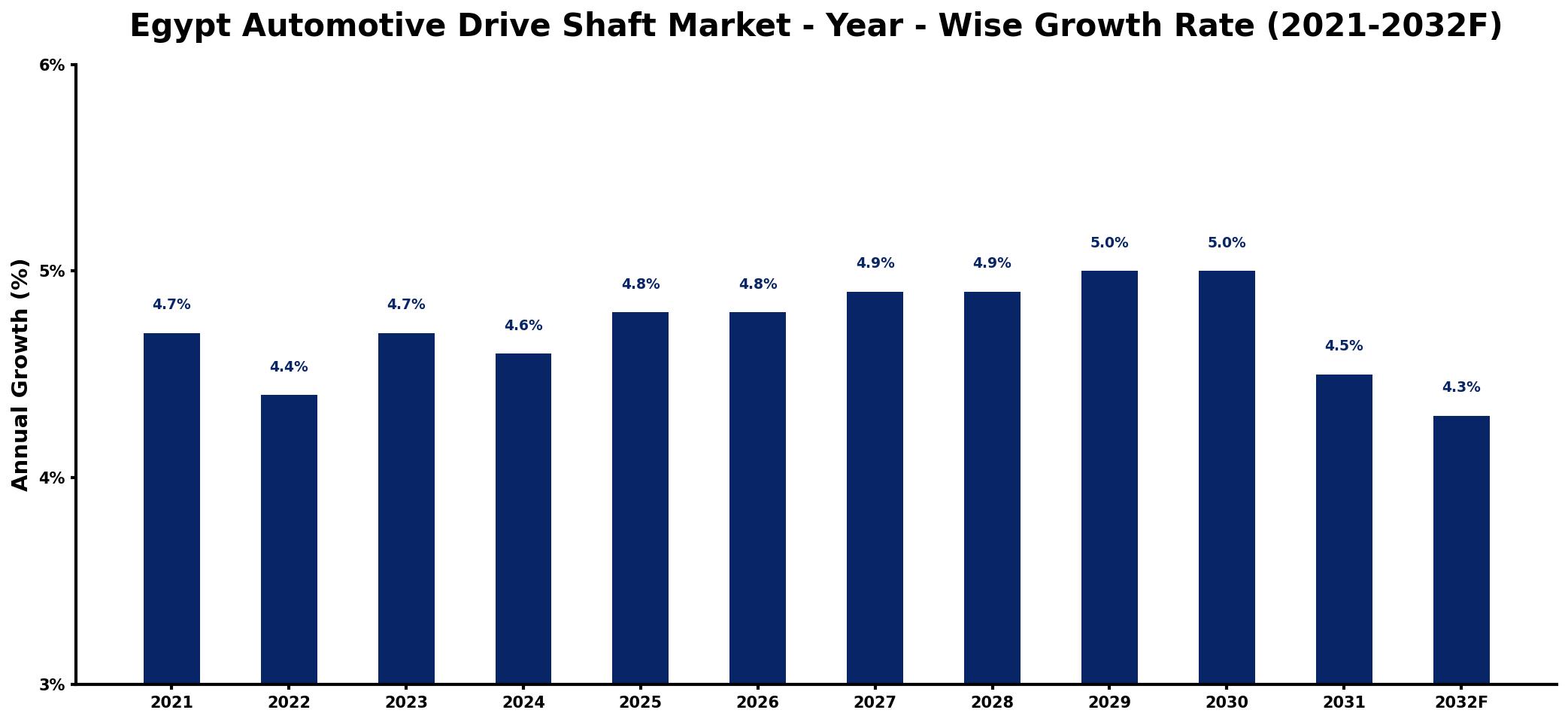
The table below presents the year‑wise growth rates along with the key drivers influencing the market
| Year | Growth Rate | Major Drivers |
| 2021 | 4.7% | Rising vehicle production levels |
| 2022 | 4.4% | Increase in infrastructure investments |
| 2023 | 4.7% | Growth in transportation sector |
| 2024 | 4.6% | Surge in export opportunities |
| 2025 | 4.8% | Expansion of renewable energy projects |
| 2026 | 4.8% | Technological advancements in manufacturing |
| 2027 | 4.9% | rising infrastructure development spending |
| 2028 | 4.9% | Boost in local assembly plants |
| 2029 | 5.0% | Growing demand for electric vehicles |
| 2030 | 5.0% | growing commercial sector adoption |
| 2031 | 4.5% | Investment in research and development |
| 2032 | 4.3% | Rising popularity of mobility services |
Note: Market size estimations and growth projections presented in this report are based on 6Wresearch's proprietary forecasting methodology, utilizing the latest available industry data, government publications, and primary research inputs.
Egypt Automotive Drive Shaft Market Synopsis
The strongest force shaping the Egypt Automotive Drive Shaft Market today is the increasing demand for automobiles, fueled by a growing middle-class population with enhanced purchasing power. As the automotive industry in Egypt evolves, the demand for innovative and efficient drive shafts becomes paramount, pushing manufacturers to innovate continuously.
Additionally, the shift towards electric vehicles is catalyzing a transformation in drive shaft technology. Manufacturers are now focused on developing products that meet the unique demands of EVs, resulting in higher torque capabilities and lightweight materials, which further drive competitive dynamics in the market.
Egypt Automotive Drive Shaft Market Key Takeaways
- The market is set to grow steadily due to an increase in vehicle production and consumer demand.
- Technological advancements and product innovations are crucial for maintaining a competitive edge.
- Government support in the form of incentives is fostering local manufacturing of automotive components.
- The shift towards electric vehicles is prompting a redesign of drive shafts for enhanced performance.
- Collaboration between manufacturers and suppliers is vital for customized solutions in this evolving market.
Evaluation of Restraints in Egypt Automotive Drive Shaft Market
While the Egypt Automotive Drive Shaft Market is characterized by opportunities, several restraints are hindering its full potential. Intense competition among both domestic and international manufacturers is a significant challenge, as companies must continuously innovate to differentiate themselves. Fluctuating raw material prices also pose a threat, impacting production costs and profit margins. Additionally, the absence of standardized regulations complicates quality control, risking product reliability and consumer trust in a burgeoning market.
Egypt Automotive Drive Shaft Market Trends
Several trends are currently shaping the Egypt Automotive Drive Shaft Market. A prominent trend is the increasing demand for lightweight drive shafts constructed from advanced materials such as carbon fiber, which enhance vehicle performance while reducing overall weight. Furthermore, the rise of electric vehicles is leading to a focus on drive shafts capable of handling higher torque outputs, catering to the specific needs of EV manufacturers. Additionally, there is a growing interest in smart drive shafts equipped with sensors for real-time performance monitoring, aligning with the automotive industry's push towards more connected and efficient vehicles.
Egypt Automotive Drive Shaft Market Opportunities
The market presents significant growth and investment opportunities for stakeholders involved in the automotive sector. The increasing middle-class population and favorable government policies aimed at boosting local automotive production create a conducive environment for drive shaft manufacturers. Furthermore, as the automotive industry in Egypt expands, there is a rising demand for high-quality, efficient drive shafts that adhere to international standards, making it an attractive area for new investments and innovations.
Government Initiatives in the Egypt Automotive Drive Shaft Market
The Egyptian government has implemented various policies to stimulate local manufacturing and enhance the automotive sector, which significantly impacts the drive shaft market. Incentives such as tax breaks and subsidies are offered to attract investment in domestic production facilities. The government also emphasizes compliance with international quality standards to elevate the competitiveness of Egyptian automotive products both domestically and in export markets. Moreover, efforts to promote environmentally sustainable practices are influencing the development of innovative drive shaft designs that align with global trends towards greener technologies.
Future Insights of the Egypt Automotive Drive Shaft Market
Looking ahead, the Egypt Automotive Drive Shaft Market is expected to experience continued growth through 2026-2032, driven by rising disposable incomes and government investment in infrastructure projects. As the automotive manufacturing sector continues to expand, it will create additional opportunities for drive shaft producers. However, the increasing prominence of electric and hybrid vehicles will necessitate a paradigm shift in manufacturing strategies, compelling traditional drive shaft manufacturers to adapt to new technologies and consumer preferences to maintain their market positions.
Egypt Automotive Drive Shaft Market Latest Developments (2025 - 2026)
In recent months, the Egypt Automotive Drive Shaft Market has witnessed a significant pivot towards sustainable and innovative manufacturing practices. Many manufacturers are investing in research and development to explore advanced materials and smart technologies. Additionally, partnerships between automotive producers and drive shaft suppliers are increasingly prevalent, aimed at developing customized solutions that address the shifting market demands. This collaborative approach is expected to drive further innovations and enhance the overall quality of drive shafts in the region.
Egypt Automotive Drive Shaft Market - Key Attractiveness of the Report
- 10 Years of Market Numbers
- Historical Data Starting from 2022 to 2025
- Base Year: 2025
- Forecast Data until 2032
- Key Performance Indicators Impacting the Market
- Major Upcoming Developments and Projects
Key Highlights of the Report:
- Egypt Automotive Drive Shaft Market Outlook
- Market Size of Egypt Automotive Drive Shaft Market, 2025
- Forecast of Egypt Automotive Drive Shaft Market, 2032
- Historical Data and Forecast of Egypt Automotive Drive Shaft Revenues & Volume for the Period 2022-2032F
- Egypt Automotive Drive Shaft Market Trend Evolution
- Egypt Automotive Drive Shaft Market Drivers and Challenges
- Egypt Automotive Drive Shaft Price Trends
- Egypt Automotive Drive Shaft Porter's Five Forces
- Egypt Automotive Drive Shaft Industry Life Cycle
- Historical Data and Forecast of Egypt Automotive Drive Shaft Market Revenues & Volume By Design Type for the Period 2022-2032F
- Historical Data and Forecast of Egypt Automotive Drive Shaft Market Revenues & Volume By Hollow Shaft for the Period 2022-2032F
- Historical Data and Forecast of Egypt Automotive Drive Shaft Market Revenues & Volume By Solid Shaft for the Period 2022-2032F
- Historical Data and Forecast of Egypt Automotive Drive Shaft Market Revenues & Volume By Position Type for the Period 2022-2032F
- Historical Data and Forecast of Egypt Automotive Drive Shaft Market Revenues & Volume By Rear Axle for the Period 2022-2032F
- Historical Data and Forecast of Egypt Automotive Drive Shaft Market Revenues & Volume By Front Axle for the Period 2022-2032F
- Historical Data and Forecast of Egypt Automotive Drive Shaft Market Revenues & Volume By Vehicle Type for the Period 2022-2032F
- Historical Data and Forecast of Egypt Automotive Drive Shaft Market Revenues & Volume By Passenger Cars for the Period 2022-2032F
- Historical Data and Forecast of Egypt Automotive Drive Shaft Market Revenues & Volume By Commercial Vehicles for the Period 2022-2032F
- Egypt Automotive Drive Shaft Import Export Trade Statistics
- Market Opportunity Assessment By Design Type
- Market Opportunity Assessment By Position Type
- Market Opportunity Assessment By Vehicle Type
- Egypt Automotive Drive Shaft Top Companies Market Share
- Egypt Automotive Drive Shaft Competitive Benchmarking By Technical and Operational Parameters
- Egypt Automotive Drive Shaft Company Profiles
- Egypt Automotive Drive Shaft Key Strategic Recommendations






































