Kazakhstan Automotive Drive Shaft Market Size, Share & Growth Rate
The Kazakhstan Automotive Drive Shaft Market was estimated at USD 410 Million in 2025 and is projected to reach USD 535 Million by 2032, growing at a CAGR of 3.9% from 2026 to 2032. This growth trajectory is underpinned by a surge in automobile production, particularly in the commercial vehicle segment, as well as ongoing government support for local manufacturing. As Kazakhstan enhances its transportation infrastructure, the demand for advanced drive shaft technologies will likely continue to rise, aligning with global trends in vehicle efficiency and performance.
Kazakhstan Automotive Drive Shaft Market Year-wise Growth Rate and Key Drivers
This graph highlights how the Kazakhstan Automotive Drive Shaft Market has steadily grown over the years, supported by major growth factors.
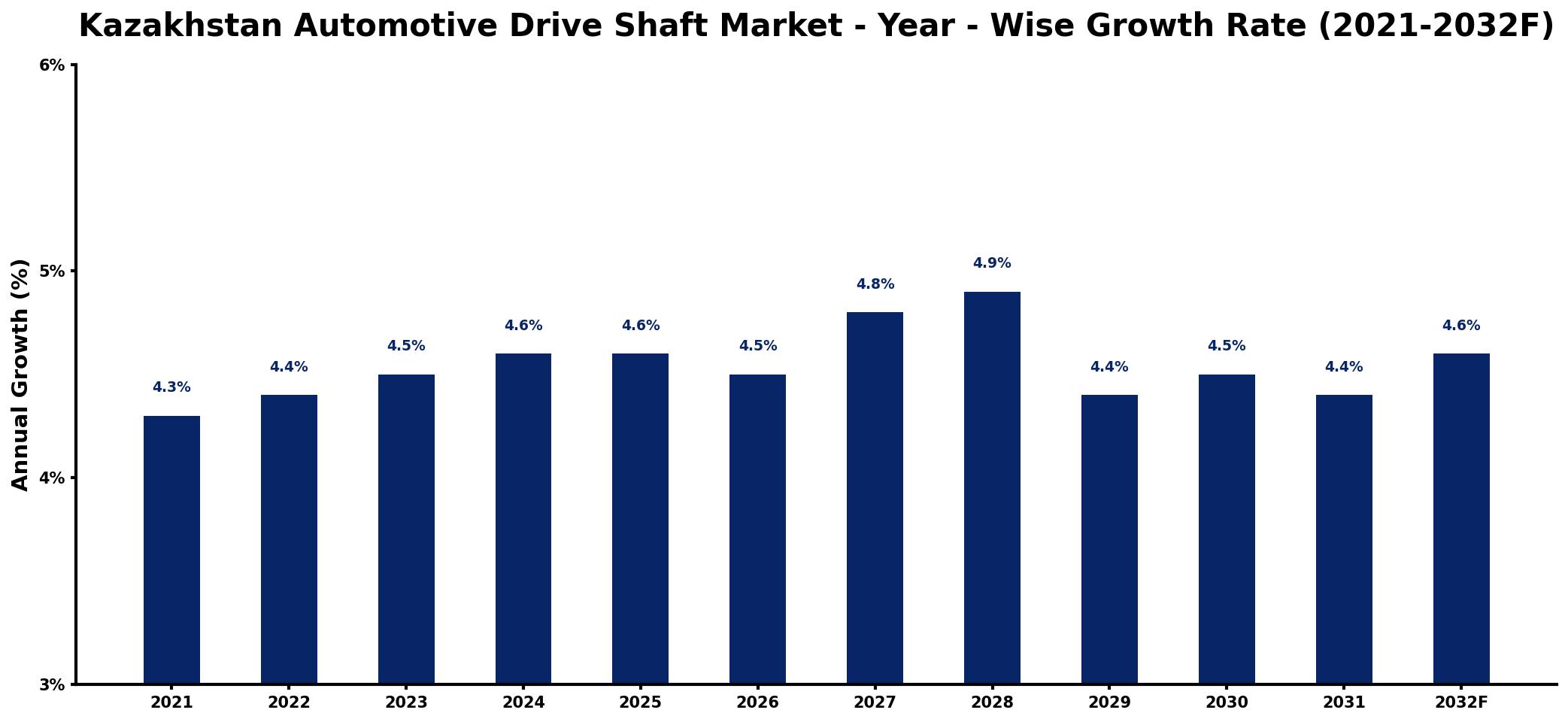
The table below presents the year‑wise growth rates along with the key drivers influencing the market
| Year | Growth Rate | Major Drivers |
| 2021 | 4.3% | Rising vehicle production rates |
| 2022 | 4.4% | Increased infrastructure development projects |
| 2023 | 4.5% | Growing consumer preference for mobility |
| 2024 | 4.6% | Expansion of electric vehicle market |
| 2025 | 4.6% | Surge in domestic manufacturing facilities |
| 2026 | 4.5% | Higher investments in transportation sector |
| 2027 | 4.8% | Boost in regional trade agreements |
| 2028 | 4.9% | Advancements in production technologies |
| 2029 | 4.4% | rising procurement volume requirements |
| 2030 | 4.5% | Growth in aftersales service sector |
| 2031 | 4.4% | Rising demand for vehicle customization |
| 2032 | 4.6% | Enhanced government incentives for production |
Note: Market size estimations and growth projections presented in this report are based on 6Wresearch's proprietary forecasting methodology, utilizing the latest available industry data, government publications, and primary research inputs.
Kazakhstan Automotive Drive Shaft Market Synopsis
The Kazakhstan Automotive Drive Shaft Market is currently experiencing a period of positive momentum, fueled by a robust growth in vehicle production and an increasing appetite for commercial vehicles. The demand for advanced drive shaft solutions is compelling manufacturers to innovate, enhancing both fuel efficiency and overall vehicle performance.
Market dynamics are heavily influenced by a blend of domestic and international players, each offering an array of drive shaft products tailored to various vehicle types. Government initiatives designed to bolster local manufacturing, coupled with substantial investments in the automotive sector, are paving the way for sustainable growth in this market.
Kazakhstan Automotive Drive Shaft Market Key Takeaways
- Growing automobile production and rising demand for commercial vehicles are key drivers of market expansion.
- Investment in advanced drive shaft technologies is essential for enhancing performance and fuel efficiency.
- Lightweight materials like carbon fiber and aluminum are gaining traction in drive shaft manufacturing.
- Government policies are aimed at promoting local production and attracting foreign investments.
- Investment opportunities abound as Kazakhstan positions itself as a burgeoning automotive manufacturing hub.
Evaluation of Restraints in Kazakhstan Automotive Drive Shaft Market
While the Kazakhstan Automotive Drive Shaft Market is on an upward trajectory, it is not without its challenges. Economic fluctuations can directly affect consumer purchasing power, leading to volatile demand. Additionally, competition from international manufacturers offering lower-cost alternatives adds pressure on local producers to maintain competitive pricing. These factors, combined with the need for continuous innovation and investment in research and development, create a complex landscape that demands strategic navigation.
Kazakhstan Automotive Drive Shaft Market Trends
A significant trend within the Kazakhstan Automotive Drive Shaft Market is the growing preference for lightweight drive shafts, utilizing materials such as carbon fiber and aluminum. These innovations not only bolster fuel efficiency but also improve vehicle dynamics. Furthermore, the increasing popularity of electric and hybrid vehicles is pushing manufacturers to adapt their drive shaft designs to accommodate these new powertrain technologies. Additionally, the integration of real-time performance monitoring sensors into drive shafts is becoming an essential feature in this evolving market landscape.
Kazakhstan Automotive Drive Shaft Market Opportunities
The market presents a wealth of investment opportunities, particularly as Kazakhstan continues to develop its automotive industry. The government's emphasis on bolstering local manufacturing capacity creates avenues for collaboration with domestic players and access to a burgeoning consumer base. Moreover, with the potential for export to neighboring markets, the Kazakhstan Automotive Drive Shaft Market stands as an attractive prospect for investors seeking to capitalize on the region's industrial growth and technological advancements.
Government Initiatives in the Kazakhstan Automotive Drive Shaft Market
The Kazakhstan government has enacted various supportive measures aimed at fostering growth within the automotive drive shaft sector. Incentives such as tax breaks, subsidies, and grants are designed to attract foreign investment while promoting domestic manufacturing. Efforts to enhance infrastructure, streamline regulatory processes, and stimulate innovation further underline the government's commitment to creating a business-friendly environment. These policies are integral in positioning Kazakhstan as a competitive player in the global automotive market.
Future Insights of the Kazakhstan Automotive Drive Shaft Market
Looking ahead, the Kazakhstan Automotive Drive Shaft Market is set for a promising evolution from 2026 to 2032. With an anticipated increase in vehicle production and a growing preference for commercial vehicles, the demand for drive shafts will likely see significant growth. The government's ongoing initiatives to bolster local manufacturing and attract foreign investments will play a crucial role in shaping market dynamics. However, the industry must remain vigilant in addressing challenges like raw material price fluctuations and the competitive landscape, ensuring robust growth amid an increasingly complex global environment.
Kazakhstan Automotive Drive Shaft Market Latest Developments (2025 - 2026)
Recent months have seen a heightened focus on technological advancements within the Kazakhstan Automotive Drive Shaft Market. Manufacturers are investing in research to optimize lightweight materials and improve drive shaft designs tailored for electric and hybrid vehicles. Additionally, there is an increased collaborative effort between local manufacturers and international partners aimed at sharing expertise and enhancing product offerings. This synergy is expected to drive innovation and improve competitive positioning within the market.
Kazakhstan Automotive Drive Shaft Market - Key Attractiveness of the Report
- 10 Years of Market Numbers
- Historical Data Starting from 2022 to 2025
- Base Year: 2025
- Forecast Data until 2032
- Key Performance Indicators Impacting the Market
- Major Upcoming Developments and Projects
Key Highlights of the Report:
- Kazakhstan Automotive Drive Shaft Market Outlook
- Market Size of Kazakhstan Automotive Drive Shaft Market, 2025
- Forecast of Kazakhstan Automotive Drive Shaft Market, 2032
- Historical Data and Forecast of Kazakhstan Automotive Drive Shaft Revenues & Volume for the Period 2022-2032F
- Kazakhstan Automotive Drive Shaft Market Trend Evolution
- Kazakhstan Automotive Drive Shaft Market Drivers and Challenges
- Kazakhstan Automotive Drive Shaft Price Trends
- Kazakhstan Automotive Drive Shaft Porter's Five Forces
- Kazakhstan Automotive Drive Shaft Industry Life Cycle
- Historical Data and Forecast of Kazakhstan Automotive Drive Shaft Market Revenues & Volume By Design Type for the Period 2022-2032F
- Historical Data and Forecast of Kazakhstan Automotive Drive Shaft Market Revenues & Volume By Hollow Shaft for the Period 2022-2032F
- Historical Data and Forecast of Kazakhstan Automotive Drive Shaft Market Revenues & Volume By Solid Shaft for the Period 2022-2032F
- Historical Data and Forecast of Kazakhstan Automotive Drive Shaft Market Revenues & Volume By Position Type for the Period 2022-2032F
- Historical Data and Forecast of Kazakhstan Automotive Drive Shaft Market Revenues & Volume By Rear Axle for the Period 2022-2032F
- Historical Data and Forecast of Kazakhstan Automotive Drive Shaft Market Revenues & Volume By Front Axle for the Period 2022-2032F
- Historical Data and Forecast of Kazakhstan Automotive Drive Shaft Market Revenues & Volume By Vehicle Type for the Period 2022-2032F
- Historical Data and Forecast of Kazakhstan Automotive Drive Shaft Market Revenues & Volume By Passenger Cars for the Period 2022-2032F
- Historical Data and Forecast of Kazakhstan Automotive Drive Shaft Market Revenues & Volume By Commercial Vehicles for the Period 2022-2032F
- Kazakhstan Automotive Drive Shaft Import Export Trade Statistics
- Market Opportunity Assessment By Design Type
- Market Opportunity Assessment By Position Type
- Market Opportunity Assessment By Vehicle Type
- Kazakhstan Automotive Drive Shaft Top Companies Market Share
- Kazakhstan Automotive Drive Shaft Competitive Benchmarking By Technical and Operational Parameters
- Kazakhstan Automotive Drive Shaft Company Profiles
- Kazakhstan Automotive Drive Shaft Key Strategic Recommendations






































