Egypt Electronic Components Market Summary
The egypt electronic components market was estimated at USD 202 Million in 2025 and is projected to reach USD 269 Million by 2032, growing at a CAGR of 4.8% from 2026 to 2032.
Egypt Electronic Components Market Year-wise Growth Rate and Key Drivers
This graph highlights how the Egypt Electronic Components Market has steadily grown over the past five years, supported by major growth factors.
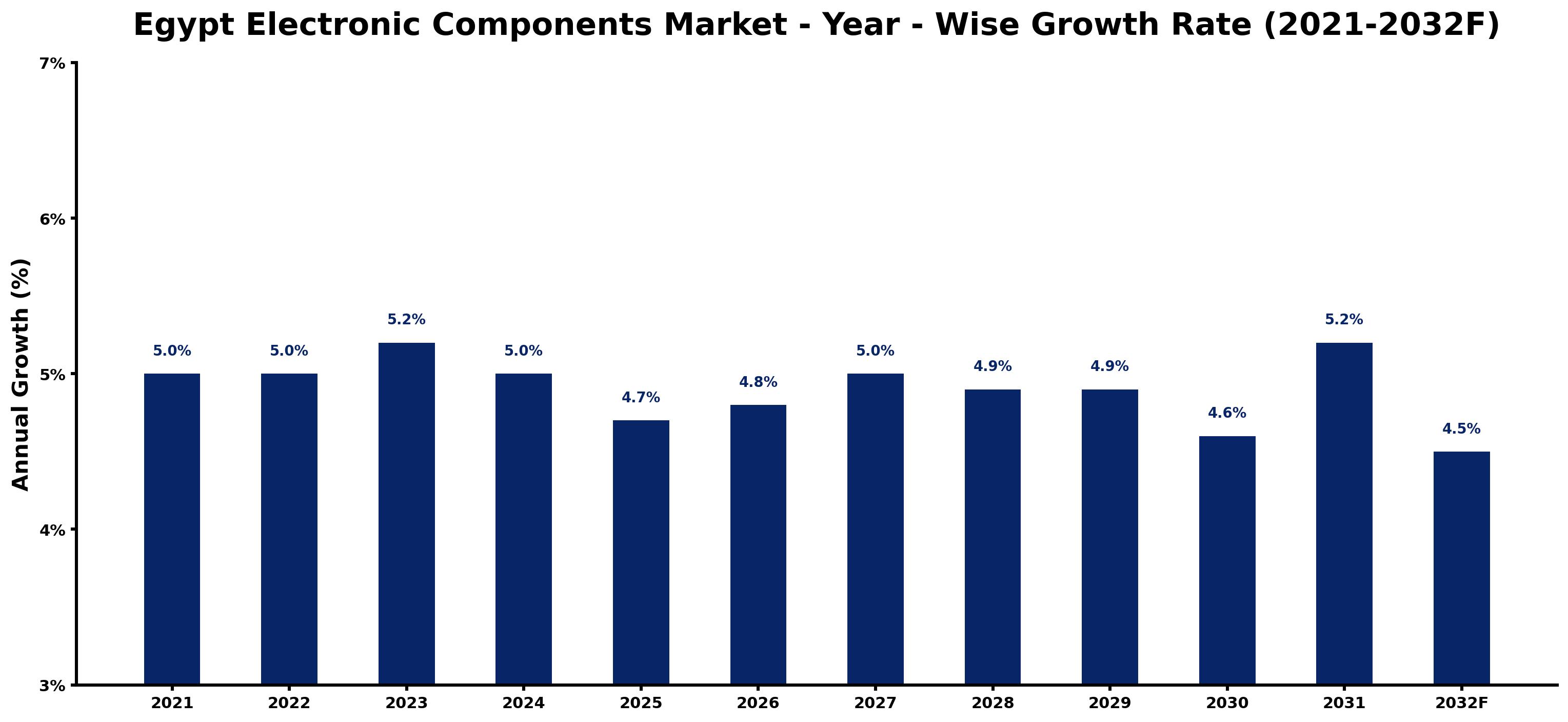
The table below presents the year wise growth rates along with the key drivers influencing the market
| Year | Growth Rate | Major Drivers |
| 2021 | 5.0% | Post-lockdown retail projects fueled innovations in electronic component sourcing strategies. |
| 2022 | 5.0% | Local manufacturers increased production capacity to meet regional electronics market demands. |
| 2023 | 5.2% | Emerging tech startups collaborated with component suppliers to enhance product offerings. |
| 2024 | 5.0% | Smart city initiatives led to heightened investments in infrastructure and electronic components. |
| 2025 | 4.7% | International partnerships introduced advanced manufacturing techniques to the Egyptian market. |
| 2026 | 4.8% | Increased urbanization spurred demand for consumer electronics, driving component usage. |
| 2027 | 5.0% | The electric vehicle industry expanded, creating new opportunities for electronic component suppliers. |
| 2028 | 4.9% | Technological upgrades in telecommunications networks prompted a shift towards modern components. |
| 2029 | 4.9% | Cost-effective solar energy solutions encouraged investments in renewable energy components. |
| 2030 | 4.6% | A focus on sustainability led firms to prioritize eco-friendly electronic components. |
| 2031 | 5.2% | Integration of AI technologies in manufacturing processes transformed component production efficiency. |
| 2032 | 4.5% | Consumer preferences for smart devices solidified the importance of advanced electronic components. |
Note - Market size estimations and growth projections presented in this report are based on 6Wresearch's advanced forecasting approach, validated with industry datasets as of June 2026.
Egypt Electronic Components Market Synopsis
The Egypt Electronic Components Market is projected to reach 4.8% and witness significant growth during the forecast period (2026-2032). This growth trajectory is driven by the increasing adoption of electronic devices across various sectors, including automotive, telecommunications, and consumer electronics. The market encompasses a diverse range of components such as semiconductors, resistors, capacitors, connectors, and integrated circuits, which are essential for the functionality of modern electronics.
Egypt Electronic Components Market Growth Drivers
The expansion of the Egypt Electronic Components Market is influenced by several key drivers:
- Technological advancements are paving the way for the development of high-performance electronic components, which are increasingly required in advanced applications like IoT devices and smart technologies.
- The rising consumer demand for electronics, particularly smartphones and home appliances, is creating a robust market for electronic components, thereby driving manufacturers to enhance production capabilities.
- The automotive industry is undergoing a transformation with the incorporation of advanced electronic systems for safety and performance, further increasing the demand for reliable electronic components.
- Regional manufacturing initiatives are being established to reduce import dependency, which not only supports local businesses but also improves supply chain efficiencies.
- Partnerships between local manufacturers and international suppliers are fostering technology transfer and innovation, positioning the Egyptian market as an emerging hub for electronic components.
Egypt Electronic Components Market Trends and Opportunities
Current trends within the Egypt Electronic Components Market indicate a strong shift towards several key areas:
- The demand for advanced semiconductor technologies, including integrated circuits and sensors, is surging due to increased applications in automotive and consumer electronics.
- Sustainability is becoming a focal point, with a growing preference for energy-efficient components as companies seek to lower their environmental footprint.
- The rise of e-commerce platforms has transformed the distribution landscape, providing businesses and consumers with streamlined access to a wide variety of electronic components.
- Investments in research and development are crucial as players in the market aim to innovate by introducing new technologies and products that meet evolving consumer needs.
- Digitalization across industries, spurred by government initiatives, is creating new opportunities for the electronic components market, particularly in automation and smart solutions.
Egypt Electronic Components Market Challenges and Restraints
Despite its significant growth potential, the Egypt Electronic Components Market faces several challenges:
- A fragmented supply chain often results in delays and increased costs for manufacturers, affecting product availability and turnaround times.
- The competitive landscape requires companies to continuously innovate, which can strain resources, particularly for smaller firms without substantial capital.
- Access to advanced technology and skilled labor remains limited, creating barriers to entry for companies aiming to enhance their product offerings.
- Economic fluctuations and regulatory uncertainties can disrupt market stability and impact long-term investment plans.
- Navigating an evolving regulatory environment poses challenges, as companies must ensure compliance with both local and international standards.
Egypt Electronic Components Market Government Investment and Initiatives
The Egypt Electronic Components Market benefits from a range of government policies and initiatives aimed at stimulating industry growth:
- The implementation of import tariffs and protective regulations has been designed to bolster local manufacturers and encourage domestic production of essential components.
- The Ministry of Communications and Information Technology has launched various initiatives to support research and development, providing incentives for companies invested in innovation.
- Policies focused on enhancing educational and vocational training programs aim to increase the availability of skilled labor within the electronics sector.
- Government efforts to improve infrastructure, such as expanding logistics capabilities, facilitate smoother operations for manufacturers and suppliers.
- Regulations ensuring quality and safety standards for electronic components are in place, promoting a competitive yet secure market environment.
Egypt Electronic Components Market Latest Developments (May 2025 - June 2026)
In the period from May 2025 to June 2026, the Egypt Electronic Components Market has seen several notable developments:
- Efforts to strengthen local manufacturing capabilities have intensified, with several initiatives aimed at reducing reliance on imported components.
- Increased collaboration between the public and private sectors has led to enhanced funding for research and development projects focusing on cutting-edge technologies.
- The government has introduced new standards to improve the quality assurance processes for electronic components, fostering greater consumer confidence.
- Emerging trends in automation and smart technologies have prompted stakeholders to invest significantly in the necessary components and infrastructure.
- The e-commerce landscape continues to evolve, making it easier for manufacturers to reach end-users directly, which is reshaping distribution models in the market.
Egypt Electronic Components Market - Key Attractiveness of the Report
- 10 Years of Market Numbers
- Historical Data Starting from 2022 to 2025
- Base Year: 2025
- Forecast Data until 2032
- Key Performance Indicators Impacting the Market
- Major Upcoming Developments and Projects
Key Highlights of the Report:
- Egypt Electronic Components Market Outlook
- Market Size of Egypt Electronic Components Market, 2025
- Forecast of Egypt Electronic Components Market, 2032F
- Historical Data and Forecast of Egypt Electronic Components Revenues & Volume for the Period 2022-2032F
- Egypt Electronic Components Market Trend Evolution
- Egypt Electronic Components Market Drivers and Challenges
- Egypt Electronic Components Price Trends
- Egypt Electronic Components Porter's Five Forces
- Egypt Electronic Components Industry Life Cycle
- Historical Data and Forecast of Egypt Electronic Components Market Revenues & Volume By Types for the Period 2022-2032F
- Historical Data and Forecast of Egypt Electronic Components Market Revenues & Volume By Passive for the Period 2022-2032F
- Historical Data and Forecast of Egypt Electronic Components Market Revenues & Volume By Active for the Period 2022-2032F
- Historical Data and Forecast of Egypt Electronic Components Market Revenues & Volume By Electro Mechanic for the Period 2022-2032F
- Historical Data and Forecast of Egypt Electronic Components Market Revenues & Volume By Applications for the Period 2022-2032F
- Historical Data and Forecast of Egypt Electronic Components Market Revenues & Volume By Automotive for the Period 2022-2032F
- Historical Data and Forecast of Egypt Electronic Components Market Revenues & Volume By Communications for the Period 2022-2032F
- Historical Data and Forecast of Egypt Electronic Components Market Revenues & Volume By Industrial for the Period 2022-2032F
- Historical Data and Forecast of Egypt Electronic Components Market Revenues & Volume By Computing Applications for the Period 2022-2032F
- Historical Data and Forecast of Egypt Electronic Components Market Revenues & Volume By Others for the Period 2022-2032F
- Egypt Electronic Components Import Export Trade Statistics
- Market Opportunity Assessment By Types
- Market Opportunity Assessment By Applications
- Egypt Electronic Components Top Companies Market Share
- Egypt Electronic Components Competitive Benchmarking By Technical and Operational Parameters
- Egypt Electronic Components Company Profiles
- Egypt Electronic Components Key Strategic Recommendations






































