Egypt Insulated Glass Market Size, Share & Growth Rate
The Egypt Insulated Glass Market was estimated at USD 463 Million in 2025 and is projected to reach USD 634 Million by 2032, growing at a CAGR of 4.6% from 2026 to 2032. This growth trajectory is fueled by a burgeoning construction sector that increasingly demands energy-efficient materials, alongside a heightened awareness of the benefits of insulated glass, such as improved thermal comfort and reduced energy expenses.
Egypt Insulated Glass Market Year-wise Growth Rate and Key Drivers
This graph highlights how the Egypt Insulated Glass Market has steadily grown over the years, supported by major growth factors.
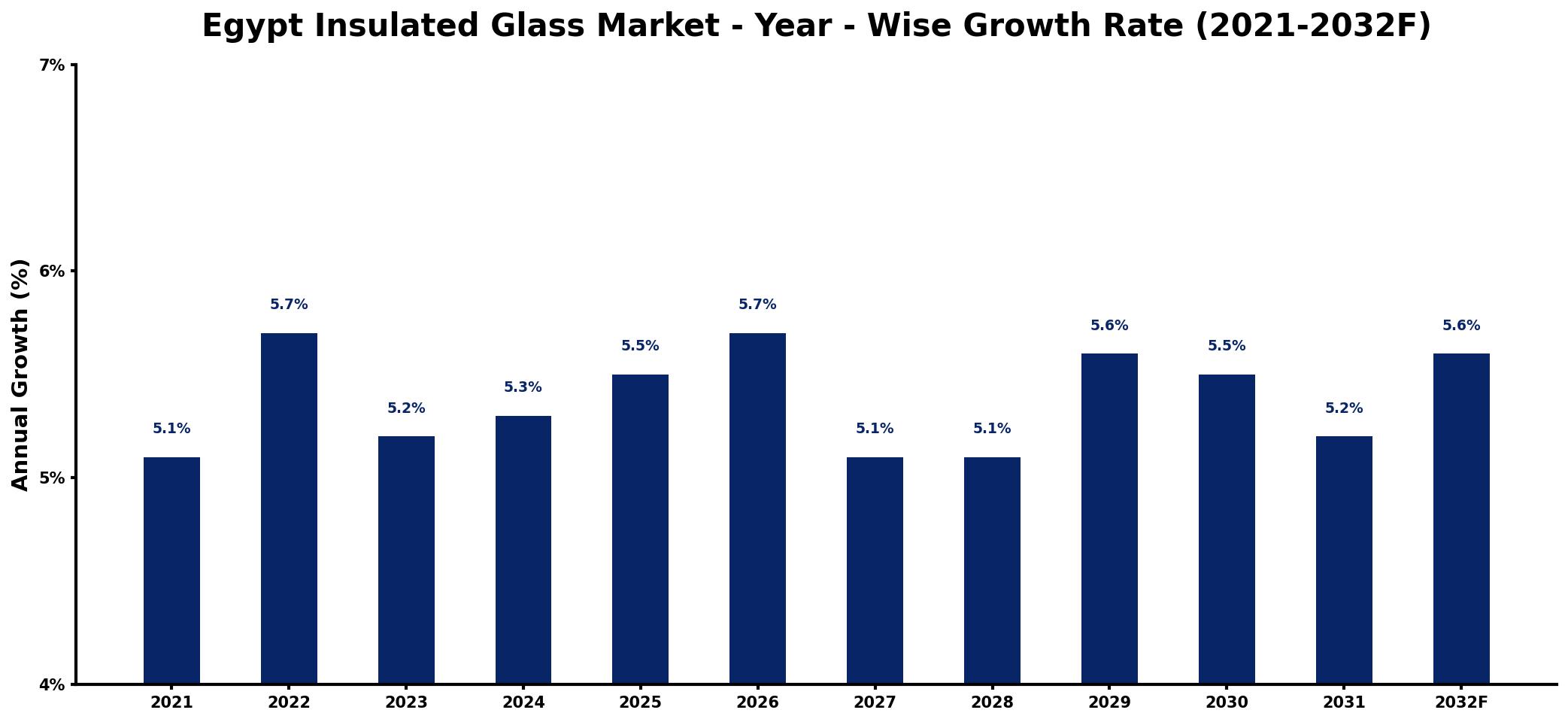
The table below presents the year‑wise growth rates along with the key drivers influencing the market
| Year | Growth Rate | Major Drivers |
| 2021 | 5.1% | Rising construction sector investments |
| 2022 | 5.7% | Increased energy efficiency regulations |
| 2023 | 5.2% | Growing residential renovation projects |
| 2024 | 5.3% | Surge in commercial building activity |
| 2025 | 5.5% | Expansion of green building initiatives |
| 2026 | 5.7% | Heightened consumer awareness sustainability |
| 2027 | 5.1% | Boost in urban development projects |
| 2028 | 5.1% | Strengthened architectural design trends |
| 2029 | 5.6% | Increased demand for energy savings |
| 2030 | 5.5% | Growing public infrastructure investments |
| 2031 | 5.2% | Rising preference for modern aesthetics |
| 2032 | 5.6% | Enhanced focus on thermal performance |
Note: Market size estimations and growth projections presented in this report are based on 6Wresearch's proprietary forecasting methodology, utilizing the latest available industry data, government publications, and primary research inputs.
Egypt Insulated Glass Market Synopsis
The Egypt Insulated Glass Market has recently gained momentum, largely driven by the construction industry's shift towards sustainable practices. This transition aligns with governmental regulations emphasizing energy-efficient building solutions. As urbanization continues to rise, the market is heading towards a robust future characterized by an increasing adoption of advanced glass technologies.
Moreover, consumer awareness regarding the advantages of insulated glass is gradually increasing, further propelling market demand. The introduction of smart glass options, which enhance functionality and energy savings, signals a transformative phase within the industry.
Egypt Insulated Glass Market Key Takeaways
- The market is expected to grow steadily due to rising construction activities.
- Government initiatives are actively promoting sustainable building materials.
- Advancements in manufacturing technology are enhancing product performance.
- Consumer awareness about energy efficiency and noise reduction is increasing.
- Investment opportunities are emerging from innovations in glass technologies.
Evaluation of Restraints in Egypt Insulated Glass Market
Despite the promising growth trajectory, the Egypt Insulated Glass Market faces notable restraints. The initial cost of insulated glass remains significantly higher than traditional alternatives, which can deter potential buyers. Furthermore, limited awareness among consumers regarding the long-term benefits of insulated glass—specifically energy savings and noise reduction—hinders broader market adoption. Compounding these issues, the presence of cheaper substitute materials can divert interest away from insulated options. Additionally, fluctuating economic conditions can affect the construction industry's stability, further impacting market demand.
Egypt Insulated Glass Market Trends
The market is currently experiencing a trend toward the integration of advanced manufacturing technologies, enhancing the thermal insulation capabilities of insulated glass. Increased focus on green building practices, spurred by regulatory frameworks, is encouraging wider adoption. Additionally, the rise of smart glass solutions reflects consumer interest in products that offer dynamic control over light and heat, indicating a shift toward multifunctional building materials.
Egypt Insulated Glass Market Opportunities
Significant investment opportunities exist in the Egypt Insulated Glass Market due to escalating demand for energy-efficient construction materials. Companies specializing in insulated glass manufacturing can leverage government incentives aimed at sustainable development. Furthermore, the evolving landscape of glass technology, with innovations such as self-tinting and energy-efficient glass, offers avenues for growth and differentiation in a competitive market.
Government Initiatives in the Egypt Insulated Glass Market
The Egyptian government is actively implementing policies designed to promote energy efficiency and sustainability in construction. Regulations now require new buildings to utilize energy-efficient materials, including insulated glass, as part of efforts to lower energy consumption and greenhouse gas emissions. Incentives such as tax breaks and subsidies are also provided to encourage the integration of insulated glass in building projects, which is expected to drive market growth significantly.
Future Insights of the Egypt Insulated Glass Market
Looking ahead to the period from 2026 to 2032, the Egypt Insulated Glass Market is anticipated to witness continued expansion. The persistent focus on energy-efficient building solutions, compounded by rising construction activities, will serve as major growth catalysts. Additionally, growing consumer awareness about the numerous advantages of insulated glass, particularly in terms of energy cost savings and indoor comfort, will sustain momentum. Advances in glass technology will further enhance market prospects, aligning with the broader trend of sustainable development.
Egypt Insulated Glass Market Latest Developments (2025 - 2026)
Recently, the insulated glass industry in Egypt has seen a surge in innovation and technological development aimed at improving product performance. Key industry players have begun to focus on the production of smart glass options, incorporating features that allow for dynamic light control. Furthermore, collaborations between manufacturers and government bodies are increasingly common as both sectors aim to align their goals towards sustainable construction practices.
Egypt Insulated Glass Market - Key Attractiveness of the Report
- 10 Years of Market Numbers
- Historical Data Starting from 2022 to 2025
- Base Year: 2025
- Forecast Data until 2032
- Key Performance Indicators Impacting the Market
- Major Upcoming Developments and Projects
Key Highlights of the Report:
- Egypt Insulated Glass Market Outlook
- Market Size of Egypt Insulated Glass Market, 2025
- Forecast of Egypt Insulated Glass Market, 2032
- Historical Data and Forecast of Egypt Insulated Glass Revenues & Volume for the Period 2022-2032F
- Egypt Insulated Glass Market Trend Evolution
- Egypt Insulated Glass Market Drivers and Challenges
- Egypt Insulated Glass Price Trends
- Egypt Insulated Glass Porter's Five Forces
- Egypt Insulated Glass Industry Life Cycle
- Historical Data and Forecast of Egypt Insulated Glass Market Revenues & Volume By Type for the Period 2022-2032F
- Historical Data and Forecast of Egypt Insulated Glass Market Revenues & Volume By Heated Insulating Glass for the Period 2022-2032F
- Historical Data and Forecast of Egypt Insulated Glass Market Revenues & Volume By Tempering Insulating Glass for the Period 2022-2032F
- Historical Data and Forecast of Egypt Insulated Glass Market Revenues & Volume By Custom Insulated Glass for the Period 2022-2032F
- Historical Data and Forecast of Egypt Insulated Glass Market Revenues & Volume By Other Glasses for the Period 2022-2032F
- Historical Data and Forecast of Egypt Insulated Glass Market Revenues & Volume By Application for the Period 2022-2032F
- Historical Data and Forecast of Egypt Insulated Glass Market Revenues & Volume By Doors & Partitions for the Period 2022-2032F
- Historical Data and Forecast of Egypt Insulated Glass Market Revenues & Volume By Kitchen Appliances & Cabinets for the Period 2022-2032F
- Historical Data and Forecast of Egypt Insulated Glass Market Revenues & Volume By Floors & Ceilings for the Period 2022-2032F
- Historical Data and Forecast of Egypt Insulated Glass Market Revenues & Volume By Furniture & Curtain Walls for the Period 2022-2032F
- Historical Data and Forecast of Egypt Insulated Glass Market Revenues & Volume By Railings & Bolted Structures for the Period 2022-2032F
- Historical Data and Forecast of Egypt Insulated Glass Market Revenues & Volume By Automotive Glasses for the Period 2022-2032F
- Historical Data and Forecast of Egypt Insulated Glass Market Revenues & Volume By End User for the Period 2022-2032F
- Historical Data and Forecast of Egypt Insulated Glass Market Revenues & Volume By Residential Buildings for the Period 2022-2032F
- Historical Data and Forecast of Egypt Insulated Glass Market Revenues & Volume By Commercial & Institutional Buildings for the Period 2022-2032F
- Historical Data and Forecast of Egypt Insulated Glass Market Revenues & Volume By Industrial Users for the Period 2022-2032F
- Egypt Insulated Glass Import Export Trade Statistics
- Market Opportunity Assessment By Type
- Market Opportunity Assessment By Application
- Market Opportunity Assessment By End User
- Egypt Insulated Glass Top Companies Market Share
- Egypt Insulated Glass Competitive Benchmarking By Technical and Operational Parameters
- Egypt Insulated Glass Company Profiles
- Egypt Insulated Glass Key Strategic Recommendations






































