Egypt IPTV Market Size, Share & Growth Rate
The Egypt IPTV Market was estimated at USD 803 Million in 2025 and is projected to reach USD 1161 Million by 2032, growing at a CAGR of 5.4% from 2026 to 2032. This robust growth trajectory is being fueled by the increasing consumer preference for on-demand content, alongside the rising penetration of affordable high-speed internet services across urban and rural areas. As Egyptian consumers embrace digital entertainment, IPTV providers are enhancing their offerings to capture a larger market share, further driving expansion.
Egypt IPTV Market Year-wise Growth Rate and Key Drivers
This graph highlights how the Egypt IPTV Market has steadily grown over the years, supported by major growth factors.
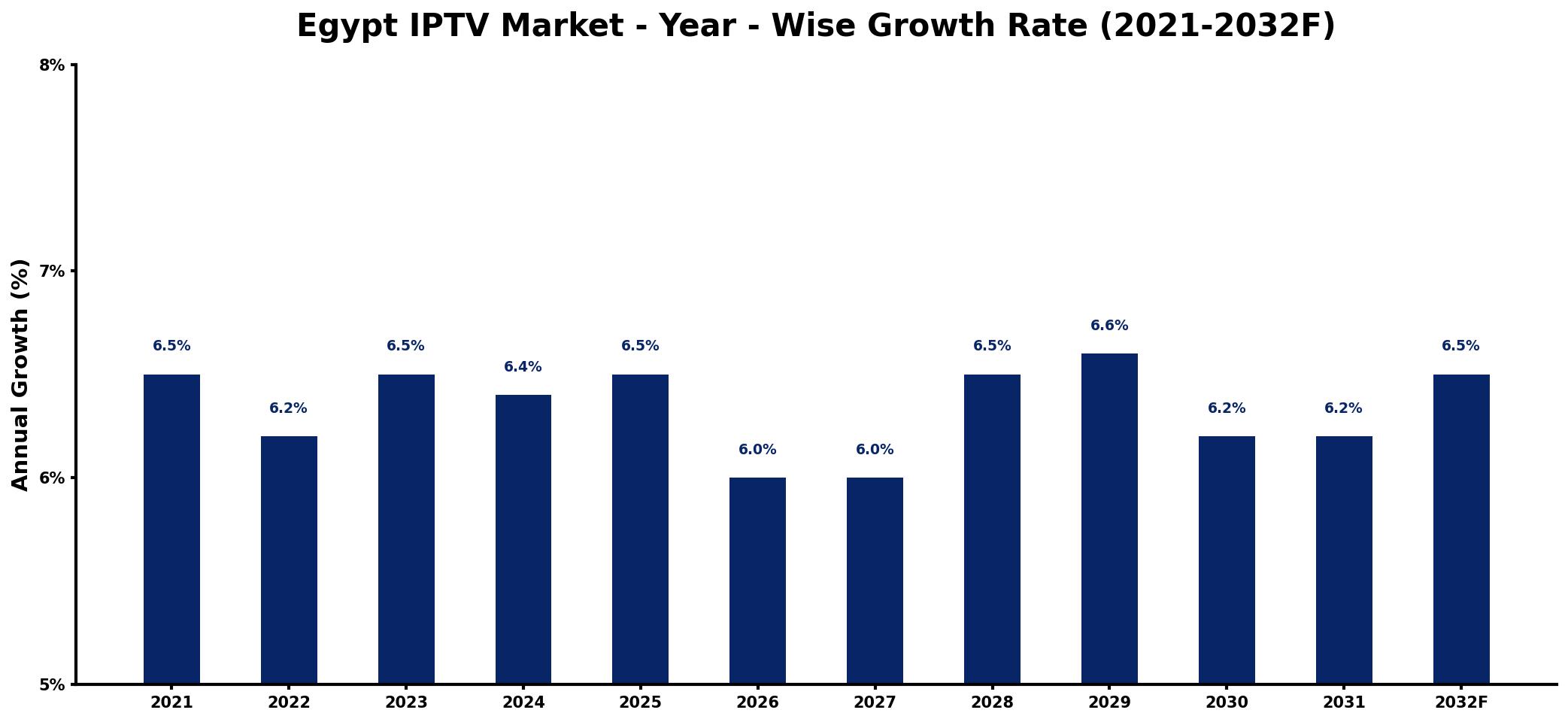
The table below presents the year‑wise growth rates along with the key drivers influencing the market
| Year | Growth Rate | Major Drivers |
| 2021 | 6.5% | Rising demand for streaming services |
| 2022 | 6.2% | Increased investment in digital infrastructure |
| 2023 | 6.5% | Expansion of content provider partnerships |
| 2024 | 6.4% | Growth in mobile internet accessibility |
| 2025 | 6.5% | Higher consumer adoption rates observed |
| 2026 | 6.0% | Emergence of new content genres |
| 2027 | 6.0% | Advancements in user interface design |
| 2028 | 6.5% | Boost in international content offerings |
| 2029 | 6.6% | Strengthened regulatory support initiatives |
| 2030 | 6.2% | Enhanced viewer engagement strategies implemented |
| 2031 | 6.2% | Development of local content production |
| 2032 | 6.5% | Wider availability of subscription models |
Note: Market size estimations and growth projections presented in this report are based on 6Wresearch's proprietary forecasting methodology, utilizing the latest available industry data, government publications, and primary research inputs.
Egypt IPTV Market Synopsis
The Egyptian IPTV market is witnessing a notable shift as audiences move away from traditional cable television in favor of internet-based solutions. This transition is not just about convenience but also about the diverse array of content that IPTV services provide, appealing to the varied tastes of Egyptian viewers.
Currently, the market is characterized by heightened competition as various service providers strive to deliver superior content and user experiences. With the ongoing digital transformation strategies supported by the government, the landscape is primed for significant developments in the near future, establishing Egypt as a burgeoning hub for digital media.
Egypt IPTV Market Key Takeaways
- Rapid consumer adoption of IPTV services is reshaping the media consumption landscape in Egypt.
- Affordable internet access is a primary driver of growth, enabling more users to engage with IPTV platforms.
- There is an increasing emphasis on high-quality content and enhanced viewing experiences from service providers.
- Regulatory frameworks are evolving to support IPTV growth while ensuring fair competition and consumer protection.
- Investment in internet infrastructure is crucial to overcome existing connectivity challenges and boost service quality.
Evaluation of Restraints in Egypt IPTV Market
Despite the promising outlook, the Egyptian IPTV market grapples with significant restraints that could hinder its momentum. A major concern is the inadequate infrastructure in various regions, where limited internet connectivity prevents seamless access to high-quality streaming services. This situation can lead to customer dissatisfaction and limit user base expansion. Additionally, the competitive threat posed by alternative streaming platforms creates pressure on traditional IPTV providers to continually innovate and enhance their offerings.
Moreover, the regulatory landscape presents complexities regarding content licensing and distribution, requiring service providers to navigate substantial compliance investments. As consumer preferences evolve, IPTV providers must remain agile, adapting their service portfolios to meet diverse viewer expectations amidst a saturated market.
Egypt IPTV Market Trends
One significant trend is the increasing popularity of bundled services that combine IPTV with internet and telecommunications offerings, appealing to budget-conscious consumers. Furthermore, the rise of interactive features, such as live streaming and real-time content recommendations, is enhancing user engagement. As technologies like 5G rollout, they are expected to further elevate IPTV service quality and accessibility, broadening market appeal.
Egypt IPTV Market Opportunities
The market holds significant growth opportunities for service providers who invest in high-quality, localized content tailored to Egyptian audiences. Additionally, partnerships with local content creators and media houses can enhance the attractiveness of IPTV offerings. As the government continues to push for digital transformation, investments in infrastructure present lucrative avenues for growth, potentially resulting in better service quality and increased user satisfaction.
Government Initiatives in the Egypt IPTV Market
The Egyptian government is actively promoting the expansion of the IPTV market through various initiatives aimed at digital transformation. Policies have been introduced to encourage telecom and media companies to provide IPTV services, ensuring fair competition and high-quality service delivery. Investments in high-speed internet infrastructure are being prioritized to enhance accessibility, while regulations are in place to protect intellectual property and foster a diverse range of content, reinforcing Egypts position as a significant player in the regional digital media landscape.
Future Insights of the Egypt IPTV Market
Looking ahead to 2026-2032, the Egypt IPTV market is set for remarkable transformation driven by continuous technological advancements and an ever-evolving content landscape. As consumers demand more personalized and interactive viewing experiences, IPTV providers will need to innovate continually to keep pace. The ongoing government support for digital initiatives will likely create a conducive environment for market growth, enabling increased investment in both infrastructure and content creation.
Egypt IPTV Market Latest Developments (2025 - 2026)
In recent months, the Egyptian IPTV landscape has seen a surge in interest from both consumers and investors. Efforts have been made to enhance user experience through upgraded technology and interface improvements, aiming to attract a broader audience. Additionally, local content production is gaining momentum as providers focus on curating content that resonates with Egyptian viewers. This shift aligns with the government's digital strategies, which are fostering a more vibrant media ecosystem.
Egypt IPTV Market - Key Attractiveness of the Report
- 10 Years of Market Numbers
- Historical Data Starting from 2022 to 2025
- Base Year: 2025
- Forecast Data until 2032
- Key Performance Indicators Impacting the Market
- Major Upcoming Developments and Projects
Key Highlights of the Report:
- Egypt IPTV Market Outlook
- Market Size of Egypt IPTV Market, 2025
- Forecast of Egypt IPTV Market, 2032
- Historical Data and Forecast of Egypt IPTV Revenues & Volume for the Period 2022-2032F
- Egypt IPTV Market Trend Evolution
- Egypt IPTV Market Drivers and Challenges
- Egypt IPTV Price Trends
- Egypt IPTV Porter's Five Forces
- Egypt IPTV Industry Life Cycle
- Historical Data and Forecast of Egypt IPTV Market Revenues & Volume By Component for the Period 2022-2032F
- Historical Data and Forecast of Egypt IPTV Market Revenues & Volume By Hardware (Router, Set-top Box, Receiver, Encoder) for the Period 2022-2032F
- Historical Data and Forecast of Egypt IPTV Market Revenues & Volume By Services (In-house services, Managed services) for the Period 2022-2032F
- Historical Data and Forecast of Egypt IPTV Market Revenues & Volume By Software for the Period 2022-2032F
- Historical Data and Forecast of Egypt IPTV Market Revenues & Volume By Transmission Type for the Period 2022-2032F
- Historical Data and Forecast of Egypt IPTV Market Revenues & Volume By Wired for the Period 2022-2032F
- Historical Data and Forecast of Egypt IPTV Market Revenues & Volume By Wireless for the Period 2022-2032F
- Historical Data and Forecast of Egypt IPTV Market Revenues & Volume By Streaming Type for the Period 2022-2032F
- Historical Data and Forecast of Egypt IPTV Market Revenues & Volume By Non-Video Television for the Period 2022-2032F
- Historical Data and Forecast of Egypt IPTV Market Revenues & Volume By Video Television for the Period 2022-2032F
- Historical Data and Forecast of Egypt IPTV Market Revenues & Volume By Subscription Type for the Period 2022-2032F
- Historical Data and Forecast of Egypt IPTV Market Revenues & Volume By Subscription-based IPTV for the Period 2022-2032F
- Historical Data and Forecast of Egypt IPTV Market Revenues & Volume By Subscription free IPTV for the Period 2022-2032F
- Historical Data and Forecast of Egypt IPTV Market Revenues & Volume By Device Type for the Period 2022-2032F
- Historical Data and Forecast of Egypt IPTV Market Revenues & Volume By Smartphones and tablets for the Period 2022-2032F
- Historical Data and Forecast of Egypt IPTV Market Revenues & Volume By Smart TVs for the Period 2022-2032F
- Historical Data and Forecast of Egypt IPTV Market Revenues & Volume By Desktops and laptops for the Period 2022-2032F
- Historical Data and Forecast of Egypt IPTV Market Revenues & Volume By Application for the Period 2022-2032F
- Historical Data and Forecast of Egypt IPTV Market Revenues & Volume By Linear Television for the Period 2022-2032F
- Historical Data and Forecast of Egypt IPTV Market Revenues & Volume By Non-linear Television for the Period 2022-2032F
- Historical Data and Forecast of Egypt IPTV Market Revenues & Volume By End User for the Period 2022-2032F
- Historical Data and Forecast of Egypt IPTV Market Revenues & Volume By SMEs for the Period 2022-2032F
- Historical Data and Forecast of Egypt IPTV Market Revenues & Volume By Large Enterprises for the Period 2022-2032F
- Historical Data and Forecast of Egypt IPTV Market Revenues & Volume By Residential customers for the Period 2022-2032F
- Historical Data and Forecast of Egypt IPTV Market Revenues & Volume By Vertical for the Period 2022-2032F
- Historical Data and Forecast of Egypt IPTV Market Revenues & Volume By Advertising and marketing for the Period 2022-2032F
- Historical Data and Forecast of Egypt IPTV Market Revenues & Volume By Media and entertainment for the Period 2022-2032F
- Historical Data and Forecast of Egypt IPTV Market Revenues & Volume By Gaming for the Period 2022-2032F
- Historical Data and Forecast of Egypt IPTV Market Revenues & Volume By Online stores for the Period 2022-2032F
- Historical Data and Forecast of Egypt IPTV Market Revenues & Volume By Telecom and IT for the Period 2022-2032F
- Historical Data and Forecast of Egypt IPTV Market Revenues & Volume By Healthcare and medical for the Period 2022-2032F
- Historical Data and Forecast of Egypt IPTV Market Revenues & Volume By Other Verticals (education and manufacturing). for the Period 2022-2032F
- Egypt IPTV Import Export Trade Statistics
- Market Opportunity Assessment By Component
- Market Opportunity Assessment By Transmission Type
- Market Opportunity Assessment By Streaming Type
- Market Opportunity Assessment By Subscription Type
- Market Opportunity Assessment By Device Type
- Market Opportunity Assessment By Application
- Market Opportunity Assessment By End User
- Market Opportunity Assessment By Vertical
- Egypt IPTV Top Companies Market Share
- Egypt IPTV Competitive Benchmarking By Technical and Operational Parameters
- Egypt IPTV Company Profiles
- Egypt IPTV Key Strategic Recommendations






































