Egypt Passive Fire Protection Market Size, Share & Growth Rate
The Egypt Passive Fire Protection Market was estimated at USD 343 Million in 2025 and is projected to reach USD 481 Million by 2032, growing at a CAGR of 4.9% from 2026 to 2032. This promising trajectory is fueled by heightened awareness around fire safety regulations, coupled with an expanding construction sector that increasingly prioritizes safety standards. The presence of government mandates for passive fire protection installations further underscores the markets potential as infrastructure developments surge.
Egypt Passive Fire Protection Market Year-wise Growth Rate and Key Drivers
This graph highlights how the Egypt Passive Fire Protection Market has steadily grown over the years, supported by major growth factors.
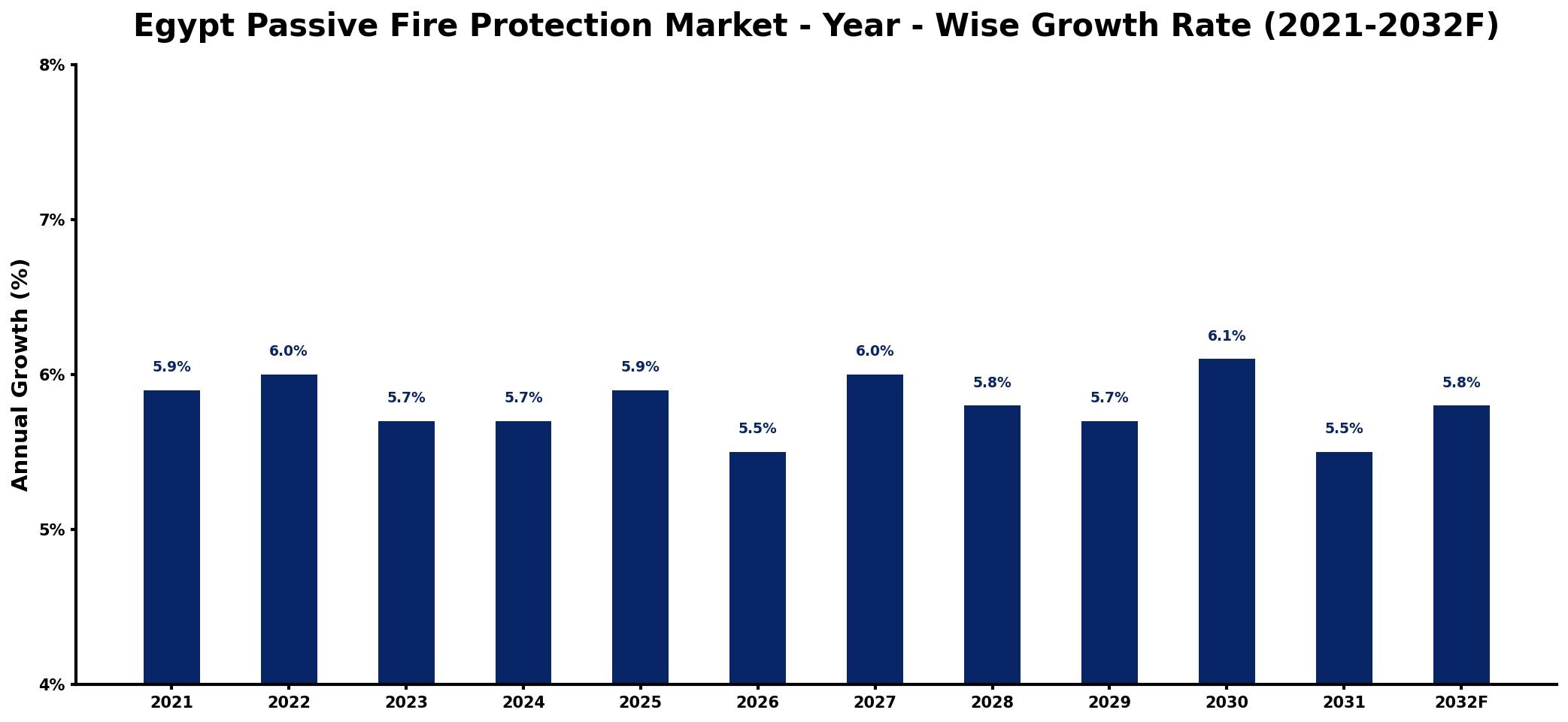
The table below presents the year‑wise growth rates along with the key drivers influencing the market
| Year | Growth Rate | Major Drivers |
| 2021 | 5.9% | Rising construction sector investments |
| 2022 | 6.0% | Increased safety regulations enforcement |
| 2023 | 5.7% | Growing awareness of safety standards |
| 2024 | 5.7% | Expansion in commercial real estate |
| 2025 | 5.9% | Surge in infrastructure development projects |
| 2026 | 5.5% | Increased focus on sustainability practices |
| 2027 | 6.0% | Higher demand from industrial sector |
| 2028 | 5.8% | Growth in residential building projects |
| 2029 | 5.7% | Investments in public safety initiatives |
| 2030 | 6.1% | Technological advancements in safety solutions |
| 2031 | 5.5% | Increased urbanization and population growth |
| 2032 | 5.8% | Expansion of logistics and warehousing |
Note: Market size estimations and growth projections presented in this report are based on 6Wresearch's proprietary forecasting methodology, utilizing the latest available industry data, government publications, and primary research inputs.
Egypt Passive Fire Protection Market Synopsis
The Egypt Passive Fire Protection Market has gained momentum recently, driven by the urgent need for fire safety measures across various sectors. As Egypt witnesses a boom in both commercial and residential construction, the demand for effective passive fire protection solutions is on the rise. However, despite this growth, significant challenges remain, primarily regarding the enforcement of regulations and product quality.
Looking ahead, the market is anticipated to continue evolving as technological advancements and innovations are embraced. Emerging products and better materials are set to improve fire resistance and meet the new standards being established across the industry. Consequently, the focus on enhancing safety protocols ensures that the market remains dynamic and responsive to both regulatory changes and consumer needs.
Egypt Passive Fire Protection Market Key Takeaways
- Increased awareness of fire safety regulations is a key driver of market growth.
- The construction sector is experiencing a surge in demand for passive fire protection products.
- Strict government regulations are mandating the installation of effective fire safety systems.
- Technological advancements are leading to innovative solutions in fire protection.
- Opportunities for investment exist through partnerships with local manufacturers and distributors.
Evaluation of Restraints in Egypt Passive Fire Protection Market
The growth of the Egypt Passive Fire Protection Market faces several restraints that hinder its full potential. A primary concern is the inconsistent enforcement of existing building codes and fire safety regulations, which often leads to non-compliance. Many property developers and owners remain unaware of the critical importance of passive fire protection measures, further complicating market growth. Moreover, the prevalence of low-quality and counterfeit products poses significant risks, as they may not meet the required safety standards, thereby jeopardizing both lives and properties.
Egypt Passive Fire Protection Market Trends
The Egypt Passive Fire Protection Market is currently shaped by several notable trends. There is a significant shift towards advanced technologies and materials that enhance fire resistance, such as innovative fire-resistant coatings and composite materials. Furthermore, the growing emphasis on sustainability in construction is driving demand for eco-friendly fire protection solutions. Companies are increasingly investing in research and development to create more effective and safer products, aligning their offerings with the latest safety regulations and market demands.
Egypt Passive Fire Protection Market Opportunities
Investors looking at the Egypt Passive Fire Protection Market will find numerous opportunities for growth. The rising number of infrastructure projects, particularly high-rise buildings, creates an urgent need for passive fire protection solutions. Investment areas that are particularly promising include fire-resistant coatings, fire-rated doors, and sealants. Additionally, as awareness of fire safety continues to grow, partnerships with local firms for product distribution can facilitate market entry and expansion.
Government Initiatives in the Egypt Passive Fire Protection Market
The Egyptian government has implemented robust regulations aimed at enhancing fire safety in buildings, directly impacting the demand for passive fire protection systems. The Ministry of Housing, Utilities, and Urban Communities, alongside the Civil Protection Authority, plays a pivotal role in enforcing compliance with fire safety standards. Recent initiatives have also focused on raising awareness regarding fire safety, indicating a commitment to improving overall safety infrastructure in the nation.
Future Insights of the Egypt Passive Fire Protection Market
As we look toward 2026 and beyond, the Egypt Passive Fire Protection Market is projected to experience sustained growth. The ongoing expansion in the construction sector, particularly in urban areas, coupled with stringent regulations mandating safety installations, will drive demand for advanced fire protection solutions. Additionally, the growing emphasis on retrofitting existing structures with updated safety measures will further catalyze market expansion, ensuring that fire safety becomes an integral component of Egypt's development strategy.
Egypt Passive Fire Protection Market Latest Developments (2025 - 2026)
In the recent months, the Egypt Passive Fire Protection Market has seen a notable shift towards innovative solutions that prioritize safety and sustainability. Companies are launching new product lines that incorporate cutting-edge technologies and materials, aimed at improving fire resistance in various building types. Additionally, strategic collaborations between manufacturers and local construction firms are becoming more common, fostering a shared commitment to meeting heightened safety standards across the industry.
Egypt Passive Fire Protection Market - Key Attractiveness of the Report
- 10 Years of Market Numbers
- Historical Data Starting from 2022 to 2025
- Base Year: 2025
- Forecast Data until 2032
- Key Performance Indicators Impacting the Market
- Major Upcoming Developments and Projects
The market was estimated at USD 343 Million in 2025 and is projected to reach USD 481 Million by 2032, growing at a CAGR of 4.9% from 2026 to 2032.
Key Highlights of the Report:
- Egypt Passive Fire Protection Market Outlook
- Market Size of Egypt Passive Fire Protection Market, 2025
- Forecast of Egypt Passive Fire Protection Market, 2032
- Historical Data and Forecast of Egypt Passive Fire Protection Revenues & Volume for the Period 2022-2032F
- Egypt Passive Fire Protection Market Trend Evolution
- Egypt Passive Fire Protection Market Drivers and Challenges
- Egypt Passive Fire Protection Price Trends
- Egypt Passive Fire Protection Porter's Five Forces
- Egypt Passive Fire Protection Industry Life Cycle
- Historical Data and Forecast of Egypt Passive Fire Protection Market Revenues & Volume By Product for the Period 2022-2032F
- Historical Data and Forecast of Egypt Passive Fire Protection Market Revenues & Volume By Cementitious Materials for the Period 2022-2032F
- Historical Data and Forecast of Egypt Passive Fire Protection Market Revenues & Volume By Intumescent Coatings for the Period 2022-2032F
- Historical Data and Forecast of Egypt Passive Fire Protection Market Revenues & Volume By Fireproofing Cladding for the Period 2022-2032F
- Historical Data and Forecast of Egypt Passive Fire Protection Market Revenues & Volume By Others for the Period 2022-2032F
- Historical Data and Forecast of Egypt Passive Fire Protection Market Revenues & Volume By Application for the Period 2022-2032F
- Historical Data and Forecast of Egypt Passive Fire Protection Market Revenues & Volume By Oil & Gas for the Period 2022-2032F
- Historical Data and Forecast of Egypt Passive Fire Protection Market Revenues & Volume By Construction for the Period 2022-2032F
- Historical Data and Forecast of Egypt Passive Fire Protection Market Revenues & Volume By Industrial for the Period 2022-2032F
- Historical Data and Forecast of Egypt Passive Fire Protection Market Revenues & Volume By Warehousing for the Period 2022-2032F
- Historical Data and Forecast of Egypt Passive Fire Protection Market Revenues & Volume By Others for the Period 2022-2032F
- Egypt Passive Fire Protection Import Export Trade Statistics
- Market Opportunity Assessment By Product
- Market Opportunity Assessment By Application
- Egypt Passive Fire Protection Top Companies Market Share
- Egypt Passive Fire Protection Competitive Benchmarking By Technical and Operational Parameters
- Egypt Passive Fire Protection Company Profiles
- Egypt Passive Fire Protection Key Strategic Recommendations






































