Estonia Bean-To-Bar Chocolate Market Size (2020-2030)
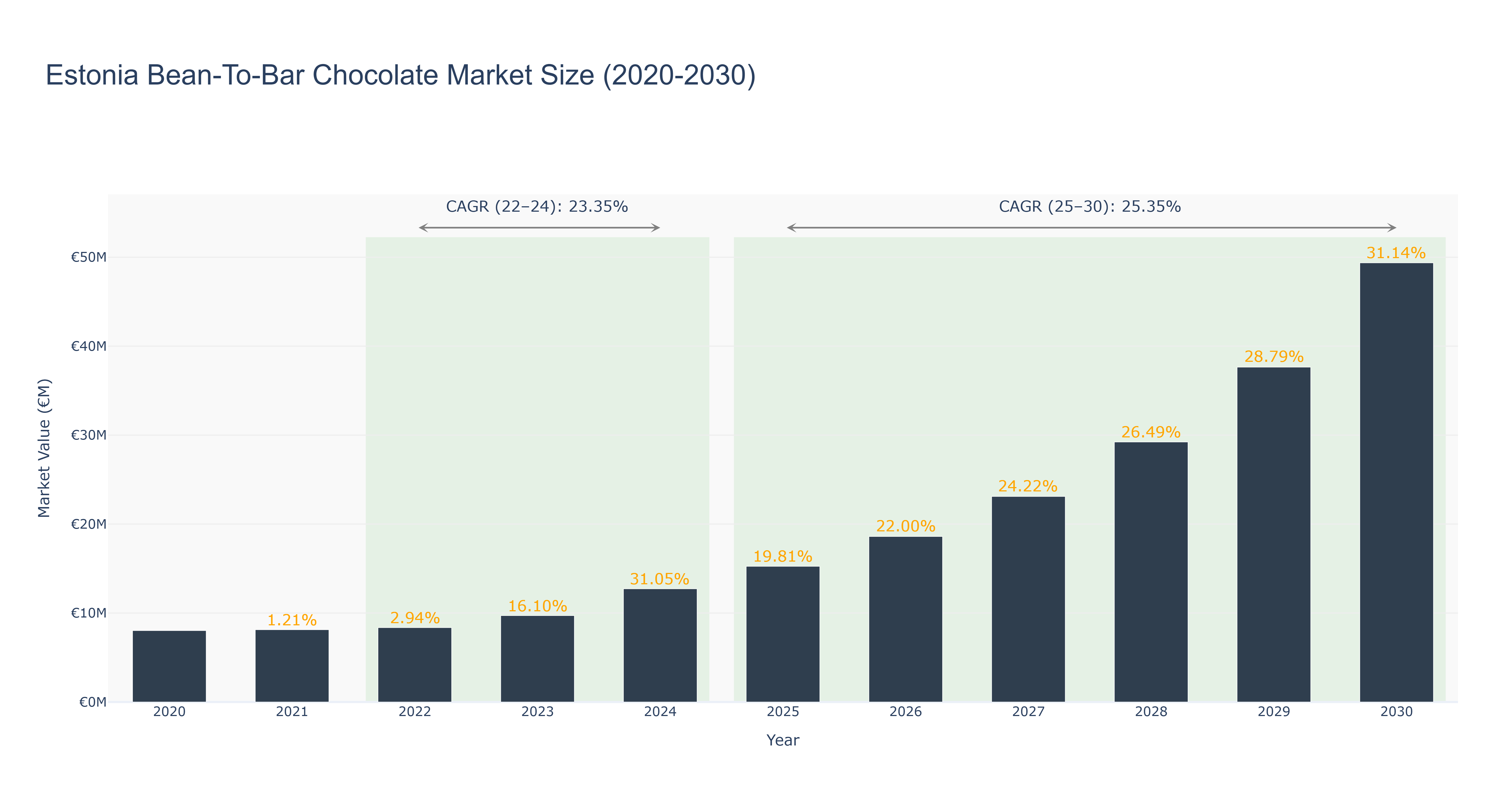
The Estonia Bean-To-Bar Chocolate Market has shown a remarkable growth trajectory over the years, with the market size reaching €49.37 million in 2030. The peak market size was observed in 2030, marking a significant increase from €8.03 million in 2020. The actual market size saw steady growth from €8.03 million in 2020 to €12.73 million in 2024, driven by increasing consumer demand and product innovation. The forecasted market size is expected to continue its upward trend, with a CAGR of 25.35% from 2025 to 2030. The market's growth can be attributed to factors such as rising disposable income, changing consumer preferences towards premium chocolate products, and a growing focus on sustainable and ethically sourced ingredients. In the near future, Estonia is set to witness new investments in chocolate manufacturing facilities, aiming to further boost the market's growth and competitiveness.
Estonia Bean-To-Bar Chocolate Market: Production & Trade Performance (2019-2025)
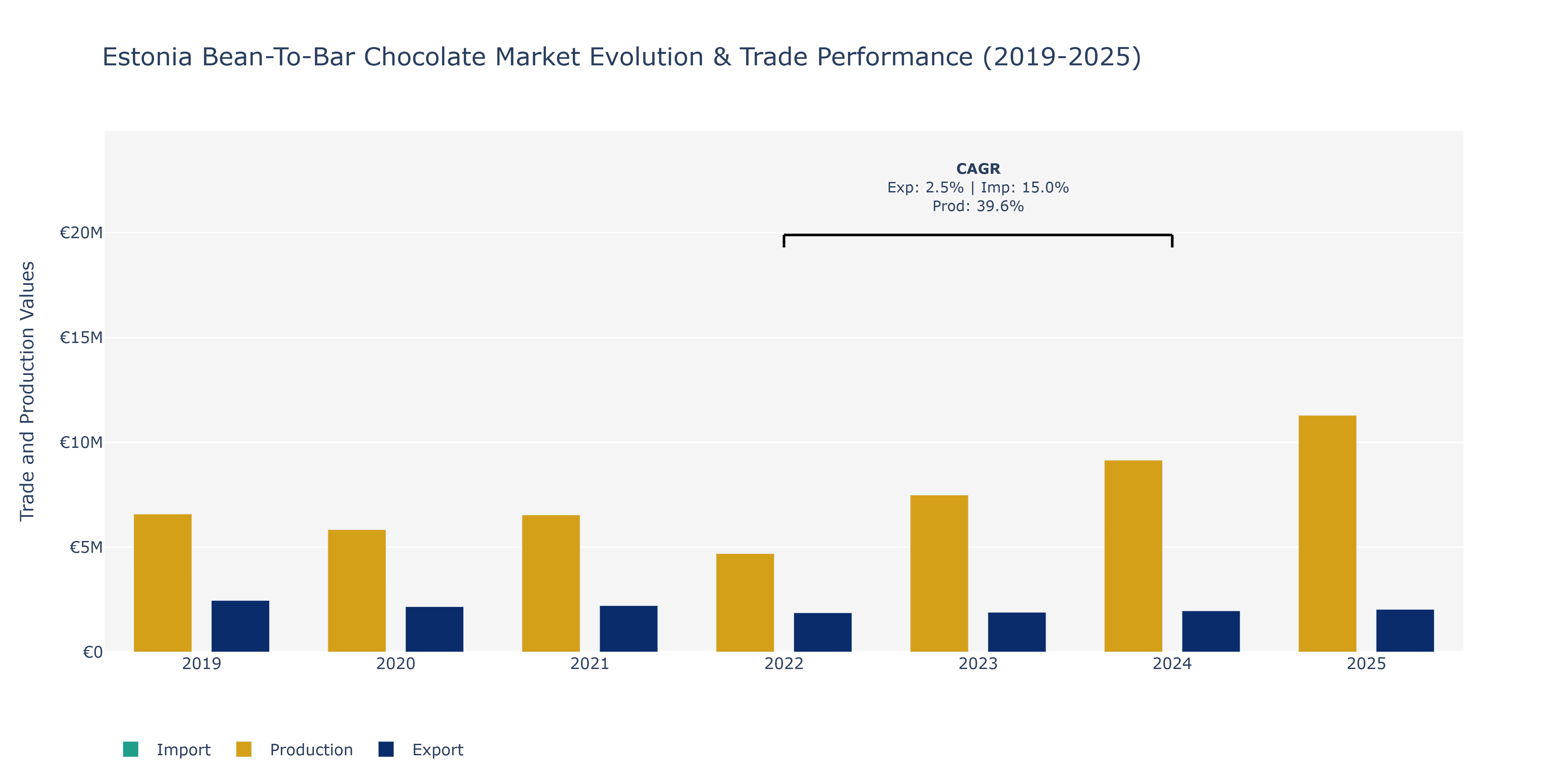
Between 2019 and 2025, the Estonia Bean-To-Bar Chocolate Market saw fluctuations in exports, imports, and production. In 2019, production peaked at €6.58 billion, while exports stood at €2.46 million and imports at €3.67 million. By 2022, there was a notable decline in exports to €1.87 million, which could be attributed to changing consumer preferences or global economic conditions impacting demand. However, imports surged to €4.32 million in the same year, possibly due to increased demand for raw materials or fluctuations in currency exchange rates. The production also declined to €4.70 billion in 2022, possibly reflecting challenges in the supply chain or production processes. Subsequently, by 2025, all metrics rebounded, with exports at €2.04 million, imports at €6.47 million, and production at €11.30 billion, indicating a potential recovery in market demand and operational efficiencies. External factors like international trade policies, evolving consumer tastes, and global economic conditions could have influenced these trends. To sustain growth, market players may need to adapt through product innovation, supply chain optimization, and strategic partnerships to navigate market uncertainties.
Key Highlights of the Report:
- Estonia Bean-To-Bar Chocolate Market Outlook
- Market Size of Estonia Bean-To-Bar Chocolate Market, 2025
- Forecast of Estonia Bean-To-Bar Chocolate Market, 2032
- Historical Data and Forecast of Estonia Bean-To-Bar Chocolate Revenues & Volume for the Period 2022 - 2032
- Estonia Bean-To-Bar Chocolate Market Trend Evolution
- Estonia Bean-To-Bar Chocolate Market Drivers and Challenges
- Estonia Bean-To-Bar Chocolate Price Trends
- Estonia Bean-To-Bar Chocolate Porter's Five Forces
- Estonia Bean-To-Bar Chocolate Industry Life Cycle
- Historical Data and Forecast of Estonia Bean-To-Bar Chocolate Market Revenues & Volume By Type for the Period 2022 - 2032
- Historical Data and Forecast of Estonia Bean-To-Bar Chocolate Market Revenues & Volume By Dark Chocolate for the Period 2022 - 2032
- Historical Data and Forecast of Estonia Bean-To-Bar Chocolate Market Revenues & Volume By Milk Chocolate for the Period 2022 - 2032
- Historical Data and Forecast of Estonia Bean-To-Bar Chocolate Market Revenues & Volume By White Chocolate for the Period 2022 - 2032
- Historical Data and Forecast of Estonia Bean-To-Bar Chocolate Market Revenues & Volume By Chocolate Bean for the Period 2022 - 2032
- Historical Data and Forecast of Estonia Bean-To-Bar Chocolate Market Revenues & Volume By Others for the Period 2022 - 2032
- Historical Data and Forecast of Estonia Bean-To-Bar Chocolate Market Revenues & Volume By Application for the Period 2022 - 2032
- Historical Data and Forecast of Estonia Bean-To-Bar Chocolate Market Revenues & Volume By Supermarkets for the Period 2022 - 2032
- Historical Data and Forecast of Estonia Bean-To-Bar Chocolate Market Revenues & Volume By Convenience Stores for the Period 2022 - 2032
- Historical Data and Forecast of Estonia Bean-To-Bar Chocolate Market Revenues & Volume By Independent Retailers for the Period 2022 - 2032
- Historical Data and Forecast of Estonia Bean-To-Bar Chocolate Market Revenues & Volume By Online Sales for the Period 2022 - 2032
- Historical Data and Forecast of Estonia Bean-To-Bar Chocolate Market Revenues & Volume By Others for the Period 2022 - 2032
- Estonia Bean-To-Bar Chocolate Import Export Trade Statistics
- Market Opportunity Assessment By Type
- Market Opportunity Assessment By Application
- Estonia Bean-To-Bar Chocolate Top Companies Market Share
- Estonia Bean-To-Bar Chocolate Competitive Benchmarking By Technical and Operational Parameters
- Estonia Bean-To-Bar Chocolate Company Profiles
- Estonia Bean-To-Bar Chocolate Key Strategic Recommendations






































