Estonia Smart Thermostat Market Size (2020-2030)
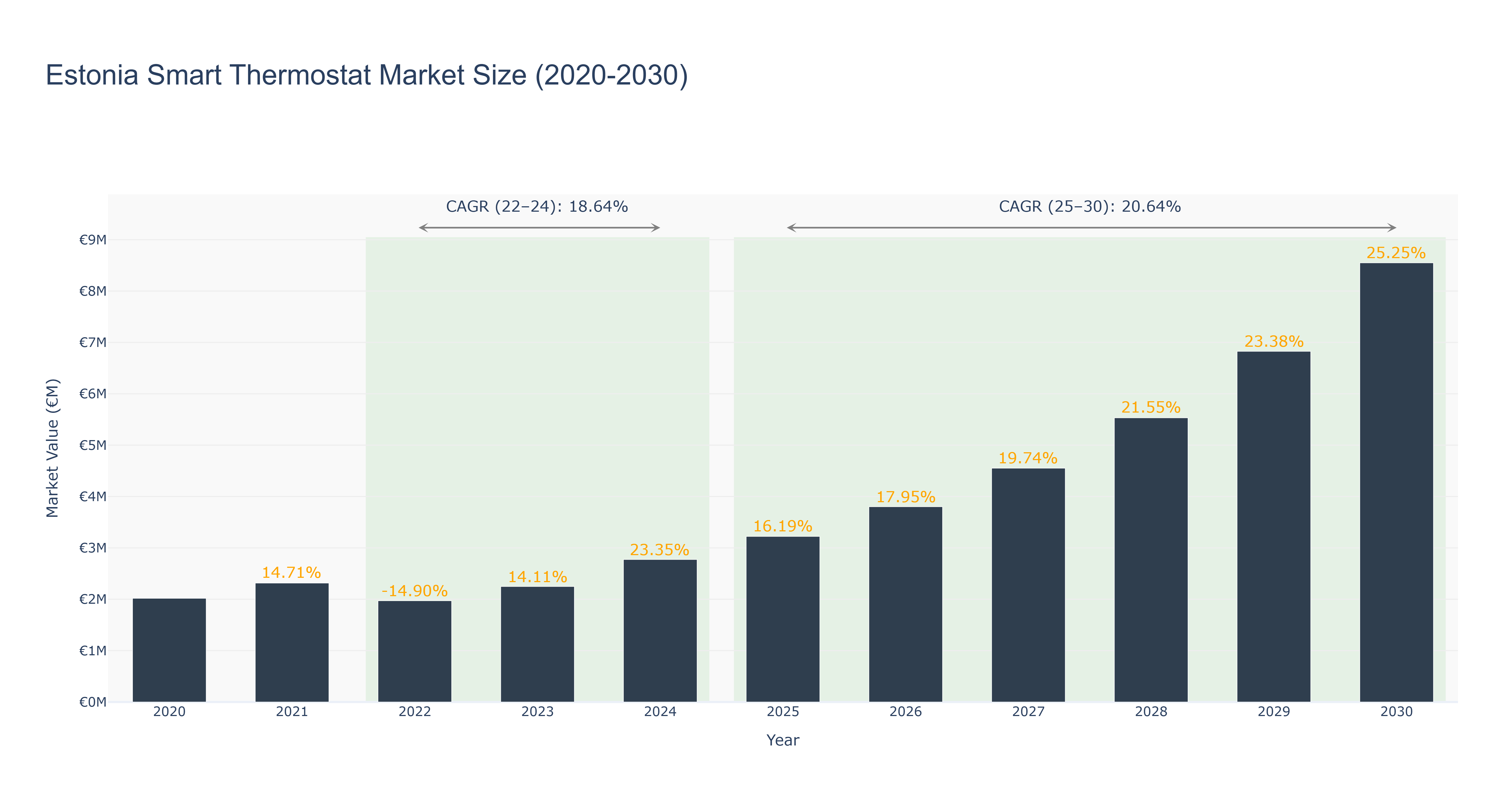
The Estonia Smart Thermostat Market has shown a promising growth trajectory. The peak market size was €8.55 million in 2030, with a steady increase from €2.02 million in 2020. The actual market size experienced fluctuations, notably a dip in 2022 to €1.97 million due to economic challenges, followed by a significant rebound to €2.77 million in 2024 driven by increased consumer demand. Forecasted market size from 2025 to 2030 is projected to reach €8.55 million, with a CAGR of 20.64% from 2025-2030. The market's growth is primarily fueled by rising awareness of energy efficiency and smart home technologies, driving the adoption of smart thermostats. Recent developments include collaborations with local utility companies to offer energy-saving incentives, paving the way for further market expansion in Estonia.
Estonia Smart Thermostat Market: Production & Trade Performance (2019-2025)
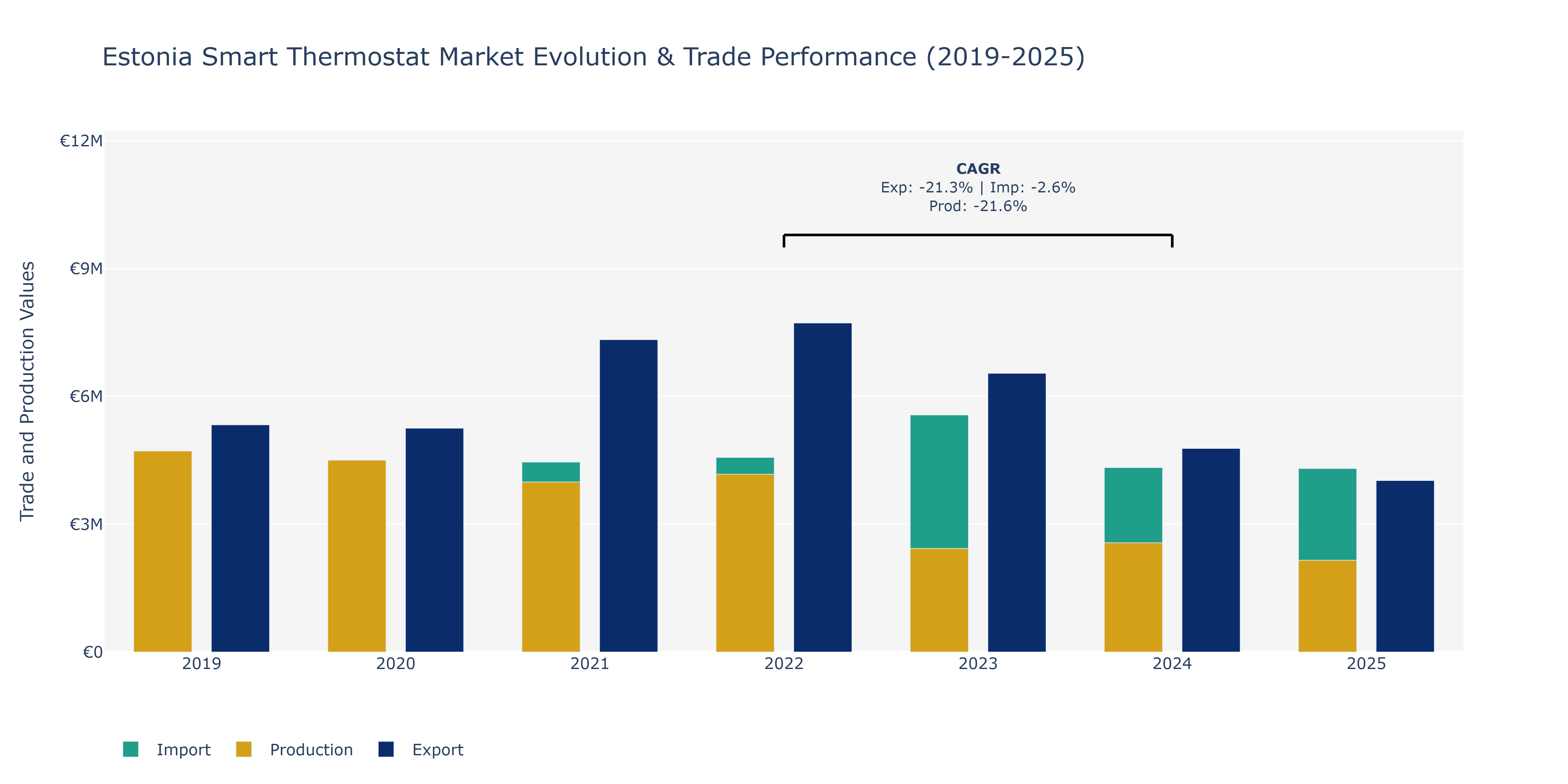
Between 2019 and 2025, the Estonia Smart Thermostat Market witnessed notable fluctuations in Exports, Imports, and Production. Exports peaked in 2021 at €7.33 million and then experienced a decline in 2025 to around €4.03 million. Imports showed a steady increase from €1.69 million in 2019 to €4.56 million in 2022 before declining slightly to approximately €4.31 million in 2025. Production, on the other hand, saw a decrease from €4.72 million in 2019 to €2.43 million in 2023, before stabilizing around €2.16 million in 2025. These fluctuations may be attributed to various factors such as changes in global demand for smart thermostats, advancements in technology affecting production efficiencies, and evolving trade relationships impacting import and export dynamics. The decline in production could be tied to shifts in consumer preferences or regulatory changes influencing market demand. To maintain market competitiveness, companies in the Estonia Smart Thermostat Market may need to focus on innovation, cost-efficiency, and adapting to changing market conditions.
Key Highlights of the Report:
- Estonia Smart Thermostat Market Outlook
- Market Size of Estonia Smart Thermostat Market, 2025
- Forecast of Estonia Smart Thermostat Market, 2032
- Historical Data and Forecast of Estonia Smart Thermostat Revenues & Volume for the Period 2022 - 2032F
- Estonia Smart Thermostat Market Trend Evolution
- Estonia Smart Thermostat Market Drivers and Challenges
- Estonia Smart Thermostat Price Trends
- Estonia Smart Thermostat Porter`s Five Forces
- Estonia Smart Thermostat Industry Life Cycle
- Historical Data and Forecast of Estonia Smart Thermostat Market Revenues & Volume By Type for the Period 2022 - 2032F
- Historical Data and Forecast of Estonia Smart Thermostat Market Revenues & Volume By Wireless for the Period 2022 - 2032F
- Historical Data and Forecast of Estonia Smart Thermostat Market Revenues & Volume By Wireless for the Period 2022 - 2032F
- Historical Data and Forecast of Estonia Smart Thermostat Market Revenues & Volume By End-User Vertical for the Period 2022 - 2032F
- Historical Data and Forecast of Estonia Smart Thermostat Market Revenues & Volume By Residential for the Period 2022 - 2032F
- Historical Data and Forecast of Estonia Smart Thermostat Market Revenues & Volume By Commercial for the Period 2022 - 2032F
- Estonia Smart Thermostat Import Export Trade Statistics
- Market Opportunity Assessment By Type
- Market Opportunity Assessment By End-User Vertical
- Estonia Smart Thermostat Top Companies Market Share
- Estonia Smart Thermostat Competitive Benchmarking By Technical and Operational Parameters
- Estonia Smart Thermostat Company Profiles
- Estonia Smart Thermostat Key Strategic Recommendations






































