Fiji Construction Aggregates Market Size Growth Rate
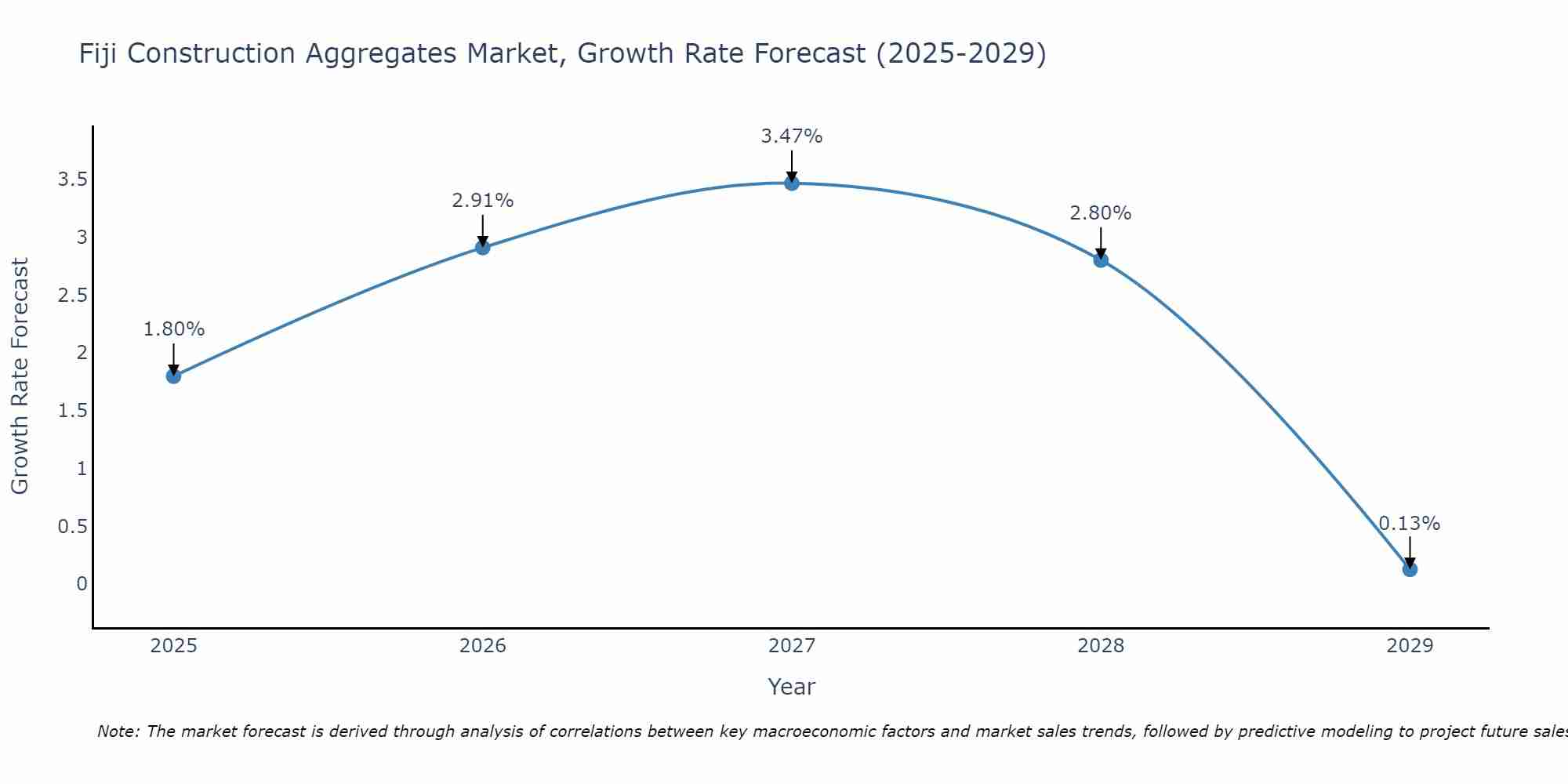
The Fiji Construction Aggregates Market is projected to witness mixed growth rate patterns during 2025 to 2029. Growth accelerates to 3.47% in 2027, following an initial rate of 1.80%, before easing to 0.13% at the end of the period.
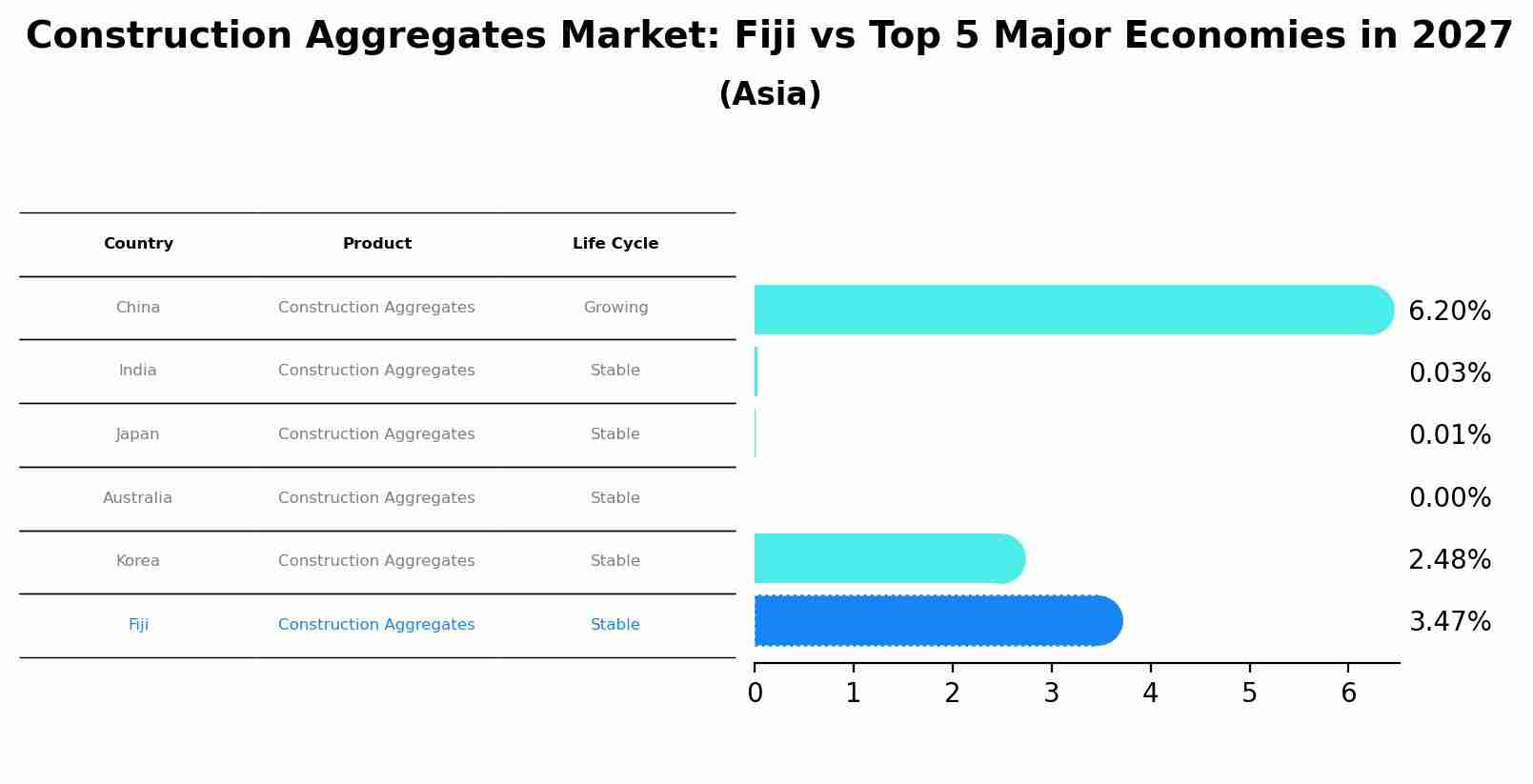
Construction Aggregates Market: Fiji vs Top 5 Major Economies in 2027 (Asia)
The Construction Aggregates market in Fiji is projected to grow at a stable growth rate of 3.47% by 2027, within the Asia region led by China, along with other countries like India, Japan, Australia and South Korea, collectively shaping a dynamic and evolving market environment driven by innovation and increasing adoption of emerging technologies.
Fiji Construction Aggregates Market Overview
The construction aggregates market in Fiji is poised for growth with the increasing demand for materials used in building infrastructure projects. Aggregates such as sand, gravel, and crushed stone are critical for making concrete, asphalt, and other construction materials. As Fiji`s construction sector grows in response to urban development, the market for construction aggregates will expand, supported by increasing residential, commercial, and industrial construction projects.
Drivers of the market
The construction aggregates market in Fiji is expanding due to the growing construction industry. As infrastructure development accelerates and urbanization increases, the demand for aggregates such as sand, gravel, and crushed stones used in the production of concrete, road construction, and other building projects is on the rise.
Challenges of the market
The construction aggregates market in Fiji faces challenges due to the limited availability of locally sourced raw materials. Most aggregates, including sand, gravel, and crushed stones, need to be imported from neighboring countries, leading to high transportation costs and delays in supply. The small scale of Fiji`s construction industry also restricts the demand for large quantities of aggregates, which limits the ability for businesses to achieve economies of scale. Additionally, environmental regulations and the limited availability of land for quarrying further complicate the supply of aggregates.
Government Policy of the market
Fijis policies prioritize sustainable quarrying practices to balance infrastructure development with environmental conservation. Investment in public infrastructure projects is a major driver for the aggregates market.
Key Highlights of the Report:
- Fiji Construction Aggregates Market Outlook
- Market Size of Fiji Construction Aggregates Market, 2024
- Forecast of Fiji Construction Aggregates Market, 2031
- Historical Data and Forecast of Fiji Construction Aggregates Revenues & Volume for the Period 2021-2031
- Fiji Construction Aggregates Market Trend Evolution
- Fiji Construction Aggregates Market Drivers and Challenges
- Fiji Construction Aggregates Price Trends
- Fiji Construction Aggregates Porter`s Five Forces
- Fiji Construction Aggregates Industry Life Cycle
- Historical Data and Forecast of Fiji Construction Aggregates Market Revenues & Volume By Product Type for the Period 2021-2031
- Historical Data and Forecast of Fiji Construction Aggregates Market Revenues & Volume By Crushed stone for the Period 2021-2031
- Historical Data and Forecast of Fiji Construction Aggregates Market Revenues & Volume By Sand for the Period 2021-2031
- Historical Data and Forecast of Fiji Construction Aggregates Market Revenues & Volume By Gravel for the Period 2021-2031
- Historical Data and Forecast of Fiji Construction Aggregates Market Revenues & Volume By Other aggregates for the Period 2021-2031
- Historical Data and Forecast of Fiji Construction Aggregates Market Revenues & Volume By Applications for the Period 2021-2031
- Historical Data and Forecast of Fiji Construction Aggregates Market Revenues & Volume By Commercial for the Period 2021-2031
- Historical Data and Forecast of Fiji Construction Aggregates Market Revenues & Volume By Residential for the Period 2021-2031
- Historical Data and Forecast of Fiji Construction Aggregates Market Revenues & Volume By Industrial for the Period 2021-2031
- Historical Data and Forecast of Fiji Construction Aggregates Market Revenues & Volume By Infrastructure for the Period 2021-2031
- Fiji Construction Aggregates Import Export Trade Statistics
- Market Opportunity Assessment By Product Type
- Market Opportunity Assessment By Applications
- Fiji Construction Aggregates Top Companies Market Share
- Fiji Construction Aggregates Competitive Benchmarking By Technical and Operational Parameters
- Fiji Construction Aggregates Company Profiles
- Fiji Construction Aggregates Key Strategic Recommendations






































