Finland Adipic Acid Market Size (2020-2030)
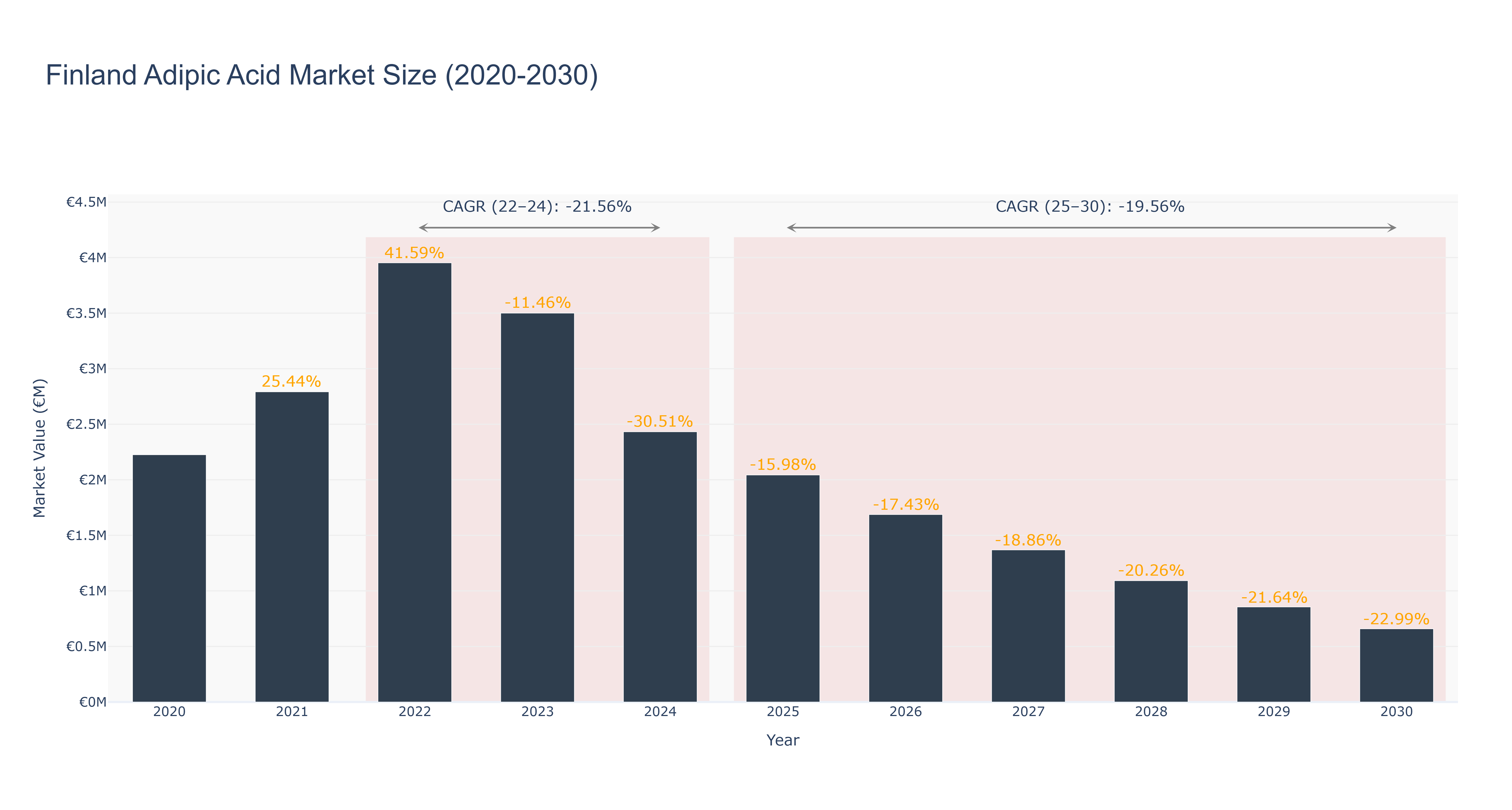
The Finland Adipic Acid Market experienced a peak market size of €3.95 million in 2022, followed by a decline to €2.04 million in 2025. The market is forecasted to further decrease to €0.66 million by 2030, with a CAGR of -19.56% from 2025 to 2030. The market faced challenges post-2022 due to a global oversupply of adipic acid leading to price reductions. However, recent industry drivers such as increasing demand for sustainable alternatives and technological advancements in production processes are expected to drive growth in the near future. Notable future developments include collaborations between Finnish companies and research institutions to develop eco-friendly production methods, positioning Finland as a key player in the green chemistry sector.
Finland Adipic Acid Market: Production & Trade Performance (2019-2025)
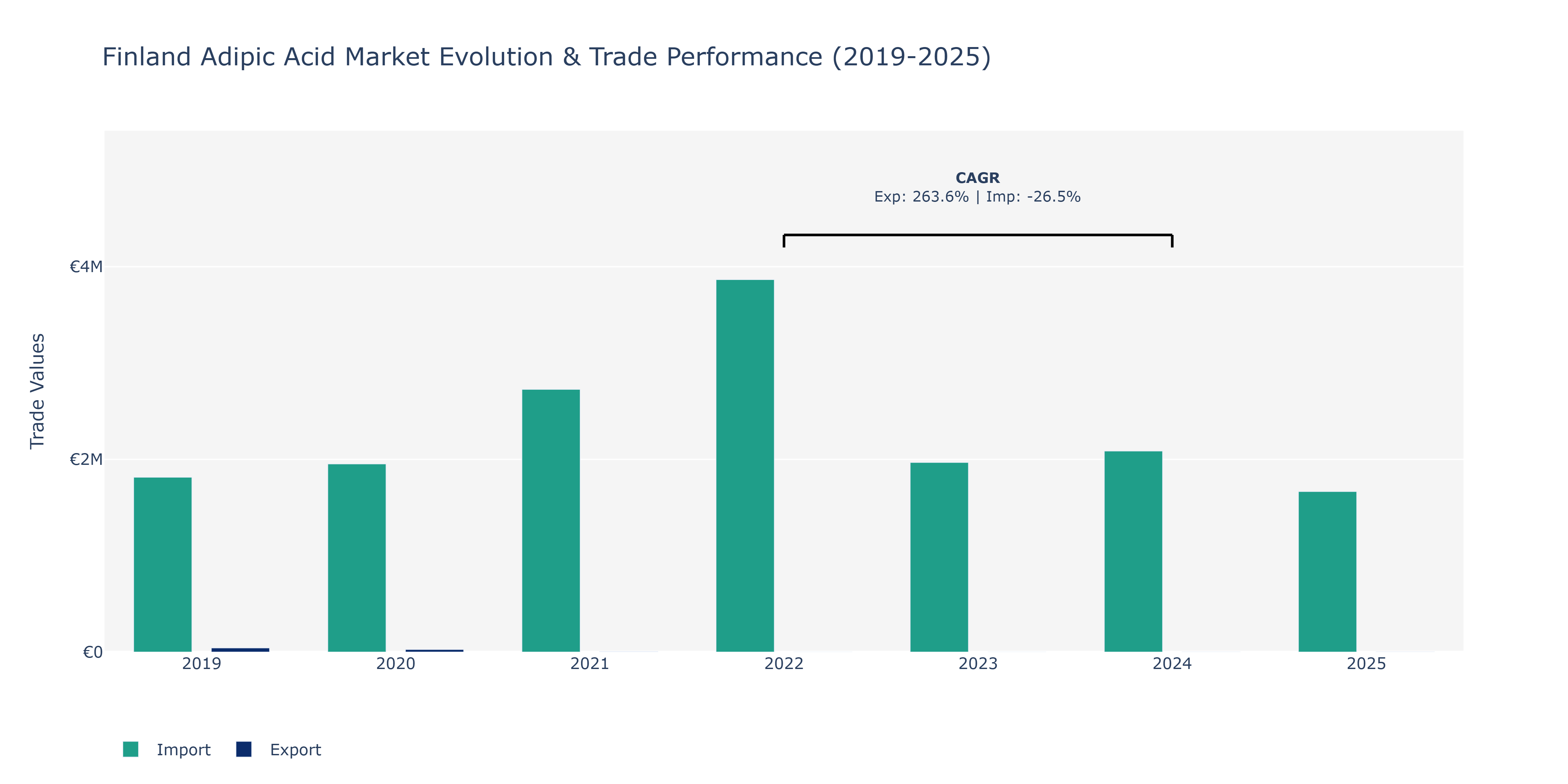
In the Finland Adipic Acid Market, exports exhibited a fluctuating trajectory from 2019 to 2025. Starting at €42.36 thousand in 2019, exports sharply declined to €26.2 thousand in 2020 before plummeting to a mere €4.4 thousand in 2021. The slight recovery in 2022 to €0.08 billion was followed by a notable uptick in 2024 to €1.08 thousand and a further increase to €1.34 thousand in 2025. Conversely, imports followed a different pattern, steadily increasing from €1.81 million in 2019 to a peak of €3.87 million in 2022 before experiencing a slight decrease in the subsequent years. These fluctuations in exports and imports can be attributed to various factors, including global demand shifts, trade policies, and raw material availability. For example, the decline in exports might be influenced by competitive pricing strategies in the market or changes in consumer preferences, whereas the increase in imports up to 2022 could stem from growing domestic consumption or changes in production capacities. To support the analysis further, examining changes in adipic acid consumption patterns in industries like automotive, textiles, and electronics could provide additional insights into the market dynamics.
Key Highlights of the Report:
- Finland Adipic acid Market Outlook
- Market Size of Finland Adipic acid Market, 2025
- Forecast of Finland Adipic acid Market, 2032
- Historical Data and Forecast of Finland Adipic acid Revenues & Volume for the Period 2022 - 2032F
- Finland Adipic acid Market Trend Evolution
- Finland Adipic acid Market Drivers and Challenges
- Finland Adipic acid Price Trends
- Finland Adipic acid Porter`s Five Forces
- Finland Adipic acid Industry Life Cycle
- Historical Data and Forecast of Finland Adipic acid Market Revenues & Volume By Application for the Period 2022 - 2032F
- Historical Data and Forecast of Finland Adipic acid Market Revenues & Volume By Nylon 6,6 Fiber for the Period 2022 - 2032F
- Historical Data and Forecast of Finland Adipic acid Market Revenues & Volume By Nylon 6,6 Resin for the Period 2022 - 2032F
- Historical Data and Forecast of Finland Adipic acid Market Revenues & Volume By Polyurethane for the Period 2022 - 2032F
- Historical Data and Forecast of Finland Adipic acid Market Revenues & Volume By Adipate Esters for the Period 2022 - 2032F
- Historical Data and Forecast of Finland Adipic acid Market Revenues & Volume By Others for the Period 2022 - 2032F
- Historical Data and Forecast of Finland Adipic acid Market Revenues & Volume By Raw Material for the Period 2022 - 2032F
- Historical Data and Forecast of Finland Adipic acid Market Revenues & Volume By Cyclohexanol for the Period 2022 - 2032F
- Historical Data and Forecast of Finland Adipic acid Market Revenues & Volume By Cyclohexanone for the Period 2022 - 2032F
- Finland Adipic acid Import Export Trade Statistics
- Market Opportunity Assessment By Application
- Market Opportunity Assessment By Raw Material
- Finland Adipic acid Top Companies Market Share
- Finland Adipic acid Competitive Benchmarking By Technical and Operational Parameters
- Finland Adipic acid Company Profiles
- Finland Adipic acid Key Strategic Recommendations






































