Finland Chlorine Market Size (2020-2030)
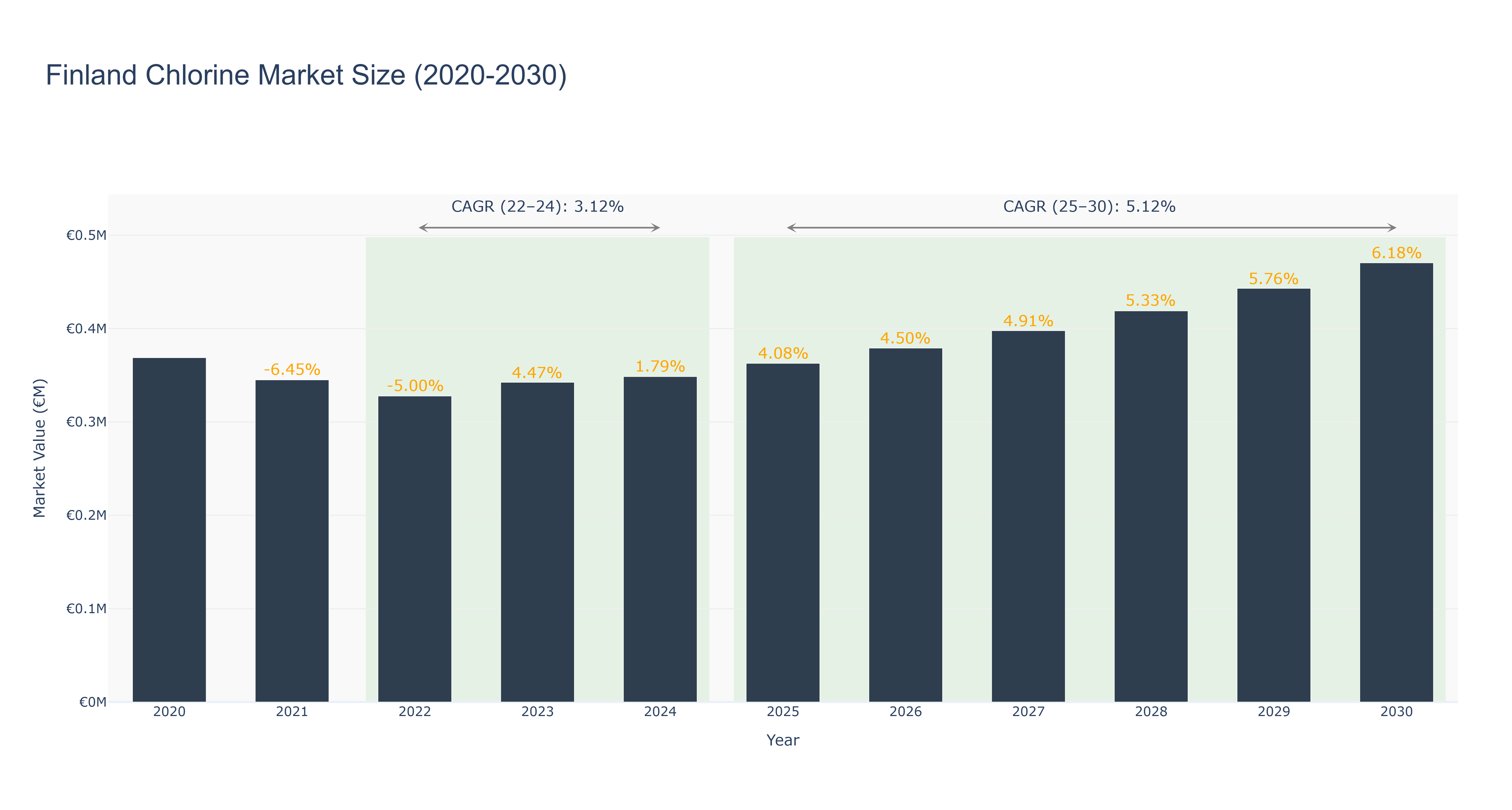
The Finland Chlorine Market experienced a gradual decline in market size from €0.37 million in 2020 to €0.33 million in 2022, attributed to factors like economic slowdown and changing consumer preferences. However, from 2023 onwards, the market showed a positive growth trajectory, with the market size reaching €0.47 million in 2030. The Compound Annual Growth Rate (CAGR) for the period 2025-2030 is projected at 5.12%, indicating a steady expansion in the market. Recent developments in the market include increased demand for eco-friendly chlorine products and advancements in chlorine production technologies. Future projects are focused on enhancing product sustainability and exploring new applications for chlorine in industries such as water treatment and pharmaceuticals. These initiatives are expected to drive further growth and innovation in the Finland Chlorine Market.
Finland Chlorine Market: Production & Trade Performance (2019-2025)
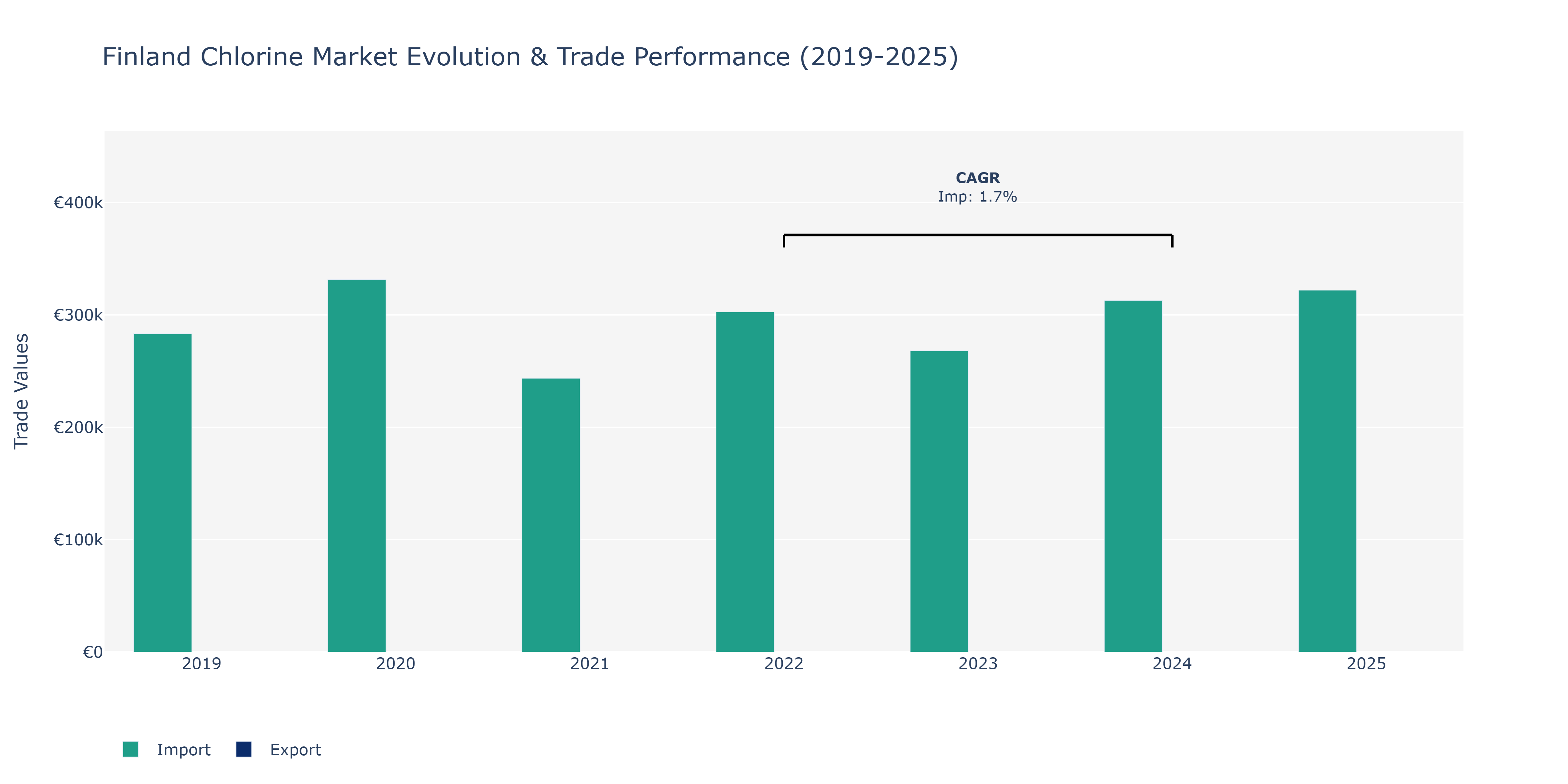
In the Finland Chlorine Market, imports experienced a fluctuating pattern between 2019 and 2025, showcasing a peak in 2025 at approximately €322 million. Notably, imports recorded a decline in 2021 but recovered in 2022, eventually reaching a peak in 2025. On the other hand, exports saw a modest figure of €1 million in 2021, followed by a remarkable increase to €18 million in 2023. These movements may be attributed to various factors such as changes in demand for chlorine-based products, global market trends, and domestic production capacities. The surge in exports in 2023 could indicate growing competitiveness in the international market or the introduction of innovative chlorine-related products by Finnish companies. The rebound of imports in 2022 and subsequent peak in 2025 might reflect increasing consumption rates or the need to meet evolving industrial requirements within Finland. Such trends emphasize the market's responsiveness to both domestic and global dynamics, highlighting the adaptability of stakeholders in the face of changing market conditions.
Finland Chlorine Market Overview
The chlorine market in Finland is influenced by its applications in water treatment, disinfection, and the production of chemicals like PVC. The market is also driven by the demand from industries such as pharmaceuticals, agriculture, and food processing, where chlorine compounds are used for sterilization and preservation.
Drivers of the market
The Chlorine Market in Finland is expanding due to the increasing use of chlorine in water purification, disinfectants, and the production of essential chemicals. With growing environmental concerns, chlorine remains critical for maintaining public health and improving the safety of water supplies, boosting market demand.
Challenges of the market
The chlorine market in Finland faces challenges from environmental concerns about its production and handling, particularly its role in the creation of toxic by-products. Additionally, fluctuations in demand from industries like water treatment and chemicals, and the need for eco-friendly alternatives, impact market stability.
Government Policy of the market
The Finnish government regulates the chlorine market with a focus on promoting the safe and sustainable production of chlorine, which is used in various industrial applications, including water treatment and chemical manufacturing. Policies aim to reduce the environmental impact of chlorine production through cleaner technologies and encourage the responsible use of chlorine in manufacturing processes.
Key Highlights of the Report:
- Finland Chlorine Market Outlook
- Market Size of Finland Chlorine Market, 2024
- Forecast of Finland Chlorine Market, 2031
- Historical Data and Forecast of Finland Chlorine Revenues & Volume for the Period 2021-2031
- Finland Chlorine Market Trend Evolution
- Finland Chlorine Market Drivers and Challenges
- Finland Chlorine Price Trends
- Finland Chlorine Porter`s Five Forces
- Finland Chlorine Industry Life Cycle
- Historical Data and Forecast of Finland Chlorine Market Revenues & Volume By Application for the Period 2021-2031
- Historical Data and Forecast of Finland Chlorine Market Revenues & Volume By EDC/PVC for the Period 2021-2031
- Historical Data and Forecast of Finland Chlorine Market Revenues & Volume By Isocyanates and Oxygenates for the Period 2021-2031
- Historical Data and Forecast of Finland Chlorine Market Revenues & Volume By Chloromethanes for the Period 2021-2031
- Historical Data and Forecast of Finland Chlorine Market Revenues & Volume By Solvents and Epichlorohydrin for the Period 2021-2031
- Historical Data and Forecast of Finland Chlorine Market Revenues & Volume By Inorganic Chemicals for the Period 2021-2031
- Historical Data and Forecast of Finland Chlorine Market Revenues & Volume By Other Applications for the Period 2021-2031
- Historical Data and Forecast of Finland Chlorine Market Revenues & Volume By End-user for the Period 2021-2031
- Historical Data and Forecast of Finland Chlorine Market Revenues & Volume By Water Treatment for the Period 2021-2031
- Historical Data and Forecast of Finland Chlorine Market Revenues & Volume By Pharmaceutical for the Period 2021-2031
- Historical Data and Forecast of Finland Chlorine Market Revenues & Volume By Chemicals for the Period 2021-2031
- Historical Data and Forecast of Finland Chlorine Market Revenues & Volume By Paper and Pulp for the Period 2021-2031
- Historical Data and Forecast of Finland Chlorine Market Revenues & Volume By Plastic for the Period 2021-2031
- Historical Data and Forecast of Finland Chlorine Market Revenues & Volume By Pesticides for the Period 2021-2031
- Historical Data and Forecast of Finland Chlorine Market Revenues & Volume By Other for the Period 2021-2031
- Finland Chlorine Import Export Trade Statistics
- Market Opportunity Assessment By Application
- Market Opportunity Assessment By End-user
- Finland Chlorine Top Companies Market Share
- Finland Chlorine Competitive Benchmarking By Technical and Operational Parameters
- Finland Chlorine Company Profiles
- Finland Chlorine Key Strategic Recommendations






































