Finland Fuel Oil Market Top 5 Importing Countries and Market Competition (HHI) Analysis
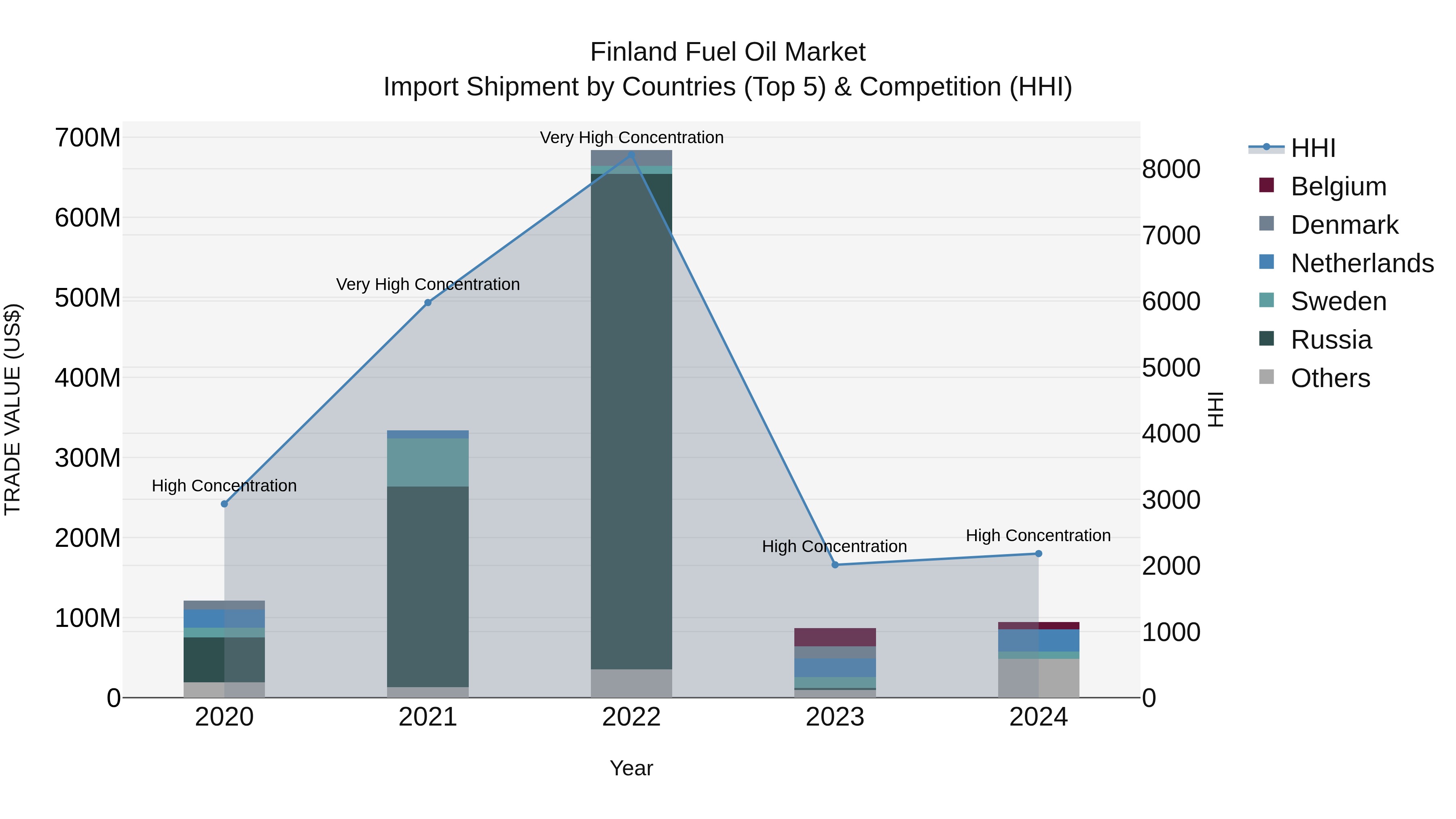
In 2024, Finland continued to rely on fuel oil imports from key suppliers such as Turkey, Netherlands, UK, USA, and Belgium. Despite a challenging market environment with a negative compound annual growth rate (CAGR) of -6.09% from 2020 to 2024, there was a notable uptick in growth at 8.48% from 2023 to 2024. The high Herfindahl-Hirschman Index (HHI) indicates a concentrated market, underscoring the significance of these top exporting countries in meeting Finland`s fuel oil demand. This trend highlights the importance of market dynamics and trade relationships in shaping Finland`s energy landscape.
Finland Fuel Oil Market Overview
The fuel oil market in Finland is shaped by the energy needs of the industrial sector, as well as heating applications in residential and commercial buildings. While fuel oil consumption has been declining due to the increasing use of renewable energy sources, it remains essential for certain industries, such as heavy manufacturing and shipping. The market is also influenced by regulatory policies aimed at reducing carbon emissions and increasing energy efficiency, leading to a gradual transition toward cleaner alternatives.
Drivers of the market
The fuel oil market in Finland is influenced by the continued use of fuel oil in heating applications, particularly in residential, commercial, and industrial sectors. Despite a growing focus on renewable energy sources, fuel oil remains essential in providing reliable energy in colder climates like Finland. The country`s reliance on energy-intensive industries such as mining, forestry, and manufacturing also sustains demand for fuel oil in industrial operations.
Challenges of the market
The Finland fuel oil market faces challenges due to increasing environmental regulations aimed at reducing carbon emissions. The transition to alternative energy sources, such as renewables, is reducing demand for fuel oil in certain sectors, including transportation and heating. Furthermore, the market is influenced by global fuel price fluctuations, which add to the uncertainty and volatility of the market.
Government Policy of the market
Stringent environmental regulations govern the fuel oil market in Finland, aiming to reduce carbon emissions. The government encourages the transition to cleaner fuels and supports innovations in refining technologies to produce low-sulfur fuel oils.
Key Highlights of the Report:
- Finland Fuel Oil Market Outlook
- Market Size of Finland Fuel Oil Market, 2024
- Forecast of Finland Fuel Oil Market, 2031
- Historical Data and Forecast of Finland Fuel Oil Revenues & Volume for the Period 2021-2031
- Finland Fuel Oil Market Trend Evolution
- Finland Fuel Oil Market Drivers and Challenges
- Finland Fuel Oil Price Trends
- Finland Fuel Oil Porter`s Five Forces
- Finland Fuel Oil Industry Life Cycle
- Historical Data and Forecast of Finland Fuel Oil Market Revenues & Volume By Application for the Period 2021-2031
- Historical Data and Forecast of Finland Fuel Oil Market Revenues & Volume By Marine for the Period 2021-2031
- Historical Data and Forecast of Finland Fuel Oil Market Revenues & Volume By Industrial for the Period 2021-2031
- Historical Data and Forecast of Finland Fuel Oil Market Revenues & Volume By Others for the Period 2021-2031
- Finland Fuel Oil Import Export Trade Statistics
- Market Opportunity Assessment By Application
- Finland Fuel Oil Top Companies Market Share
- Finland Fuel Oil Competitive Benchmarking By Technical and Operational Parameters
- Finland Fuel Oil Company Profiles
- Finland Fuel Oil Key Strategic Recommendations






































