Finland Lumber Market Top 5 Importing Countries and Market Competition (HHI) Analysis
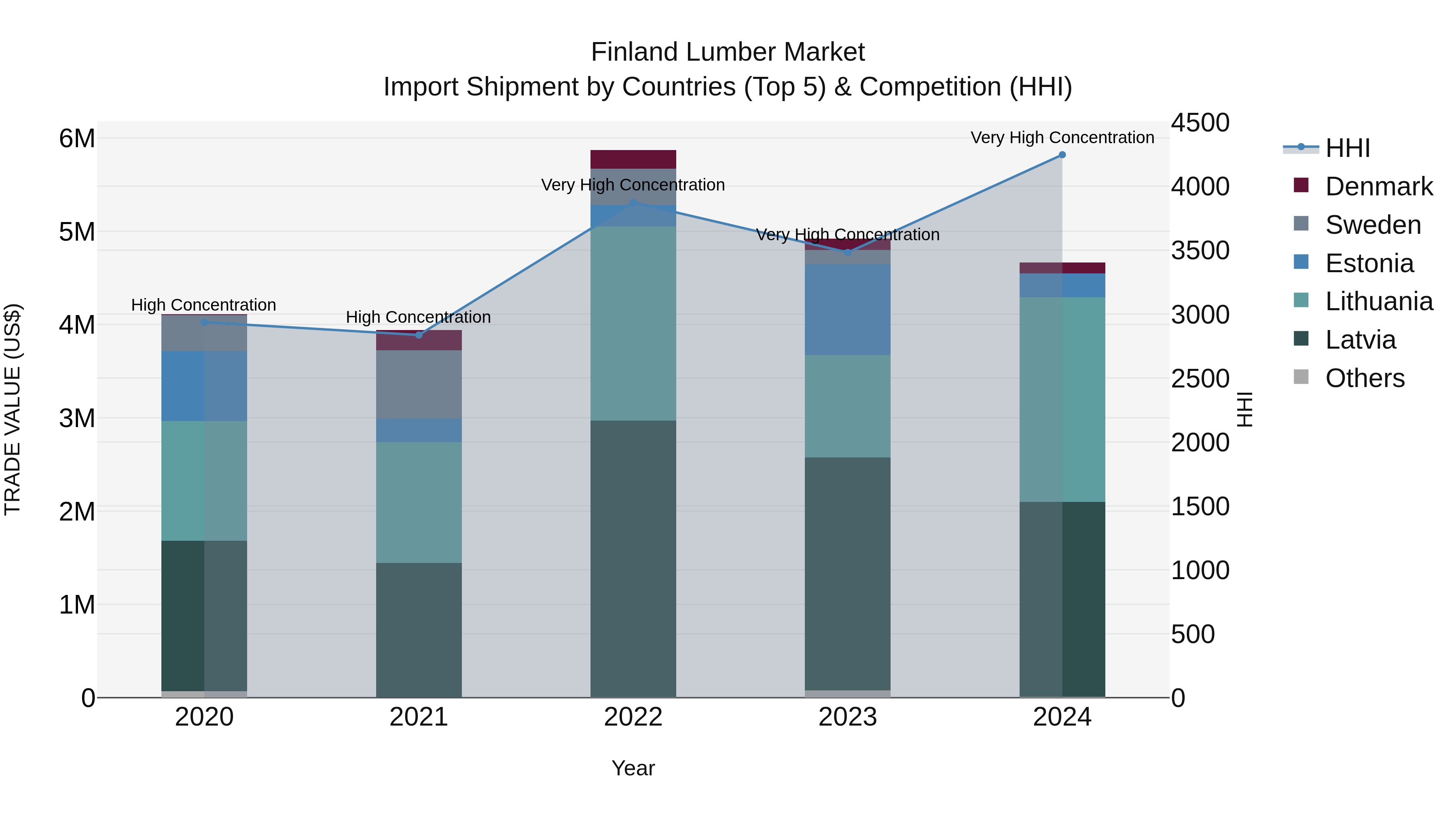
Despite a slight decline in growth rate in 2024, Finland continues to heavily rely on lumber imports from neighboring countries such as Lithuania, Latvia, and Estonia. The high Herfindahl-Hirschman Index (HHI) indicates a concentrated market with dominant suppliers. The compound annual growth rate (CAGR) from 2020 to 2024 suggests a steady increase in lumber imports, reflecting Finland`s consistent demand for wood products. The country`s close trade relationships with Denmark and Poland also contribute significantly to its lumber import market dynamics.
Finland Lumber Market Overview
The lumber market in Finland is witnessing steady growth, driven by the countrys strong forestry sector and increasing demand for sustainable building materials. Finland is one of the largest producers of timber in Europe, and its timber industry plays a vital role in the economy. As the global focus shifts towards eco-friendly and sustainable construction practices, Finnish lumber is gaining popularity for use in residential and commercial buildings, as well as in furniture production. The trend toward environmentally conscious building materials is expected to continue supporting the demand for Finnish lumber in both domestic and international markets.
Drivers of the market
The lumber market in Finland is driven by the growing construction and real estate sectors, which demand sustainable and high-quality wood products. As a country with abundant forest resources, Finland`s timber industry is well-positioned to meet the needs of domestic and international markets. The demand for eco-friendly and certified wood products is increasing as part of a broader trend toward sustainable building materials.
Challenges of the market
The lumber market in Finland faces challenges related to environmental sustainability, as growing global demand for wood products leads to concerns about deforestation and the depletion of forest resources. Additionally, the market is affected by fluctuating timber prices, which are influenced by factors such as weather conditions, transport costs, and global market trends. The market must also address increasing pressure for sustainable forestry practices and the growing demand for wood products in construction and other sectors.
Government Policy of the market
In Finland, the Lumber market is influenced by government policies that support sustainable forestry and wood product manufacturing. Finlands forestry management policies ensure that timber is sourced responsibly, with an emphasis on sustainability and ecological balance. The government also supports the use of timber in construction through initiatives promoting green building practices, further boosting demand for lumber products in the country.
Key Highlights of the Report:
- Finland Lumber Market Outlook
- Market Size of Finland Lumber Market, 2024
- Forecast of Finland Lumber Market, 2031
- Historical Data and Forecast of Finland Lumber Revenues & Volume for the Period 2021-2031
- Finland Lumber Market Trend Evolution
- Finland Lumber Market Drivers and Challenges
- Finland Lumber Price Trends
- Finland Lumber Porter`s Five Forces
- Finland Lumber Industry Life Cycle
- Historical Data and Forecast of Finland Lumber Market Revenues & Volume By Types for the Period 2021-2031
- Historical Data and Forecast of Finland Lumber Market Revenues & Volume By Hardwood Lumber for the Period 2021-2031
- Historical Data and Forecast of Finland Lumber Market Revenues & Volume By Softwood Lumber for the Period 2021-2031
- Historical Data and Forecast of Finland Lumber Market Revenues & Volume By Application for the Period 2021-2031
- Historical Data and Forecast of Finland Lumber Market Revenues & Volume By Construction for the Period 2021-2031
- Historical Data and Forecast of Finland Lumber Market Revenues & Volume By Furniture for the Period 2021-2031
- Historical Data and Forecast of Finland Lumber Market Revenues & Volume By Flooring for the Period 2021-2031
- Historical Data and Forecast of Finland Lumber Market Revenues & Volume By Moldings for the Period 2021-2031
- Historical Data and Forecast of Finland Lumber Market Revenues & Volume By Others for the Period 2021-2031
- Finland Lumber Import Export Trade Statistics
- Market Opportunity Assessment By Types
- Market Opportunity Assessment By Application
- Finland Lumber Top Companies Market Share
- Finland Lumber Competitive Benchmarking By Technical and Operational Parameters
- Finland Lumber Company Profiles
- Finland Lumber Key Strategic Recommendations






































