Finland Non-alcoholic Wine Market Top 5 Importing Countries and Market Competition (HHI) Analysis
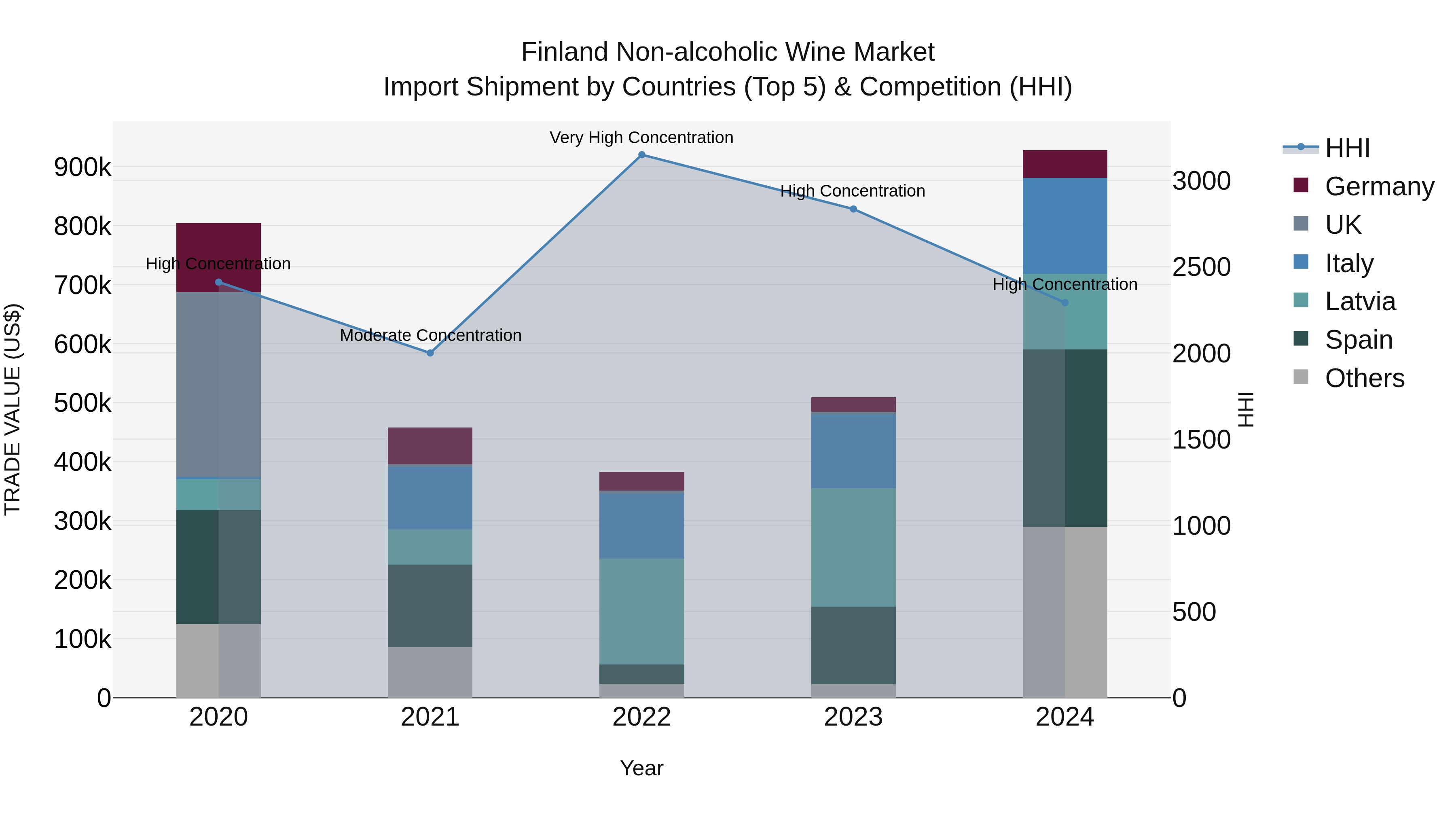
In 2024, Finland saw significant growth in non-alcoholic wine import shipments, with top exporters being Spain, Chile, Italy, Latvia, and Germany. The high Herfindahl-Hirschman Index (HHI) indicates a concentrated market. The compound annual growth rate (CAGR) from 2020 to 2024 was a steady 3.66%, while the growth rate from 2023 to 2024 spiked at an impressive 82.31%. These figures suggest a growing demand for non-alcoholic wine in Finland, with key players from various countries meeting consumer needs and preferences in the market.
Key Highlights of the Report:
- Finland Non-Alcoholic Wine Market Outlook
- Market Size of Finland Non-Alcoholic Wine Market, 2025
- Forecast of Finland Non-Alcoholic Wine Market, 2032
- Historical Data and Forecast of Finland Non-Alcoholic Wine Revenues & Volume for the Period 2022 - 2032
- Finland Non-Alcoholic Wine Market Trend Evolution
- Finland Non-Alcoholic Wine Market Drivers and Challenges
- Finland Non-Alcoholic Wine Price Trends
- Finland Non-Alcoholic Wine Porter's Five Forces
- Finland Non-Alcoholic Wine Industry Life Cycle
- Historical Data and Forecast of Finland Non-Alcoholic Wine Market Revenues & Volume By Product Type for the Period 2022 - 2032
- Historical Data and Forecast of Finland Non-Alcoholic Wine Market Revenues & Volume By Alcohol-Free for the Period 2022 - 2032
- Historical Data and Forecast of Finland Non-Alcoholic Wine Market Revenues & Volume By 0.5% Alcohol by Volume for the Period 2022 - 2032
- Historical Data and Forecast of Finland Non-Alcoholic Wine Market Revenues & Volume By Category for the Period 2022 - 2032
- Historical Data and Forecast of Finland Non-Alcoholic Wine Market Revenues & Volume By Plain for the Period 2022 - 2032
- Historical Data and Forecast of Finland Non-Alcoholic Wine Market Revenues & Volume By Flavored for the Period 2022 - 2032
- Historical Data and Forecast of Finland Non-Alcoholic Wine Market Revenues & Volume By Distribution Channel for the Period 2022 - 2032
- Historical Data and Forecast of Finland Non-Alcoholic Wine Market Revenues & Volume By Store-Based for the Period 2022 - 2032
- Historical Data and Forecast of Finland Non-Alcoholic Wine Market Revenues & Volume By Non-Store-Based for the Period 2022 - 2032
- Finland Non-Alcoholic Wine Import Export Trade Statistics
- Market Opportunity Assessment By Product Type
- Market Opportunity Assessment By Category
- Market Opportunity Assessment By Distribution Channel
- Finland Non-Alcoholic Wine Top Companies Market Share
- Finland Non-Alcoholic Wine Competitive Benchmarking By Technical and Operational Parameters
- Finland Non-Alcoholic Wine Company Profiles
- Finland Non-Alcoholic Wine Key Strategic Recommendations






































