Finland Smart Thermostat Market Size (2020-2030)
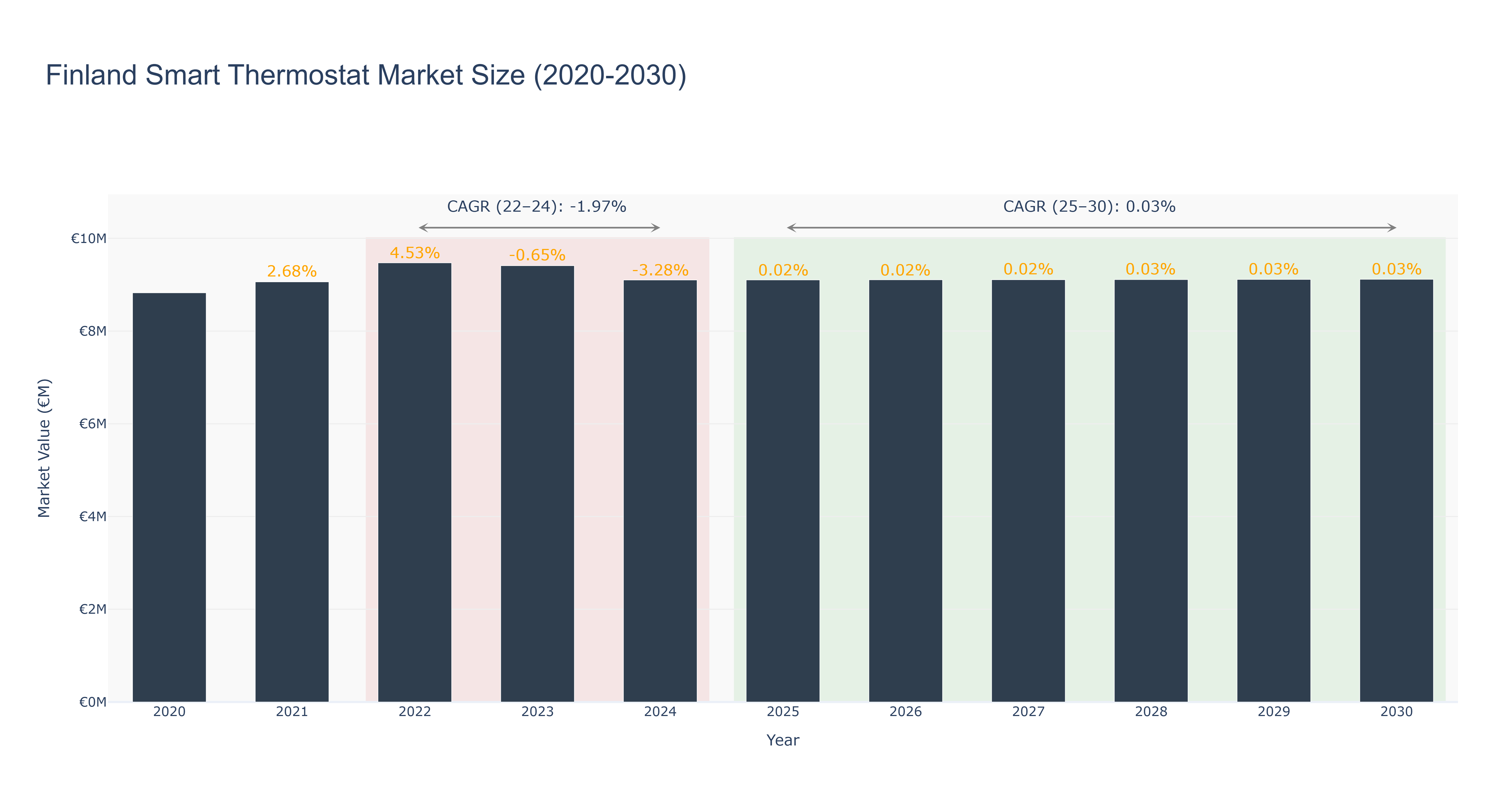
The Finland Smart Thermostat Market has shown a fluctuating trend over the years. The peak market size of €9.47 million was recorded in 2022, followed by a decline to €9.10 million in 2024. The market is forecasted to grow steadily from 2025 to 2030, reaching €9.12 million in 2030. The CAGR for the period 2022-24 was -1.97%, reflecting a slight decrease, while the CAGR for 2025-30 is projected at 0.03%, indicating a marginal but positive growth rate. The market experienced a downturn due to economic uncertainties and technological shifts, but it is expected to rebound as smart home adoption increases in Finland. Recent developments include partnerships with energy companies to promote energy-efficient solutions, with future projects focusing on integrating smart thermostats with renewable energy sources to enhance sustainability in residential heating systems.
Finland Smart Thermostat Market: Production & Trade Performance (2019-2025)
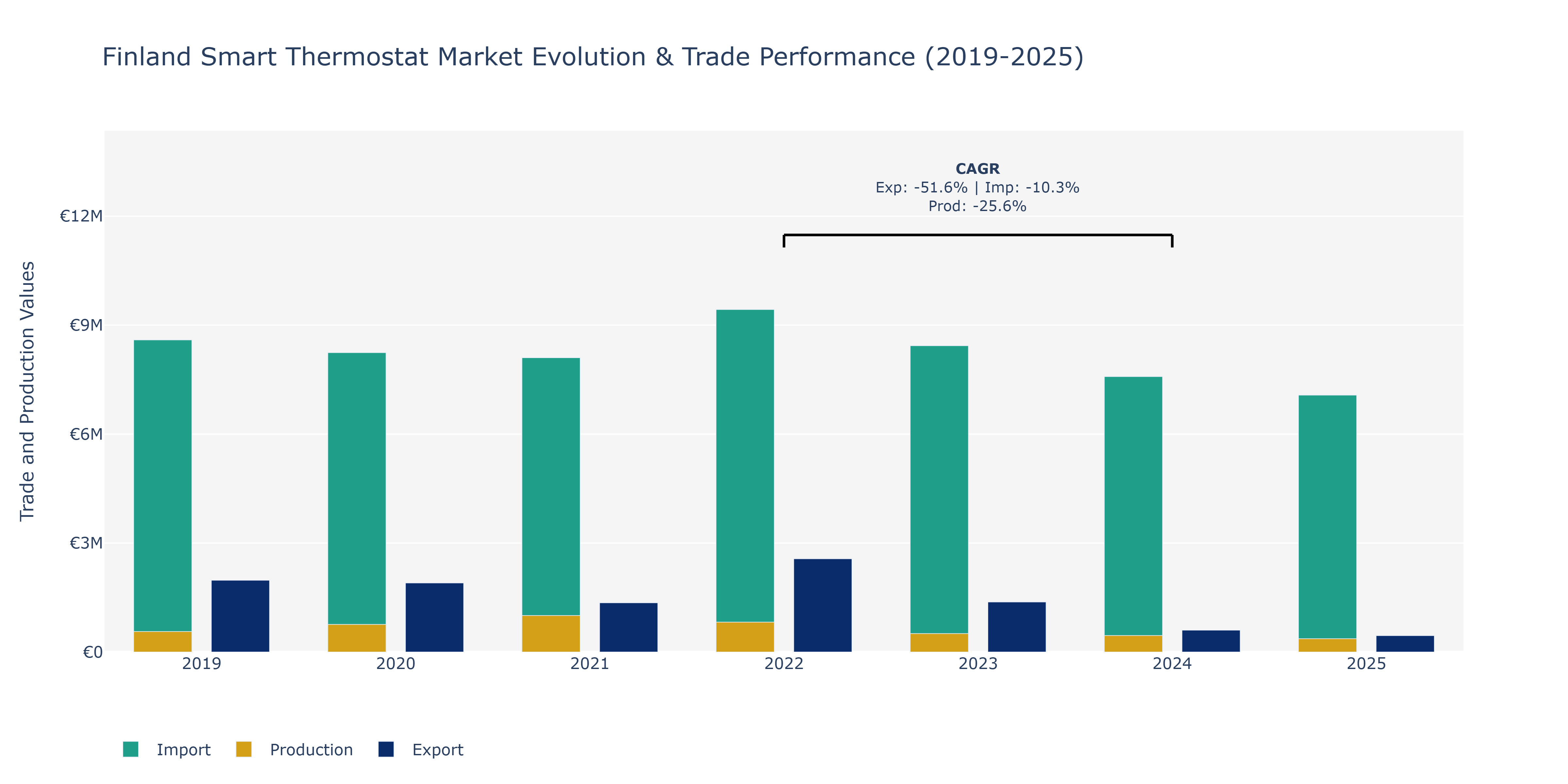
In the Finland Smart Thermostat Market, exports witnessed fluctuations over the years, starting at €1.98 million in 2019, dropping to €1.36 million in 2021, before sharply increasing to €2.57 million in 2022, a peak point. The abrupt decline to €602.61 thousand in 2024 indicates a significant downturn. Imports showed a more stable trend, decreasing slightly from €8.59 million in 2019 to €8.1 million in 2021, before rising to €9.43 million in 2022, another peak, and then dropping to €7.58 million in 2024. Production levels fluctuated as well, with a peak at €1.00 million in 2021, and a sharp decline to €0.46 million in 2024. These trends could be attributed to factors such as changes in consumer demand, technological advancements impacting manufacturing efficiency, and market competition. The increase in exports in 2022 may be linked to strategic partnerships forged by Finnish companies, driving higher demand for smart thermostat products globally, as reported by industry analysts (source: TechSci Research).
Key Highlights of the Report:
- Finland Smart Thermostat Market Outlook
- Market Size of Finland Smart Thermostat Market, 2024
- Forecast of Finland Smart Thermostat Market, 2031
- Historical Data and Forecast of Finland Smart Thermostat Revenues & Volume for the Period 2021-2031
- Finland Smart Thermostat Market Trend Evolution
- Finland Smart Thermostat Market Drivers and Challenges
- Finland Smart Thermostat Price Trends
- Finland Smart Thermostat Porter`s Five Forces
- Finland Smart Thermostat Industry Life Cycle
- Historical Data and Forecast of Finland Smart Thermostat Market Revenues & Volume By Type for the Period 2021-2031
- Historical Data and Forecast of Finland Smart Thermostat Market Revenues & Volume By Wireless for the Period 2021-2031
- Historical Data and Forecast of Finland Smart Thermostat Market Revenues & Volume By Wireless for the Period 2021-2031
- Historical Data and Forecast of Finland Smart Thermostat Market Revenues & Volume By End-User Vertical for the Period 2021-2031
- Historical Data and Forecast of Finland Smart Thermostat Market Revenues & Volume By Residential for the Period 2021-2031
- Historical Data and Forecast of Finland Smart Thermostat Market Revenues & Volume By Commercial for the Period 2021-2031
- Finland Smart Thermostat Import Export Trade Statistics
- Market Opportunity Assessment By Type
- Market Opportunity Assessment By End-User Vertical
- Finland Smart Thermostat Top Companies Market Share
- Finland Smart Thermostat Competitive Benchmarking By Technical and Operational Parameters
- Finland Smart Thermostat Company Profiles
- Finland Smart Thermostat Key Strategic Recommendations






































