France Alcohol Testing Market Summary
The france alcohol testing market was estimated at USD 185 Million in 2025 and is projected to reach USD 207 Million by 2032, growing at a CAGR of 1.3% from 2026 to 2032.
France Alcohol Testing Market Year-wise Growth Rate and Key Drivers
This graph highlights how the France Alcohol Testing Market has steadily grown over the past five years, supported by major growth factors.
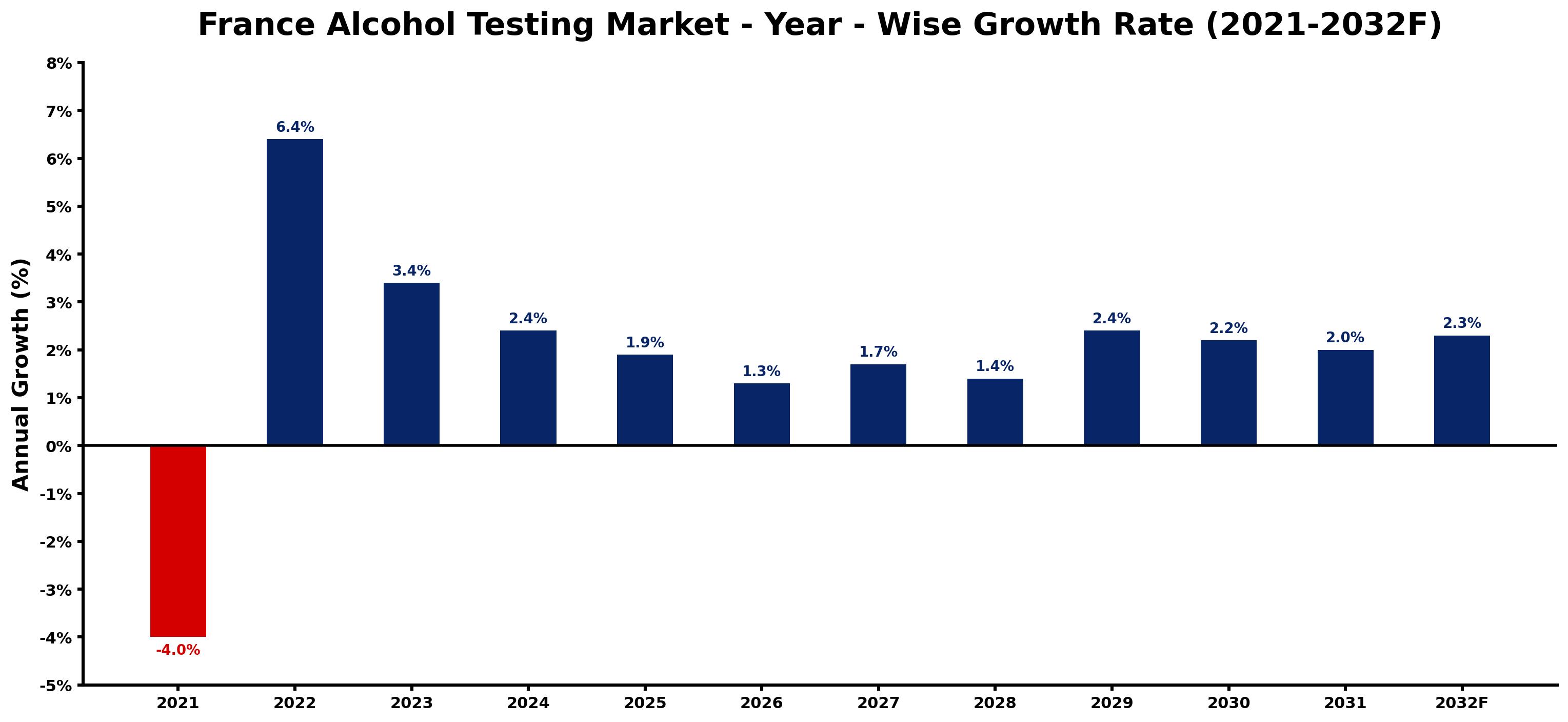
The table below presents the year wise growth rates along with the key drivers influencing the market
| Year | Growth Rate | Major Drivers |
| 2021 | -4.0% | Increased travel restrictions and event cancellations severely limited alcohol consumption opportunities in social settings. |
| 2022 | 6.4% | Public awareness campaigns on alcohol-related accidents highlight the importance of testing. |
| 2023 | 3.4% | Corporate responsibility initiatives lead companies to invest in employee alcohol testing solutions. |
| 2024 | 2.4% | Technological innovations in portable testing devices enhance accuracy and accessibility. |
| 2025 | 1.9% | Increased focus on workplace safety regulations encourages routine alcohol testing protocols. |
| 2026 | 1.3% | Local governments implement stricter penalties for drunk driving, spurring testing device sales. |
| 2027 | 1.7% | The popularity of ride-sharing services creates new opportunities for alcohol testing solutions. |
| 2028 | 1.4% | Consumer lifestyle shifts towards health consciousness stimulate demand for at-home testing kits. |
| 2029 | 2.4% | Collaboration between tech firms and healthcare providers improves testing device functionality. |
| 2030 | 2.2% | Expansion of event-driven testing services aligns with increased festival and concert activities. |
| 2031 | 2.0% | Societal attitudes shift towards accountability, driving public demand for alcohol testing. |
| 2032 | 2.3% | Emerging smart technology integrates alcohol testing into daily lifestyle applications. |
Note - Market size estimations and growth projections presented in this report are based on 6Wresearch's advanced forecasting approach, validated with industry datasets as of June 2026.
France Alcohol Testing Market Synopsis
The France Alcohol Testing Market is projected to reach 1.3% and witness significant growth during the forecast period (2026-2032). Driven by heightened awareness regarding the dangers of alcohol consumption while driving, alongside stringent regulations enforcing alcohol testing, this market showcases a robust growth trajectory. The increasing prevalence of portable and user-friendly testing devices among law enforcement, workplaces, and individual consumers underscores the expanding scope of this market.
France Alcohol Testing Market Growth Drivers
Several factors contribute to the growth of the France Alcohol Testing Market. The primary drivers include:
- Rising public awareness of the consequences of drunk driving has compelled individuals and organizations to seek reliable alcohol testing solutions to promote road safety.
- Stringent government regulations concerning blood alcohol concentration limits require compliance, driving demand for effective testing devices across various sectors.
- Technological advancements are enabling more accurate and convenient testing options, enhancing the appeal of portable devices within both private and professional settings.
- The focus on workplace safety is prompting businesses to implement alcohol testing protocols, further expanding the market as industries recognize the importance of a sober work environment.
- Innovative product development, particularly in the area of smartphone-connected breathalyzers, is attracting a wider consumer base that values convenience and accuracy.
France Alcohol Testing Market Trends and Opportunities
Current market trends indicate a definitive shift towards non-invasive and portable alcohol testing methods. These trends reveal:
- The increasing adoption of Bluetooth-enabled breathalyzers ensures that users can obtain and share results instantly, aligning with the trend towards mobile connectivity.
- Rapid screening tests are gaining notoriety, particularly in safety-sensitive industries, as organizations prioritize timely and efficient monitoring of alcohol levels.
- Market players are focusing on user-friendly designs that accommodate various demographics, enhancing accessibility for individual consumers and organizations.
- The integration of advanced sensors and algorithms in testing devices significantly improves the accuracy of results, fostering trust and reliability among consumers.
- Public campaigns around responsible drinking are instigating a cultural shift that encourages proactive measures for alcohol monitoring, thereby bolstering market demand.
France Alcohol Testing Market Challenges and Restraints
While the France Alcohol Testing Market presents numerous growth opportunities, it also faces several challenges:
- The complex regulatory environment governing alcohol testing devices necessitates compliance with stringent standards, which can be both time-consuming and costly for manufacturers.
- As consumer expectations evolve towards non-invasive testing methods, manufacturers are tasked with innovating rapidly to meet demand, which requires ongoing investment in research and development.
- Heightened competition among various testing device providers can make it challenging for new entrants to establish a foothold in the market.
- Consumer skepticism surrounding the accuracy of certain testing methods may hinder market acceptance, necessitating ongoing efforts in quality assurance and education.
- The economic climate and fluctuations in public spending can impact investment in alcohol testing solutions, particularly within governmental and institutional frameworks.
France Alcohol Testing Market Investment Opportunities
The growing regulatory framework surrounding alcohol consumption presents notable investment opportunities within the France Alcohol Testing Market, including:
- Expansion into advanced alcohol testing technology, such as portable devices that integrate with mobile applications, aligns with consumer preferences for convenience and connectivity.
- Collaboration with public health organizations and law enforcement agencies can facilitate enhanced distribution and usage of alcohol testing devices, fostering market penetration.
- Investing in research to develop innovative, non-invasive testing methods can set firms apart in a competitive landscape, capturing a larger market share.
- Focus on product differentiation through unique features such as rapid testing capabilities and built-in educational resources can enhance consumer appeal.
- Strategic marketing efforts that highlight the importance of responsible drinking and workplace safety can drive demand and awareness for alcohol testing solutions.
France Alcohol Testing Market Government Investment and Initiatives
The French government actively enforces policies designed to reduce alcohol-related incidents and enhance roadway safety. Key initiatives include:
- The legal blood alcohol concentration (BAC) limit for drivers is set at 0.5 grams per liter, reinforcing the necessity for accurate testing equipment to uphold this standard.
- Regular roadside alcohol testing programs are conducted to ensure compliance with regulations, driving consistent demand for effective testing devices.
- Drivers are mandated to carry a breathalyzer kit in their vehicles, significantly impacting the market dynamics and encouraging widespread adoption of testing devices.
- Public campaigns focused on the dangers of drunk driving are supported by legislative measures, creating an environment conducive to market growth.
- Regulatory measures prohibit the sale of alcohol to intoxicated individuals, further necessitating the use of alcohol testing devices in various establishments.
France Alcohol Testing Market Latest Developments (May 2025 - June 2026)
Recent developments in the France Alcohol Testing Market reflect a tilt towards innovative solutions and increased enforcement of regulations. Key highlights include:
- New product launches featuring enhanced smartphone connectivity have been instrumental in meeting consumer demands for portable testing solutions.
- Public health initiatives have intensified, encouraging workplaces to adopt comprehensive alcohol testing protocols to ensure employee safety and well-being.
- Technological advancements in sensor calibration are leading to more accurate breathalyzer results, fostering consumer confidence in the reliability of testing methods.
- Increased collaboration between manufacturers and regulatory bodies highlights a commitment to compliance and product safety within the market.
- The expansion of educational campaigns aimed at informing the public about the implications of drunk driving has contributed to a growing acceptance of alcohol testing practices.
France Alcohol Testing Market - Key Attractiveness of the Report
- 10 Years of Market Numbers
- Historical Data Starting from 2022 to 2025
- Base Year: 2025
- Forecast Data until 2032
- Key Performance Indicators Impacting the Market
- Major Upcoming Developments and Projects
Key Highlights of the Report:
- France Alcohol Testing Market Outlook
- Market Size of France Alcohol Testing Market, 2025
- Forecast of France Alcohol Testing Market, 2032F
- Historical Data and Forecast of France Alcohol Testing Revenues & Volume for the Period 2022-2032F
- France Alcohol Testing Market Trend Evolution
- France Alcohol Testing Market Drivers and Challenges
- France Alcohol Testing Price Trends
- France Alcohol Testing Porter's Five Forces
- France Alcohol Testing Industry Life Cycle
- Historical Data and Forecast of France Alcohol Testing Market Revenues & Volume By Testing Equipment Types for the Period 2022-2032F
- Historical Data and Forecast of France Alcohol Testing Market Revenues & Volume By Infrared Based Breathalyzer for the Period 2022-2032F
- Historical Data and Forecast of France Alcohol Testing Market Revenues & Volume By Semi-conductor Based Breathalyzer for the Period 2022-2032F
- Historical Data and Forecast of France Alcohol Testing Market Revenues & Volume By Immunoassay Analyzers for the Period 2022-2032F
- Historical Data and Forecast of France Alcohol Testing Market Revenues & Volume By Fuel Cell Based Breathalyzer for the Period 2022-2032F
- Historical Data and Forecast of France Alcohol Testing Market Revenues & Volume By Oral Fluid Testing Devices for the Period 2022-2032F
- Historical Data and Forecast of France Alcohol Testing Market Revenues & Volume By Hair Testing Devices for the Period 2022-2032F
- Historical Data and Forecast of France Alcohol Testing Market Revenues & Volume By Urine Testing Devices for the Period 2022-2032F
- Historical Data and Forecast of France Infrared Based Breathalyzer Alcohol Testing Market Revenues & Volume By Others for the Period 2022-2032F
- Historical Data and Forecast of France Alcohol Testing Market Revenues & Volume By Applications for the Period 2022-2032F
- Historical Data and Forecast of France Alcohol Testing Market Revenues & Volume By Alcohol Detection for the Period 2022-2032F
- Historical Data and Forecast of France Alcohol Testing Market Revenues & Volume By Drug Detection for the Period 2022-2032F
- France Alcohol Testing Import Export Trade Statistics
- Market Opportunity Assessment By Testing Equipment Types
- Market Opportunity Assessment By Applications
- France Alcohol Testing Top Companies Market Share
- France Alcohol Testing Competitive Benchmarking By Technical and Operational Parameters
- France Alcohol Testing Company Profiles
- France Alcohol Testing Key Strategic Recommendations






































