France Algorithmic Trading Market Size & Growth Rate (2026-2032)
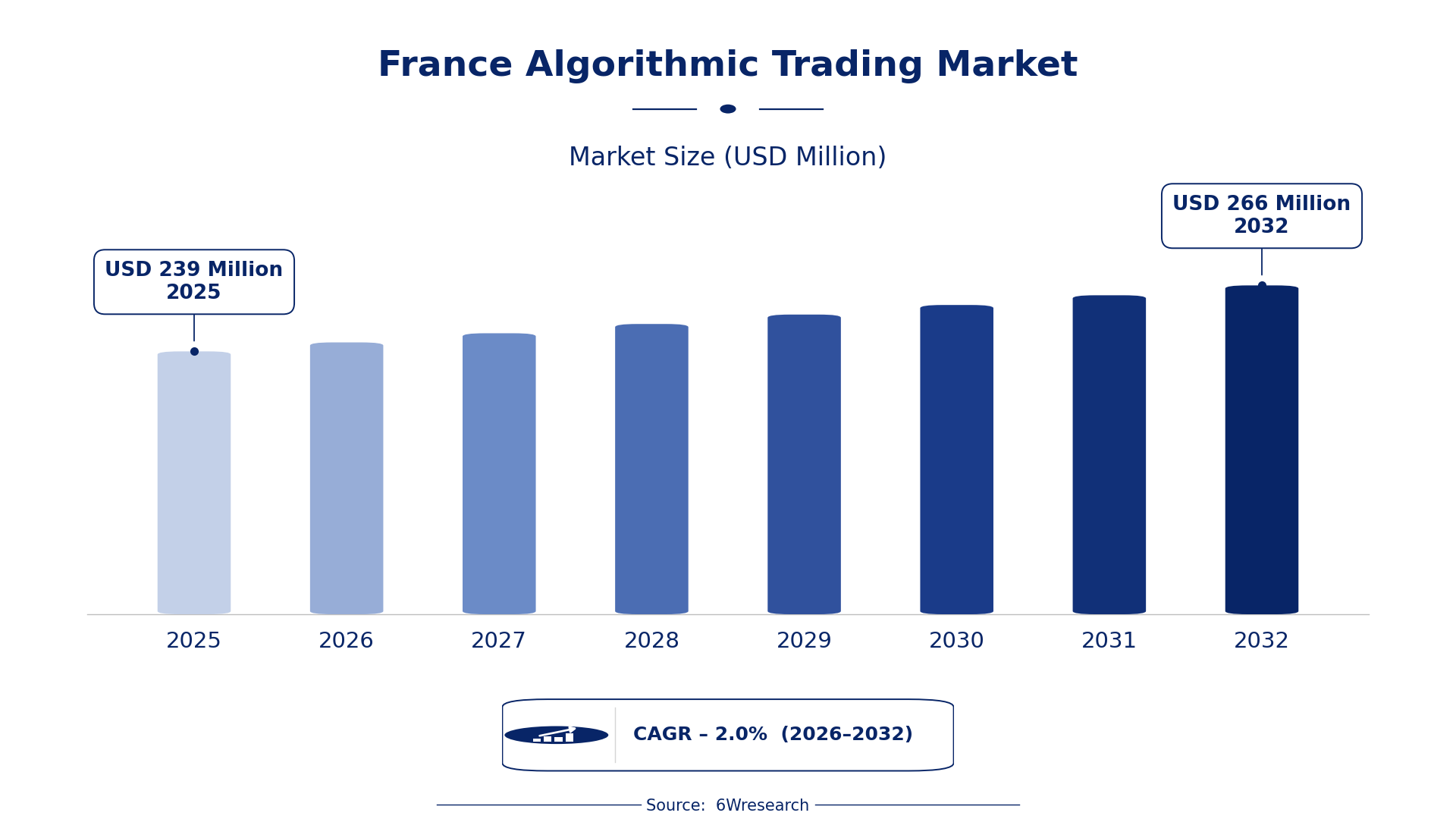
The France Algorithmic Trading Market was estimated at USD 239 Million in 2025 and is projected to reach USD 266 Million by 2032, growing at a CAGR of 2.0% from 2026 to 2032.
France Algorithmic Trading Market Synopsis
The France Algorithmic Trading Market is witnessing a transformative phase, heavily influenced by technological innovations and the increasing need for efficient trading solutions. As financial institutions and retail investors alike embrace automation, the market is rapidly evolving, reflecting broader shifts in trading practices.
Driven by the demand for high-frequency trading and sophisticated algorithms, the market is attracting significant investments in technology and infrastructure. The regulatory environment is becoming more stringent, compelling participants to adapt while ensuring compliance with evolving standards.
France Algorithmic Trading Market Year-wise Growth Rate and Key Drivers
This graph illustrates the annual growth rates of the France Algorithmic Trading Market from 2021 to 2032, highlighting a steady upward trajectory and projected expansion over the forecast period.
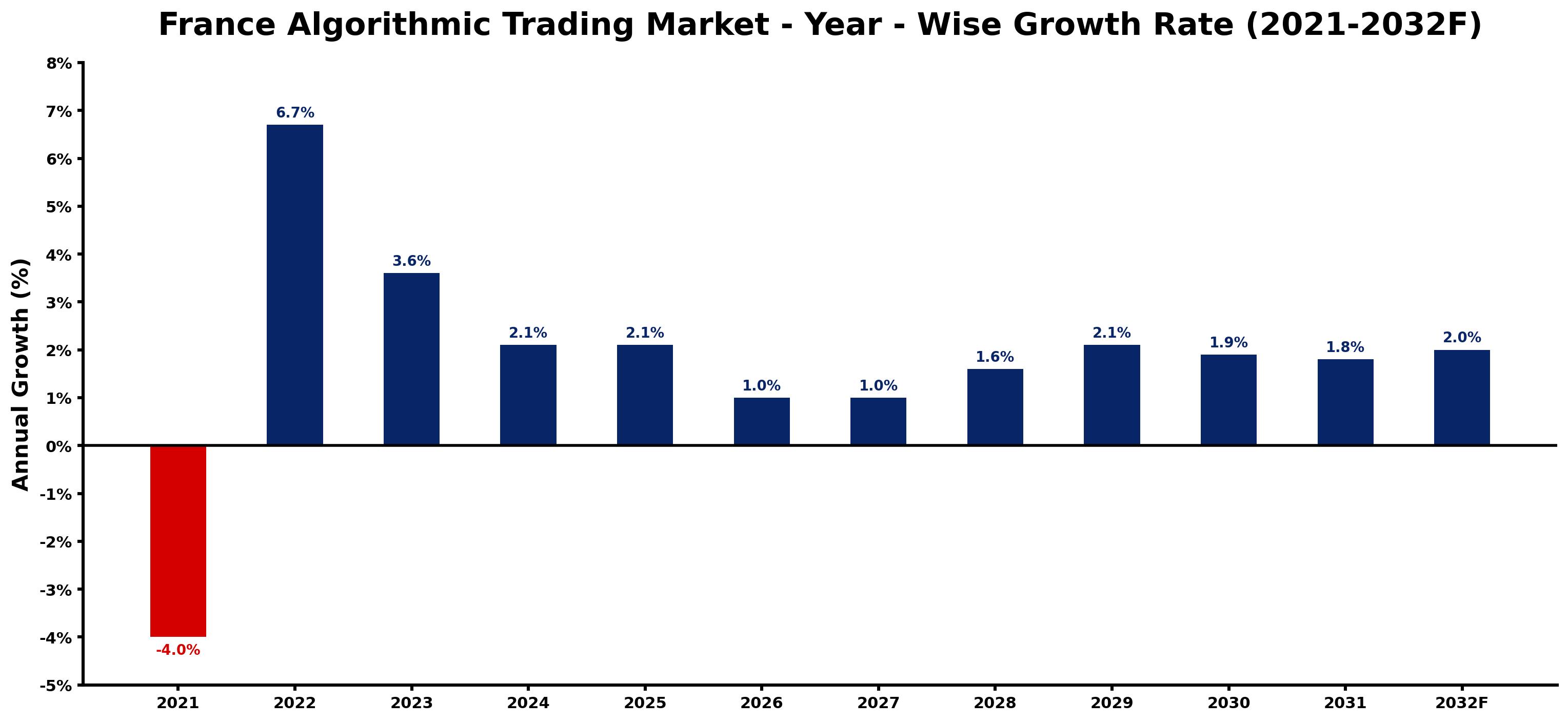
The table below presents the year‑wise growth rates along with the key drivers influencing the market
| Year | Growth Rate | Major Drivers |
| 2021 | -4.0% | EDHEC risk institute research reduced algorithmic trading adoption |
| 2022 | 6.7% | Regulatory support from AMF for algorithmic transparency |
| 2023 | 3.6% | Increased adoption of AI in stock trading platforms |
| 2024 | 2.1% | Growing interest in ESG trading algorithms among investors |
| 2025 | 2.1% | Launch of new fintech hubs in Paris region |
| 2026 | 1.0% | Enhanced trading analytics tools provided by French firms |
| 2027 | 1.0% | Development of local data centers boosting low-latency trading |
| 2028 | 1.6% | Rising fintech collaborations among Parisian startups |
| 2029 | 2.1% | Increased retail investor participation in algorithmic trading |
| 2030 | 1.9% | Strengthening of cybersecurity regulations enhancing trading trust |
| 2031 | 1.8% | Government incentives for tech innovation in trading sector |
| 2032 | 2.0% | Growth in digital assets fostering algorithmic strategies |
Note: Market size estimations and growth projections presented in this report are based on 6Wresearch's proprietary forecasting methodology, utilizing the latest available industry data, government publications, and primary research inputs.
France Algorithmic Trading Market Key Takeaways
Below are some of the specific key takeaways from the market, including:
- Technological advancements are central to the growth of algorithmic trading in France.
- Retail investors are increasingly participating, driving demand for user-friendly platforms.
- Regulatory requirements are influencing trading strategies and practices across the sector.
- AI and machine learning are becoming integral to developing trading algorithms.
- Environmental, social, and governance (ESG) factors are shaping trading decisions and strategies.
Evaluation of Restraints in France Algorithmic Trading Market
Despite the market's potential, several factors are constraining its growth. Strict regulatory frameworks, such as those established under MiFID II, impose compliance costs that can strain smaller firms. Additionally, the fierce competition among algorithmic trading firms is compressing profit margins, making it challenging for new entrants to establish a foothold. The need for cutting-edge technology is an ongoing financial burden, particularly as market participants strive to maintain an edge in an increasingly crowded field.
France Algorithmic Trading Market Trends
Several key trends are emerging in the France Algorithmic Trading Market. The adoption of artificial intelligence and machine learning is on the rise, enabling firms to refine their trading strategies and improve decision-making processes. Retail investors are also driving demand for accessible algorithmic trading tools, leading to the development of platforms that cater to this growing audience.
on top of that, compliance with regulations such as MiFID II is reshaping trading strategies, pushing firms towards greater transparency. The increasing emphasis on ESG factors is prompting algorithmic traders to incorporate sustainability into their decision-making frameworks, reflecting a shift in market priorities.
France Algorithmic Trading Market Opportunities
The France Algorithmic Trading Market is rife with investment opportunities. The burgeoning demand for advanced trading technologies and data analytics tools presents a prime area for growth. Companies specializing in algorithmic trading platforms and risk management solutions are well-positioned to capitalize on this trend.
Additionally, there is a significant opportunity for investment in R&D focused on innovative algorithms and AI technologies. As firms strive to differentiate themselves in a competitive marketplace, innovative solutions that enhance trading performance will be in high demand.
Government Initiatives in the France Algorithmic Trading Market
The regulatory framework governing the France Algorithmic Trading Market is evolving to promote both innovation and market integrity. The Autorité des Marchés Financiers (AMF) plays a crucial role in overseeing trading activities, ensuring compliance, and fostering a stable trading environment. Recent developments underscore the government's commitment to maintaining transparency while encouraging technological advancements.
- A national regulatory framework was introduced in 2025, enhancing reporting requirements for algorithmic trading firms.
- Current initiatives include an ongoing review of high-frequency trading practices to ensure compliance with new transparency standards.
- Upcoming measures are planned for 2026 to further regulate the use of AI in trading strategies to mitigate risks associated with algorithmic trading.
- Recent efforts have focused on enhancing digital infrastructure to support algorithmic trading activities across the financial sector.
Future Insights of the France Algorithmic Trading Market
Looking ahead, the France Algorithmic Trading Market is set for steady growth, driven by advancements in technology and a persistent demand for efficient trading solutions. As financial institutions and retail investors alike increasingly seek automated strategies, the market will likely see enhanced innovation and investment.
The interplay of regulatory changes and market dynamics will shape the future of algorithmic trading in France. Firms that can adapt to these shifts while prioritizing transparency and risk management will be better positioned to thrive in the coming years.
France Algorithmic Trading Market Latest Developments
In the past year, the France Algorithmic Trading Market has experienced a wave of significant developments. Increased investments in technology have been a hallmark of the sector, as firms race to enhance their trading capabilities amidst growing competition. Regulatory updates have also shaped the operational landscape, prompting firms to adapt quickly to new compliance standards.
- A major technology vendor launched a new algorithmic trading platform in Q3 2025, designed to enhance execution speed and reliability.
- Current initiatives include partnerships between fintech companies and traditional financial institutions to develop advanced trading algorithms.
- A regulatory initiative focusing on AI-driven trading strategies is currently underway, aimed at ensuring compliance with the latest standards.
- Plans are in motion for a national awareness campaign in early 2026 to educate retail investors on algorithmic trading tools.
France Algorithmic Trading Market - Key Attractiveness of the Report
- 10 Years of Market Numbers
- Historical Data Starting from 2022 to 2025
- Base Year: 2025
- Forecast Data until 2032
- Key Performance Indicators Impacting the Market
- Major Upcoming Developments and Projects
The French government, through the Autorité des Marchés Financiers (AMF), has implemented a regulatory framework that emphasizes compliance while fostering innovation, which includes transparency measures and ongoing reviews of trading practices.
Key Highlights of the Report:
- France Algorithmic Trading Market Outlook
- Market Size of France Algorithmic Trading Market, 2025
- Forecast of France Algorithmic Trading Market, 2032
- Historical Data and Forecast of France Algorithmic Trading Revenues & Volume for the Period 2022-2032F
- France Algorithmic Trading Market Trend Evolution
- France Algorithmic Trading Market Drivers and Challenges
- France Algorithmic Trading Price Trends
- France Algorithmic Trading Porter's Five Forces
- France Algorithmic Trading Industry Life Cycle
- Historical Data and Forecast of France Algorithmic Trading Market Revenues & Volume By Trading Type for the Period 2022-2032F
- Historical Data and Forecast of France Algorithmic Trading Market Revenues & Volume By Foreign Exchange (FOREX) for the Period 2022-2032F
- Historical Data and Forecast of France Algorithmic Trading Market Revenues & Volume By Stock Markets for the Period 2022-2032F
- Historical Data and Forecast of France Algorithmic Trading Market Revenues & Volume By Exchange-Traded Fund (ETF) for the Period 2022-2032F
- Historical Data and Forecast of France Algorithmic Trading Market Revenues & Volume By Bonds for the Period 2022-2032F
- Historical Data and Forecast of France Algorithmic Trading Market Revenues & Volume By Cryptocurrencies for the Period 2022-2032F
- Historical Data and Forecast of France Algorithmic Trading Market Revenues & Volume By Others for the Period 2022-2032F
- Historical Data and Forecast of France Algorithmic Trading Market Revenues & Volume By Deployment Mode for the Period 2022-2032F
- Historical Data and Forecast of France Algorithmic Trading Market Revenues & Volume By Cloud for the Period 2022-2032F
- Historical Data and Forecast of France Algorithmic Trading Market Revenues & Volume By On-premises for the Period 2022-2032F
- Historical Data and Forecast of France Algorithmic Trading Market Revenues & Volume By Component for the Period 2022-2032F
- Historical Data and Forecast of France Algorithmic Trading Market Revenues & Volume By Solutions for the Period 2022-2032F
- Historical Data and Forecast of France Algorithmic Trading Market Revenues & Volume By Services for the Period 2022-2032F
- Historical Data and Forecast of France Algorithmic Trading Market Revenues & Volume By Enterprise Size for the Period 2022-2032F
- Historical Data and Forecast of France Algorithmic Trading Market Revenues & Volume By Small and Medium-sized Enterprises (SMEs) for the Period 2022-2032F
- Historical Data and Forecast of France Algorithmic Trading Market Revenues & Volume By Large Enterprises for the Period 2022-2032F
- France Algorithmic Trading Import Export Trade Statistics
- Market Opportunity Assessment By Trading Type
- Market Opportunity Assessment By Deployment Mode
- Market Opportunity Assessment By Component
- Market Opportunity Assessment By Enterprise Size
- France Algorithmic Trading Top Companies Market Share
- France Algorithmic Trading Competitive Benchmarking By Technical and Operational Parameters
- France Algorithmic Trading Company Profiles
- France Algorithmic Trading Key Strategic Recommendations






































