Bahrain Algorithmic Trading Market Size & Growth Rate (2026-2032)
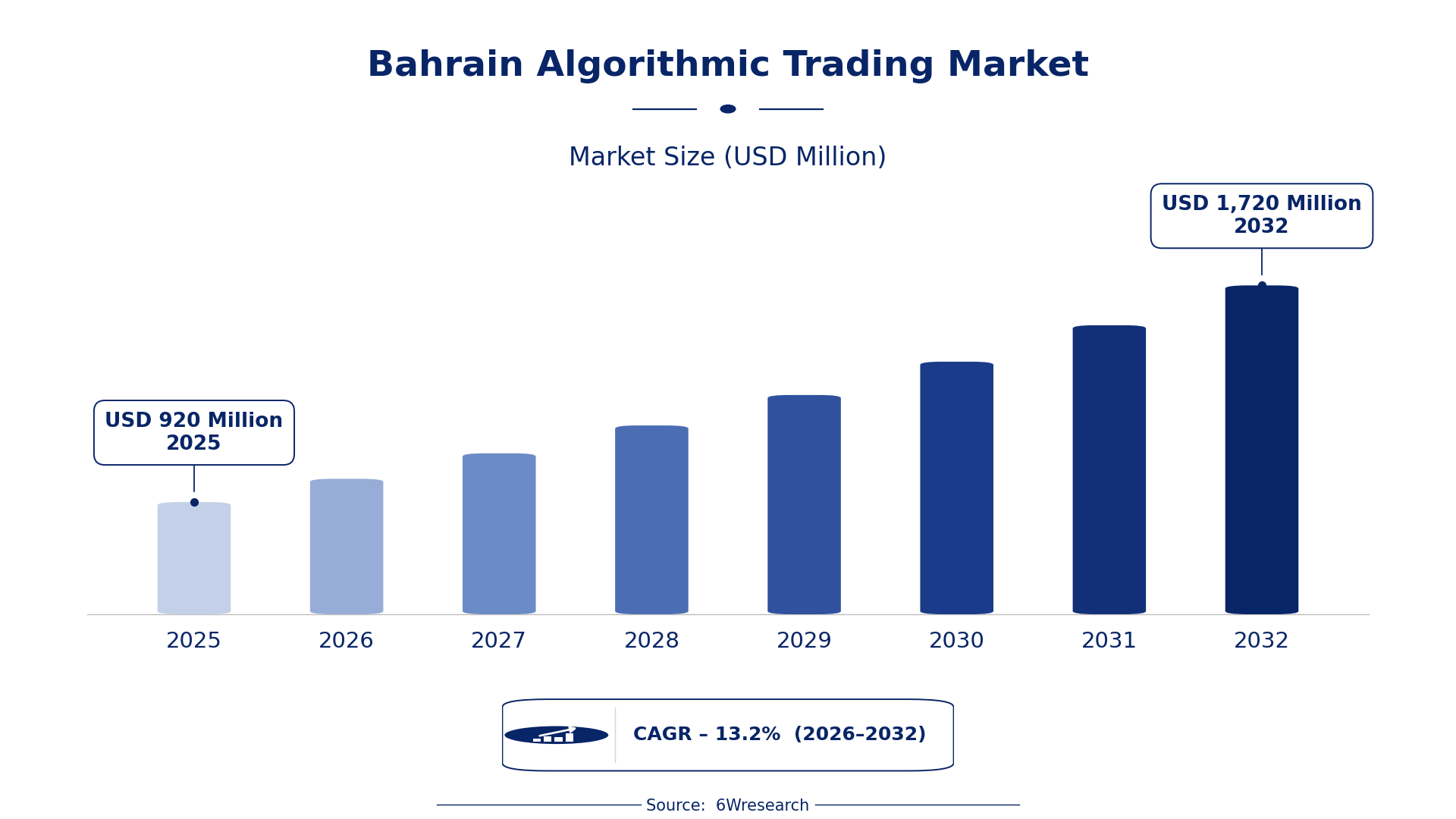
The Bahrain Algorithmic Trading Market was estimated at USD 920 Million in 2025 and is projected to reach USD 1720 Million by 2032, growing at a CAGR of 13.2% from 2026 to 2032.
Bahrain Algorithmic Trading Market Synopsis
The Bahrain Algorithmic Trading Market is witnessing a notable shift, with local financial institutions embracing automated trading strategies to enhance efficiency. This trend is driven by the demand for faster execution and reduced transaction costs, making algorithmic trading increasingly attractive to banks and asset managers.
As Bahrain positions itself as a burgeoning fintech hub, international firms are taking notice, leading to a heightened interest in algorithmic trading solutions. The evolution of the regulatory framework is further bolstering this market, as authorities work to create an environment conducive to innovative trading practices.
Bahrain Algorithmic Trading Market Year-wise Growth Rate and Key Drivers
This graph illustrates the annual growth rates of the Bahrain Algorithmic Trading Market from 2021 to 2032, highlighting a steady upward trajectory and projected expansion over the forecast period.
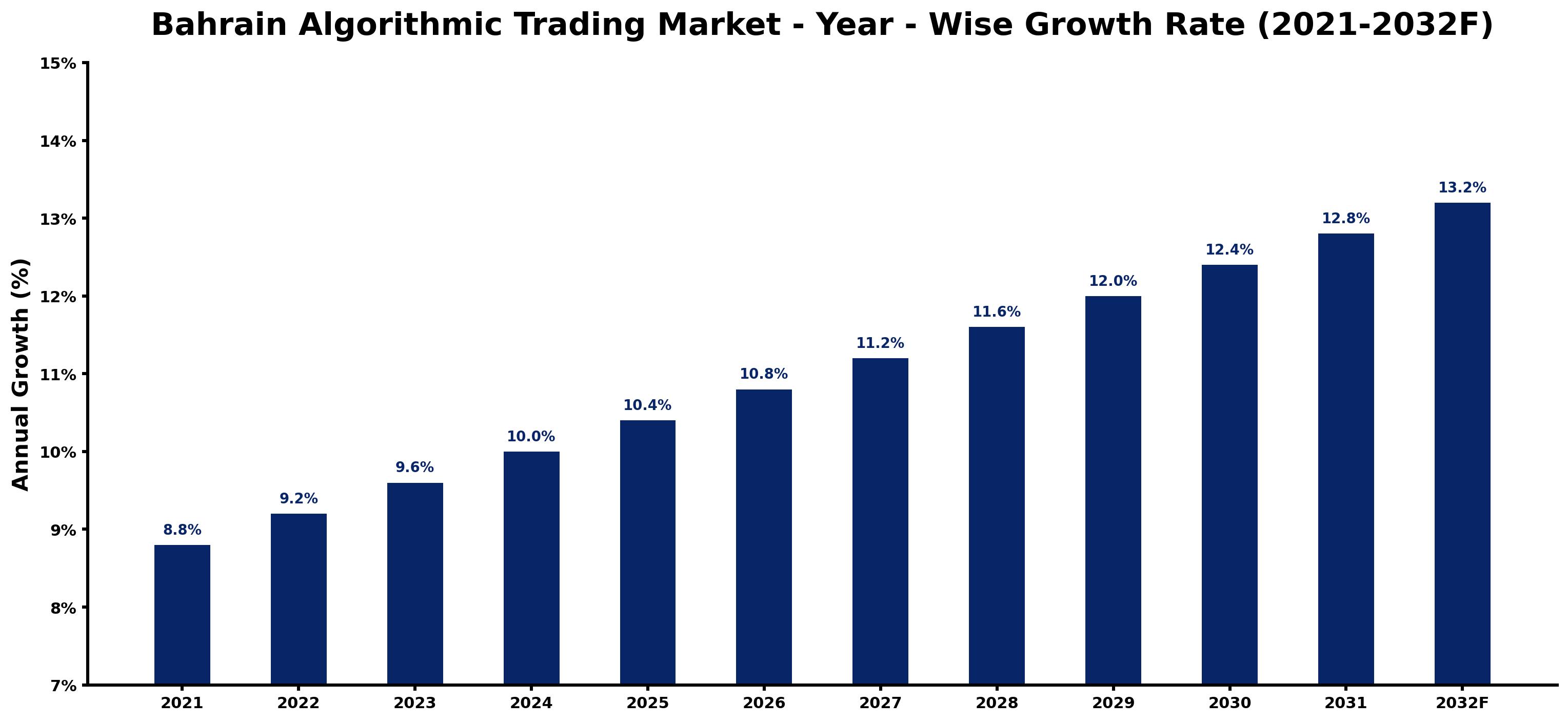
The table below presents the year‑wise growth rates along with the key drivers influencing the market
| Year | Growth Rate | Major Drivers |
| 2021 | 8.8% | Bahrain Fintech Bay supports innovative trading technologies. |
| 2022 | 9.2% | Increased regulatory clarity from the Central Bank of Bahrain. |
| 2023 | 9.6% | Growing interest in digital assets among Bahraini investors. |
| 2024 | 10.0% | Bahrain Economic Vision 2030 promotes financial technology expansion. |
| 2025 | 10.4% | Rising numbers of licensed algorithmic trading firms in Bahrain. |
| 2026 | 10.8% | Enhanced cybersecurity measures attract algorithmic trading firms. |
| 2027 | 11.2% | Local universities emphasize data science in finance programs. |
| 2028 | 11.6% | Bahrain's strategic location boosts regional trading activities. |
| 2029 | 12.0% | Emerging partnerships with global trading platforms enhance accessibility. |
| 2030 | 12.4% | Increased retail investor participation in algorithmic trading. |
| 2031 | 12.8% | Collaboration with tech firms drives trading software advancements. |
| 2032 | 13.2% | Strengthened data privacy laws encourage algorithmic trading adoption. |
Note: Market size estimations and growth projections presented in this report are based on 6Wresearch's proprietary forecasting methodology, utilizing the latest available industry data, government publications, and primary research inputs.
Bahrain Algorithmic Trading Market Key Takeaways
Below are some of the specific key takeaways from the market, including:
- The market is driven by increasing adoption of AI-driven algorithms for trading across various asset classes.
- Regulatory initiatives are actively shaping a supportive framework for algorithmic trading in Bahrain.
- Local financial institutions are investing heavily in developing or partnering with algo-trading platforms.
- Concerns regarding market surveillance and systemic risk remain critical challenges for the industry.
- Investment opportunities are emerging in trading infrastructure and risk management tools tailored for algorithmic trading.
Evaluation of Restraints in Bahrain Algorithmic Trading Market
Despite the growing interest, the Bahrain Algorithmic Trading Market faces several restraints. Regulatory uncertainty poses a significant hurdle, as the framework around high-frequency trading remains in flux. Additionally, a shortage of skilled professionals, particularly quant analysts and algorithm developers, hampers the growth of innovative trading solutions. The high cost of infrastructure and maintenance is another barrier, making it challenging for smaller firms and retail investors to enter the market.
Bahrain Algorithmic Trading Market Trends
The integration of artificial intelligence and machine learning in trading algorithms is a defining trend, enhancing predictive capabilities and decision-making processes. There’s also a marked shift towards real-time data analytics, enabling traders to make informed decisions swiftly. on top of that, the rise of digital assets is adding a new dimension to algorithmic trading strategies, encouraging innovation in trading methodologies.
Bahrain Algorithmic Trading Market Opportunities
Opportunities for growth are abundant, particularly in the development of AI-driven predictive modeling tools. As local banks and investment firms seek to optimize their trading operations, partnerships with tech companies specializing in algorithmic solutions are becoming increasingly common. Additionally, the emergence of cryptocurrency trading presents a novel avenue for algorithmic strategies, potentially attracting new investors to the market.
Government Initiatives in the Bahrain Algorithmic Trading Market
The regulatory landscape in Bahrain is evolving to embrace algorithmic trading, with the government prioritizing frameworks that enhance market liquidity and investor confidence. Initiatives are being implemented to facilitate innovation and ensure that the market can safely accommodate advanced trading technologies.
- A regulatory framework introduced in 2025 aims to standardize practices for algorithmic trading, ensuring transparency and risk management.
- Currently underway is a pilot program allowing fintech startups to test algorithmic trading solutions in a controlled environment, promoting innovation.
- A planned initiative set for 2027 focuses on establishing training programs in collaboration with universities to develop a skilled workforce in quantitative trading.
- The Central Bank of Bahrain is working to enhance market surveillance tools to better monitor algorithmic trading activities.
- Recent partnerships between the Bahrain Bourse and technology providers aim to integrate AI capabilities into trading systems.
Future Insights of the Bahrain Algorithmic Trading Market
Looking ahead, the Bahrain Algorithmic Trading Market is set for considerable expansion. As technology continues to advance and regulatory frameworks solidify, more financial institutions will embrace algorithmic trading. The increasing focus on digital assets and the demand for innovative trading solutions will further propel this market, potentially positioning Bahrain as a key player in the regional financial ecosystem.
Bahrain Algorithmic Trading Market Latest Developments
In recent months, activity in the Bahrain Algorithmic Trading Market has intensified, reflecting a growing commitment to modern trading practices. Financial institutions are actively seeking partnerships and technology solutions to enhance their algorithmic trading capabilities.
- A major technology vendor announced a partnership with local banks in early 2025 to develop advanced algorithmic trading tools tailored to regional needs.
- An initiative that began in Q2 2025 focuses on improving the speed and efficiency of trade execution through upgraded digital infrastructure.
- A rollout expected to begin in late 2026 aims to introduce enhanced AI capabilities into the Bahrain Bourse’s trading platform.
- Currently ongoing is a comprehensive review of existing regulations to better align with global standards for high-frequency trading practices.
- Recent developments include the launch of a workshop series in mid-2025 aimed at educating finance professionals on algorithmic trading strategies.
Bahrain Algorithmic Trading Market - Key Attractiveness of the Report
- 10 Years of Market Numbers
- Historical Data Starting from 2022 to 2025
- Base Year: 2025
- Forecast Data until 2032
- Key Performance Indicators Impacting the Market
- Major Upcoming Developments and Projects
Key Highlights of the Report:
- Bahrain Algorithmic Trading Market Outlook
- Market Size of Bahrain Algorithmic Trading Market, 2025
- Forecast of Bahrain Algorithmic Trading Market, 2032
- Historical Data and Forecast of Bahrain Algorithmic Trading Revenues & Volume for the Period 2022-2032F
- Bahrain Algorithmic Trading Market Trend Evolution
- Bahrain Algorithmic Trading Market Drivers and Challenges
- Bahrain Algorithmic Trading Price Trends
- Bahrain Algorithmic Trading Porter's Five Forces
- Bahrain Algorithmic Trading Industry Life Cycle
- Historical Data and Forecast of Bahrain Algorithmic Trading Market Revenues & Volume By Trading Type for the Period 2022-2032F
- Historical Data and Forecast of Bahrain Algorithmic Trading Market Revenues & Volume By Foreign Exchange (FOREX) for the Period 2022-2032F
- Historical Data and Forecast of Bahrain Algorithmic Trading Market Revenues & Volume By Stock Markets for the Period 2022-2032F
- Historical Data and Forecast of Bahrain Algorithmic Trading Market Revenues & Volume By Exchange-Traded Fund (ETF) for the Period 2022-2032F
- Historical Data and Forecast of Bahrain Algorithmic Trading Market Revenues & Volume By Bonds for the Period 2022-2032F
- Historical Data and Forecast of Bahrain Algorithmic Trading Market Revenues & Volume By Cryptocurrencies for the Period 2022-2032F
- Historical Data and Forecast of Bahrain Algorithmic Trading Market Revenues & Volume By Others for the Period 2022-2032F
- Historical Data and Forecast of Bahrain Algorithmic Trading Market Revenues & Volume By Deployment Mode for the Period 2022-2032F
- Historical Data and Forecast of Bahrain Algorithmic Trading Market Revenues & Volume By Cloud for the Period 2022-2032F
- Historical Data and Forecast of Bahrain Algorithmic Trading Market Revenues & Volume By On-premises for the Period 2022-2032F
- Historical Data and Forecast of Bahrain Algorithmic Trading Market Revenues & Volume By Component for the Period 2022-2032F
- Historical Data and Forecast of Bahrain Algorithmic Trading Market Revenues & Volume By Solutions for the Period 2022-2032F
- Historical Data and Forecast of Bahrain Algorithmic Trading Market Revenues & Volume By Services for the Period 2022-2032F
- Historical Data and Forecast of Bahrain Algorithmic Trading Market Revenues & Volume By Enterprise Size for the Period 2022-2032F
- Historical Data and Forecast of Bahrain Algorithmic Trading Market Revenues & Volume By Small and Medium-sized Enterprises (SMEs) for the Period 2022-2032F
- Historical Data and Forecast of Bahrain Algorithmic Trading Market Revenues & Volume By Large Enterprises for the Period 2022-2032F
- Bahrain Algorithmic Trading Import Export Trade Statistics
- Market Opportunity Assessment By Trading Type
- Market Opportunity Assessment By Deployment Mode
- Market Opportunity Assessment By Component
- Market Opportunity Assessment By Enterprise Size
- Bahrain Algorithmic Trading Top Companies Market Share
- Bahrain Algorithmic Trading Competitive Benchmarking By Technical and Operational Parameters
- Bahrain Algorithmic Trading Company Profiles
- Bahrain Algorithmic Trading Key Strategic Recommendations






































