France Application Security Market Size & Growth Rate (2026-2032)
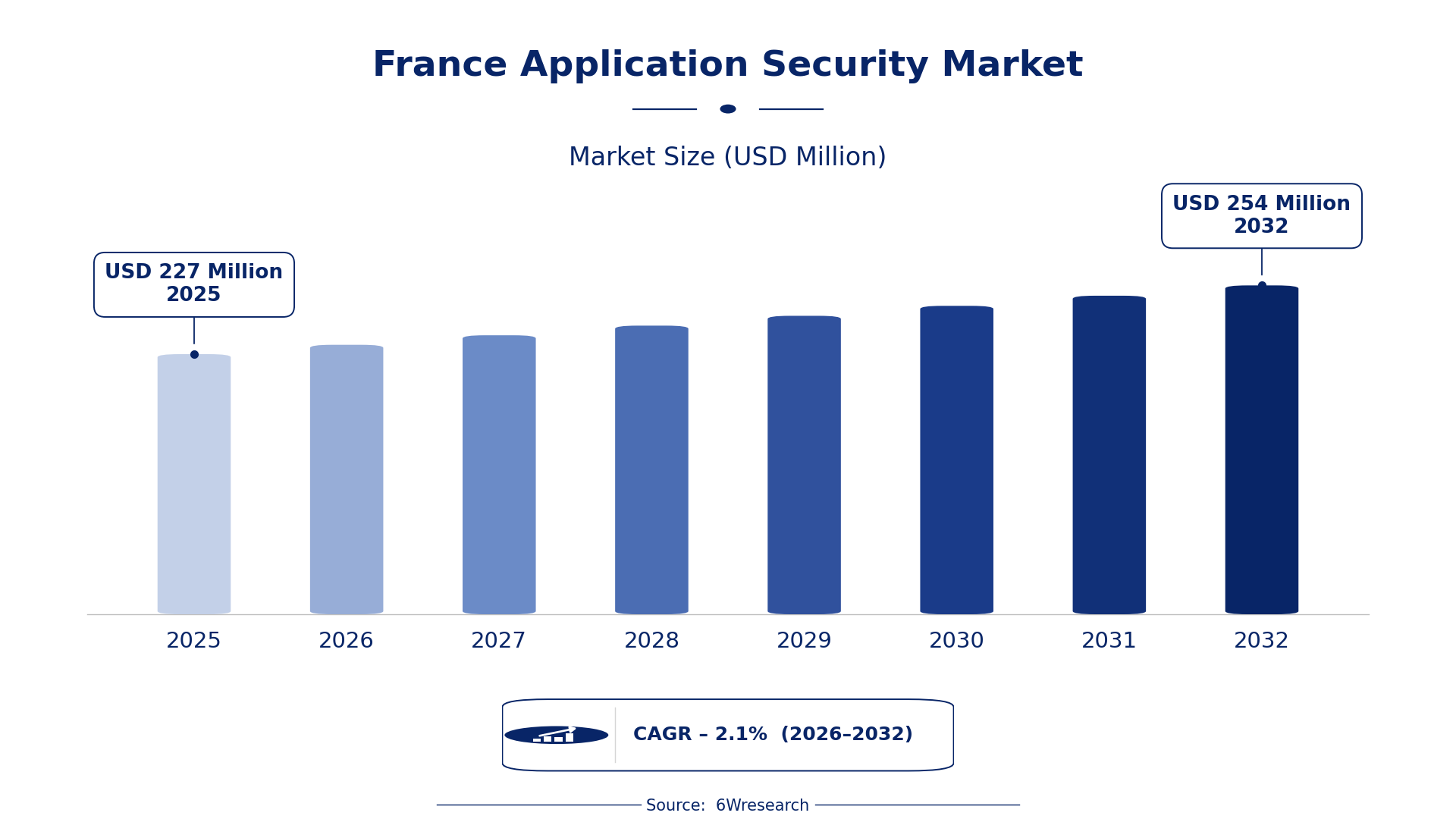
The France Application Security Market was estimated at USD 227 Million in 2025 and is projected to reach USD 254 Million by 2032, growing at a CAGR of 2.1% from 2026 to 2032.
France Application Security Market Synopsis
Recent momentum in the France Application Security Market reflects a heightened urgency among organizations to fortify their defenses against an increasing barrage of cyber threats. As digital transformation accelerates across various sectors, the need for sophisticated security solutions has become paramount.
Looking ahead, the market is set to evolve as organizations adopt more integrated security frameworks. This shift is driven by the growing complexity of cyber risks and the regulatory demands placed on businesses, positioning application security as a cornerstone of modern IT strategies.
France Application Security Market Year-wise Growth Rate and Key Drivers
This graph illustrates the annual growth rates of the France Application Security Market from 2021 to 2032, highlighting a steady upward trajectory and projected expansion over the forecast period.
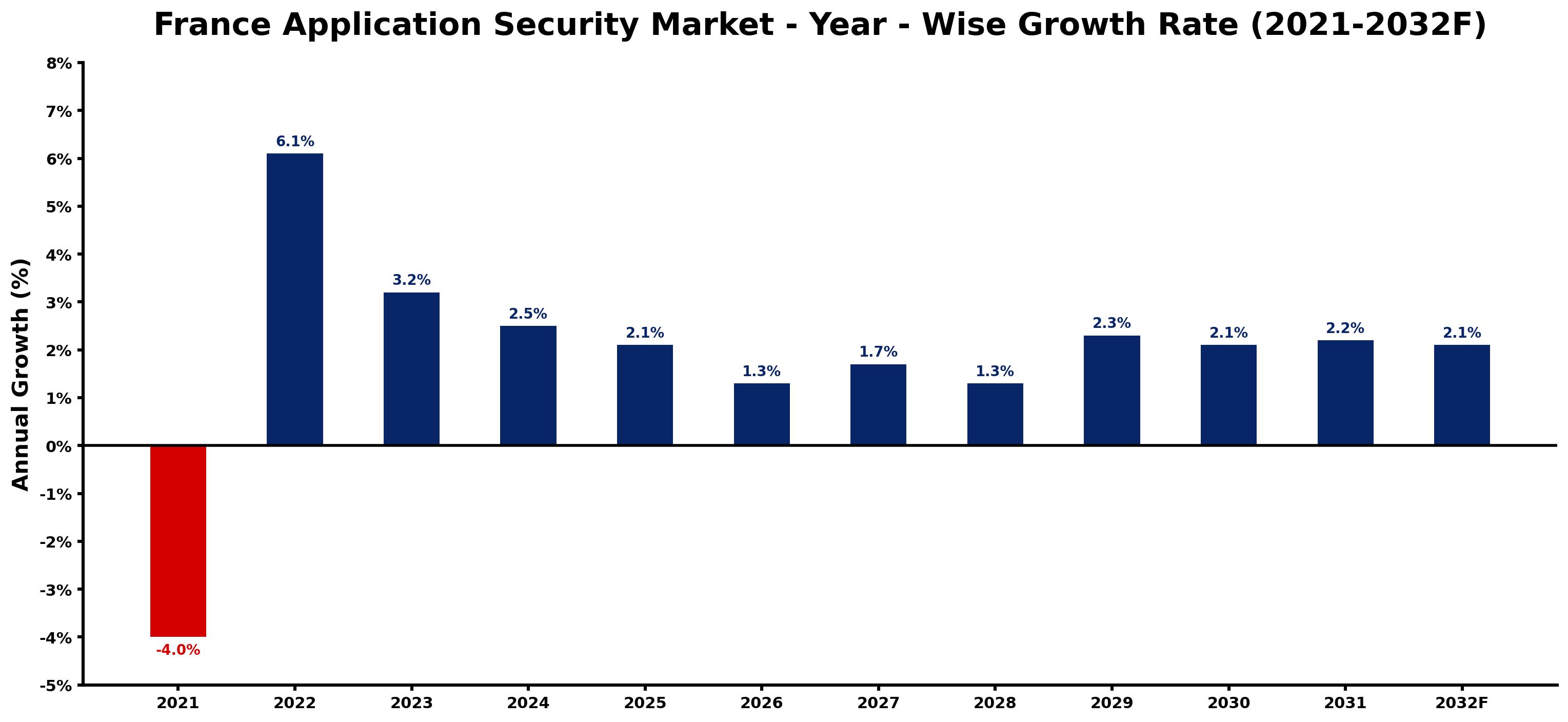
The table below presents the year‑wise growth rates along with the key drivers influencing the market
| Year | Growth Rate | Major Drivers |
| 2021 | -4.0% | GDPR compliance costs hampered small business investments. |
| 2022 | 6.1% | Increased GDPR compliance demands from French enterprises. |
| 2023 | 3.2% | Growing adoption of DevSecOps practices in French tech. |
| 2024 | 2.5% | Rising investments in fintech security solutions in France. |
| 2025 | 2.1% | Strengthened cybersecurity regulations from ANSSI for applications. |
| 2026 | 1.3% | Increased remote work leading to higher application security needs. |
| 2027 | 1.7% | Increasing cyber threats targeting French digital transformation efforts. |
| 2028 | 1.3% | Local startups driving innovation in application security technologies. |
| 2029 | 2.3% | Government incentives for secure software development practices. |
| 2030 | 2.1% | Adoption of AI-driven security tools in French organizations. |
| 2031 | 2.2% | Rising consumer awareness of app security in France. |
| 2032 | 2.1% | Enhanced mobile application security requirements from telecom operators. |
Note: Market size estimations and growth projections presented in this report are based on 6Wresearch's proprietary forecasting methodology, utilizing the latest available industry data, government publications, and primary research inputs.
France Application Security Market Key Takeaways
Below are some of the specific key takeaways from the market, including:
- Steady growth is expected as organizations increase investment in application security due to rising cyber threats.
- Cloud-based application security solutions are gaining traction as businesses seek more flexible security options.
- The shift towards DevSecOps practices is revolutionizing how security is embedded within development processes.
- Automation and artificial intelligence are becoming critical components for effective threat detection and response.
- Mobile application security is increasingly prioritized as consumer reliance on mobile devices intensifies.
Evaluation of Restraints in France Application Security Market
Despite the market's potential, several factors hinder its growth. The escalating sophistication of cyber threats often outpaces the capabilities of existing security solutions, leaving gaps in protection. Additionally, the shortage of skilled cybersecurity professionals complicates the implementation of advanced security measures, causing delays in adopting robust frameworks. Small and medium enterprises face budget constraints that make investing in comprehensive security solutions a daunting challenge. Such limitations pose serious risks as the attack surface expands with the rise of IoT and mobile applications.
France Application Security Market Trends
Key trends shaping the France Application Security Market include an increasing reliance on cloud services, which has prompted a shift toward scalable application security solutions. Companies are embracing DevSecOps to incorporate security throughout the software development lifecycle, minimizing vulnerabilities. The role of automation and AI in threat detection is critical, helping organizations respond to incidents more swiftly. on top of that, the escalating use of mobile applications drives demand for tailored security measures in that domain.
France Application Security Market Opportunities
The market presents fertile ground for investment, particularly in cybersecurity startups focused on innovative application security solutions. As organizations wrestle with the challenges of securing their applications, consulting services can bridge knowledge gaps, helping businesses enhance their security postures. There’s significant room for development of advanced solutions that cater specifically to France's regulatory environment and unique security challenges, offering promising prospects for growth in this sector.
Government Initiatives in the France Application Security Market
Government policies play a crucial role in shaping the France Application Security Market, establishing a framework that encourages enhanced cybersecurity practices. The introduction of the General Data Protection Regulation (GDPR) has set a high standard for data protection, compelling organizations to adopt stringent security measures. Coupled with initiatives from the National Cybersecurity Strategy, there’s a clear commitment to fortifying the nation's cybersecurity posture.
- A recently completed initiative in 2023 focused on strengthening the cybersecurity infrastructure of small enterprises through subsidized security assessments.
- Currently ongoing is a public campaign to raise awareness about cybersecurity best practices among businesses, targeting sectors with high data sensitivity.
- A planned public-private partnership aims to develop a national framework for incident response, expected to be announced by 2025.
- The National Agency for the Security of Information Systems (ANSSI) continues to provide essential resources and guidelines to help businesses comply with GDPR.
- A new regulatory framework introduced in 2024 mandates enhanced security protocols for organizations handling sensitive information.
Future Insights of the France Application Security Market
Looking towards 2026-2032, the France Application Security Market is set for substantial growth. Organizations will increasingly prioritize securing their digital assets as cyber threats become more prevalent and complex. The regulatory landscape will continue to evolve, demanding higher compliance standards. Additionally, the trend towards remote work and increased mobile device usage will drive innovation in application security solutions, ensuring market players remain agile and responsive to emerging challenges.
France Application Security Market Latest Developments
The past year has seen dynamic activity in the France Application Security Market, with organizations ramping up efforts to enhance their security measures. The urgency for advanced solutions has driven several notable developments as companies look to stay ahead of potential threats.
- A leading cybersecurity firm rolled out an integrated application security platform in Q1 2023, combining threat intelligence with real-time protection capabilities.
- An initiative aimed at improving the cybersecurity skills of professionals began in mid-2023 and remains underway, focusing on training programs and workshops.
- By the end of 2023, a collaborative research project involving several tech companies is set to deliver innovations in AI-driven security solutions tailored for the French market.
- Plans for a significant security upgrade to public sector applications are expected to commence in early 2025, involving comprehensive assessments and enhancements.
- A major technology vendor announced a partnership in late 2023 to develop advanced mobile security solutions specifically designed for French enterprises.
France Application Security Market - Key Attractiveness of the Report
- 10 Years of Market Numbers
- Historical Data Starting from 2022 to 2025
- Base Year: 2025
- Forecast Data until 2032
- Key Performance Indicators Impacting the Market
- Major Upcoming Developments and Projects
Key Highlights of the Report:
- France Application Security Market Outlook
- Market Size of France Application Security Market, 2025
- Forecast of France Application Security Market, 2032
- Historical Data and Forecast of France Application Security Revenues & Volume for the Period 2022-2032F
- France Application Security Market Trend Evolution
- France Application Security Market Drivers and Challenges
- France Application Security Price Trends
- France Application Security Porter's Five Forces
- France Application Security Industry Life Cycle
- Historical Data and Forecast of France Application Security Market Revenues & Volume By Component for the Period 2022-2032F
- Historical Data and Forecast of France Application Security Market Revenues & Volume By Software Tools (SAST and DAST) for the Period 2022-2032F
- Historical Data and Forecast of France Application Security Market Revenues & Volume By Services for the Period 2022-2032F
- Historical Data and Forecast of France Application Security Market Revenues & Volume By Type for the Period 2022-2032F
- Historical Data and Forecast of France Application Security Market Revenues & Volume By Web Application Security for the Period 2022-2032F
- Historical Data and Forecast of France Application Security Market Revenues & Volume By Mobile Application Security for the Period 2022-2032F
- Historical Data and Forecast of France Application Security Market Revenues & Volume By Deployment Mode for the Period 2022-2032F
- Historical Data and Forecast of France Application Security Market Revenues & Volume By On-premises for the Period 2022-2032F
- Historical Data and Forecast of France Application Security Market Revenues & Volume By Cloud for the Period 2022-2032F
- Historical Data and Forecast of France Application Security Market Revenues & Volume By Organization Size for the Period 2022-2032F
- Historical Data and Forecast of France Application Security Market Revenues & Volume By Large Enterprises for the Period 2022-2032F
- Historical Data and Forecast of France Application Security Market Revenues & Volume By SMEs for the Period 2022-2032F
- Historical Data and Forecast of France Application Security Market Revenues & Volume By Vertical Healthcare for the Period 2022-2032F
- Historical Data and Forecast of France Application Security Market Revenues & Volume By Healthcare for the Period 2022-2032F
- Historical Data and Forecast of France Application Security Market Revenues & Volume By BFSI for the Period 2022-2032F
- France Application Security Import Export Trade Statistics
- Market Opportunity Assessment By Component
- Market Opportunity Assessment By Type
- Market Opportunity Assessment By Deployment Mode
- Market Opportunity Assessment By Organization Size
- Market Opportunity Assessment By Vertical Healthcare
- France Application Security Top Companies Market Share
- France Application Security Competitive Benchmarking By Technical and Operational Parameters
- France Application Security Company Profiles
- France Application Security Key Strategic Recommendations






































