Qatar Application Security Market Size & Growth Rate (2026-2032)
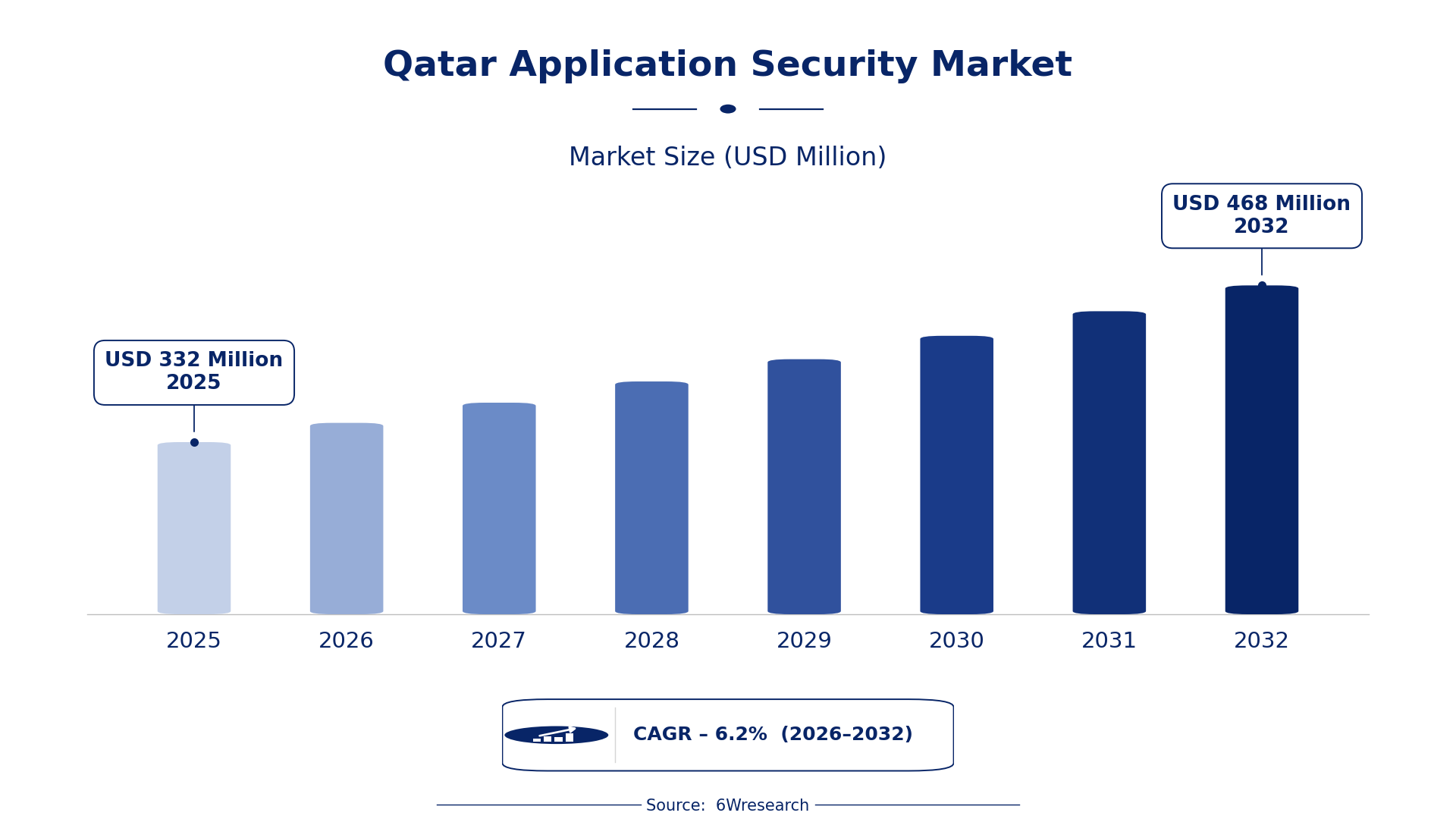
The Qatar Application Security Market was estimated at USD 332 Million in 2025 and is projected to reach USD 468 Million by 2032, growing at a CAGR of 6.2% from 2026 to 2032.
Qatar Application Security Market Synopsis
As Qatar's digital economy expands, the security of applications has taken center stage. Organizations are integrating application security into their core strategies, primarily to protect sensitive data and maintain customer trust amidst rising cyber threats.
With the surge in mobile and web-based applications, the demand for application security solutions is not only growing but is also evolving. Solutions like static and dynamic application security testing are being adopted to address vulnerabilities early in the software development life cycle, marking a shift toward proactive security measures.
Qatar Application Security Market Year-wise Growth Rate and Key Drivers
This graph illustrates the annual growth rates of the Qatar Application Security Market from 2021 to 2032, highlighting a steady upward trajectory and projected expansion over the forecast period.
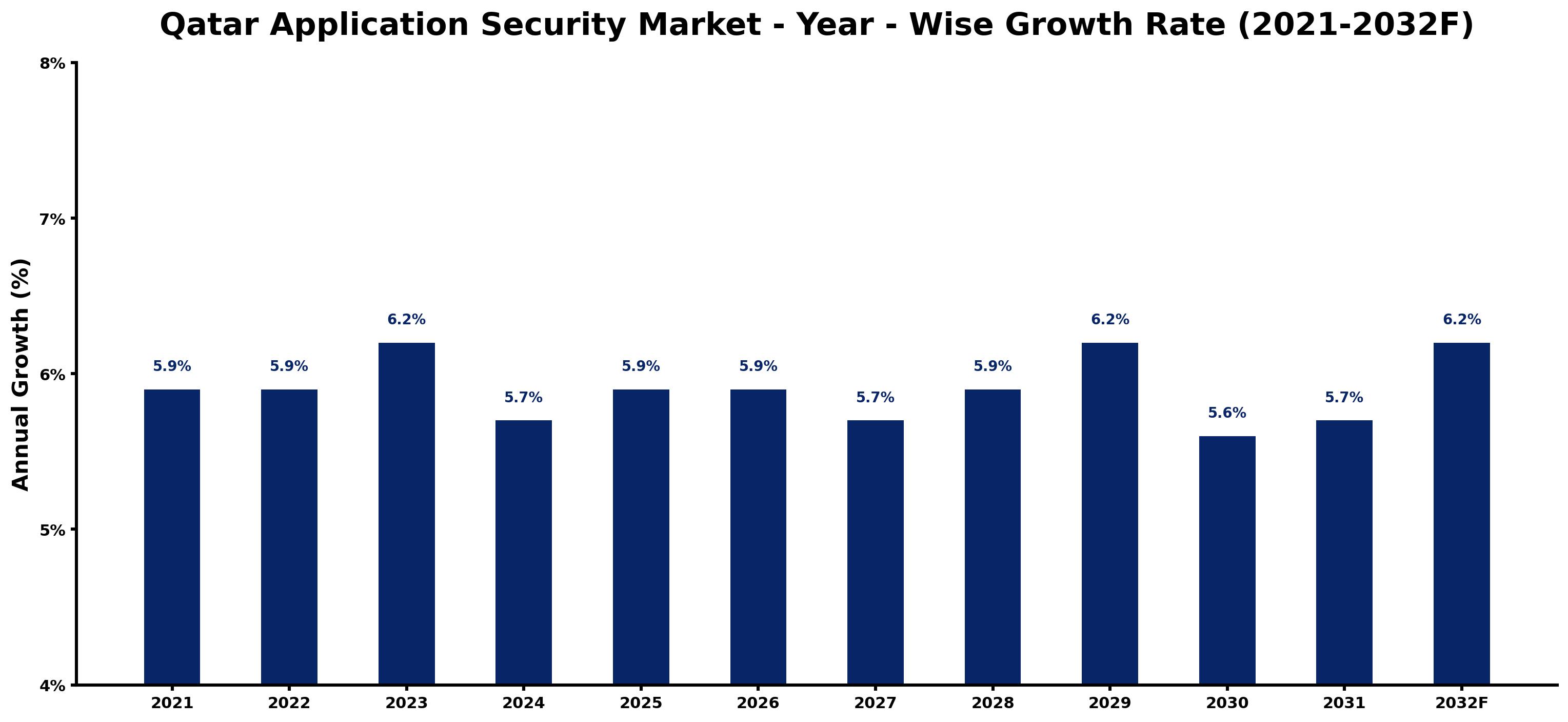
The table below presents the year‑wise growth rates along with the key drivers influencing the market
| Year | Growth Rate | Major Drivers |
| 2021 | 5.9% | Increased cybersecurity threats during World Cup preparations. |
| 2022 | 5.9% | Qatar National Cybersecurity Strategy implementation accelerating security needs. |
| 2023 | 6.2% | Rising adoption of cloud applications among local enterprises. |
| 2024 | 5.7% | Government incentives for digital transformation in key sectors. |
| 2025 | 5.9% | Growing focus on protecting personal data under Qatari law. |
| 2026 | 5.9% | Booming fintech sector requiring enhanced application security measures. |
| 2027 | 5.7% | Increased mobile app usage driving demand for security solutions. |
| 2028 | 5.9% | Public sector push for secure online services and portals. |
| 2029 | 6.2% | Strengthened regulations on digital identity protection in applications. |
| 2030 | 5.6% | Emergence of local cybersecurity startups enhancing market competitiveness. |
| 2031 | 5.7% | Rising investment in smart city applications necessitating security frameworks. |
| 2032 | 6.2% | Collaboration with international firms boosting application security capabilities. |
Note: Market size estimations and growth projections presented in this report are based on 6Wresearch's proprietary forecasting methodology, utilizing the latest available industry data, government publications, and primary research inputs.
Qatar Application Security Market Key Takeaways
Below are some of the specific key takeaways from the market, including:
- The market is driven by increasing cyber threats and the need for robust security measures.
- Organizations are prioritizing secure development practices as a direct response to high-profile data breaches.
- Dynamic application security testing is becoming a key focus for many businesses.
- Investment in application security is being viewed as essential to maintaining customer trust and safeguarding data integrity.
- The integration of security into the software development lifecycle is reshaping traditional development practices.
Evaluation of Restraints in Qatar Application Security Market
The Qatar Application Security Market faces constraints primarily due to the rapid evolution of software applications. Increasing complexity, combined with diverse development methodologies, poses challenges for ensuring comprehensive security throughout the application lifecycle. Organizations must also contend with vulnerabilities in third-party components, making it essential to implement effective security measures without hindering agility. on top of that, there is a pressing need to foster a culture of secure coding practices among developers to mitigate risks effectively. These challenges necessitate a concerted effort to elevate the standards of application security across the region.
Qatar Application Security Market Trends
Emerging trends indicate a strong shift towards automation in application security processes. Automated tools for static and dynamic testing are gaining traction as they enhance efficiency and accuracy. Additionally, the rise of DevSecOps is influencing organizations to incorporate security measures earlier in the software development cycle, allowing for quicker identification and remediation of vulnerabilities. Another notable trend is the growing emphasis on training developers in secure coding practices to minimize risks associated with application development.
Qatar Application Security Market Opportunities
The market presents substantial growth opportunities, particularly in sectors heavily reliant on digital applications, such as finance, healthcare, and e-commerce. Organizations are looking to adopt comprehensive application security frameworks that encompass testing, monitoring, and incident response. Additionally, the demand for managed security services is rising, as many businesses seek expertise in navigating the complex security landscape. Companies that can innovate and adapt to the evolving threat landscape stand to benefit significantly in the coming years.
Government Initiatives in the Qatar Application Security Market
The Qatari government has recognized the critical importance of application security as part of its broader digital transformation agenda. By establishing a regulatory environment that promotes security best practices, government initiatives are shaping the future of the application security market. Support for public-private partnerships is also evident, fostering collaboration to enhance national security standards.
- A recent initiative launched in early 2025 introduced a cybersecurity framework aimed at improving application security across all public sector entities.
- Currently ongoing is a nationwide training program designed to educate developers on secure coding practices and application security essentials.
- A planned public-private partnership expected to start by late 2026 will focus on developing advanced security technologies tailored for the application development community.
- The government is in the process of revising regulations to ensure that all software applications comply with established security standards by 2027.
- An upcoming national security awareness campaign targeting businesses and educational institutions is set to launch in early 2026.
Future Insights of the Qatar Application Security Market
As we look ahead to 2026-2032, the Qatar Application Security Market is expected to evolve dramatically. The increasing sophistication of cyber threats will drive organizations to adopt more advanced security solutions, making automation and AI integral components of application security strategies. on top of that, regulatory requirements will continue to shape security practices, necessitating ongoing investments in compliance and risk management. The demand for integrated security solutions that encompass testing, monitoring, and risk assessment will be pivotal in ensuring a resilient application environment.
Qatar Application Security Market Latest Developments
In the last 12-14 months, activity within the Qatar Application Security Market has intensified as organizations react to a growing threat landscape. Investments are being made into new technologies and partnerships to enhance application security protocols.
- A major technology vendor launched a state-of-the-art application security testing solution in Q1 2025, aiming to simplify the testing process for developers.
- An initiative that began in late 2025 is currently underway to integrate application security tools directly into popular development environments, streamlining security practices.
- By mid-2026, a regional operator plans to expand its managed security services to include comprehensive application security assessments for businesses.
- A collaborative project is set to kick off in early 2026, bringing together industry leaders to develop standard security practices across various sectors.
Qatar Application Security Market - Key Attractiveness of the Report
- 10 Years of Market Numbers
- Historical Data Starting from 2022 to 2025
- Base Year: 2025
- Forecast Data until 2032
- Key Performance Indicators Impacting the Market
- Major Upcoming Developments and Projects
Key Highlights of the Report:
- Qatar Application Security Market Outlook
- Market Size of Qatar Application Security Market, 2025
- Forecast of Qatar Application Security Market, 2032
- Historical Data and Forecast of Qatar Application Security Revenues & Volume for the Period 2022-2032F
- Qatar Application Security Market Trend Evolution
- Qatar Application Security Market Drivers and Challenges
- Qatar Application Security Price Trends
- Qatar Application Security Porter's Five Forces
- Qatar Application Security Industry Life Cycle
- Historical Data and Forecast of Qatar Application Security Market Revenues & Volume By Component for the Period 2022-2032F
- Historical Data and Forecast of Qatar Application Security Market Revenues & Volume By Software Tools (SAST and DAST) for the Period 2022-2032F
- Historical Data and Forecast of Qatar Application Security Market Revenues & Volume By Services for the Period 2022-2032F
- Historical Data and Forecast of Qatar Application Security Market Revenues & Volume By Type for the Period 2022-2032F
- Historical Data and Forecast of Qatar Application Security Market Revenues & Volume By Web Application Security for the Period 2022-2032F
- Historical Data and Forecast of Qatar Application Security Market Revenues & Volume By Mobile Application Security for the Period 2022-2032F
- Historical Data and Forecast of Qatar Application Security Market Revenues & Volume By Deployment Mode for the Period 2022-2032F
- Historical Data and Forecast of Qatar Application Security Market Revenues & Volume By On-premises for the Period 2022-2032F
- Historical Data and Forecast of Qatar Application Security Market Revenues & Volume By Cloud for the Period 2022-2032F
- Historical Data and Forecast of Qatar Application Security Market Revenues & Volume By Organization Size for the Period 2022-2032F
- Historical Data and Forecast of Qatar Application Security Market Revenues & Volume By Large Enterprises for the Period 2022-2032F
- Historical Data and Forecast of Qatar Application Security Market Revenues & Volume By SMEs for the Period 2022-2032F
- Historical Data and Forecast of Qatar Application Security Market Revenues & Volume By Vertical Healthcare for the Period 2022-2032F
- Historical Data and Forecast of Qatar Application Security Market Revenues & Volume By Healthcare for the Period 2022-2032F
- Historical Data and Forecast of Qatar Application Security Market Revenues & Volume By BFSI for the Period 2022-2032F
- Qatar Application Security Import Export Trade Statistics
- Market Opportunity Assessment By Component
- Market Opportunity Assessment By Type
- Market Opportunity Assessment By Deployment Mode
- Market Opportunity Assessment By Organization Size
- Market Opportunity Assessment By Vertical Healthcare
- Qatar Application Security Top Companies Market Share
- Qatar Application Security Competitive Benchmarking By Technical and Operational Parameters
- Qatar Application Security Company Profiles
- Qatar Application Security Key Strategic Recommendations






































