France Carbon Credit Market Size, Share & Growth Rate
The France Carbon Credit Market was estimated at USD 196 Million in 2025 and is projected to reach USD 216 Million by 2032, growing at a CAGR of 1.4% from 2026 to 2032. This growth trajectory is fueled by France's strong commitment to reducing greenhouse gas emissions and enhancing its regulatory framework under the EU ETS. Increasing participation from various sectors, driven by both compliance needs and corporate sustainability goals, further contributes to this upward trend.
France Carbon Credit Market Year-wise Growth Rate and Key Drivers
This graph highlights how the France Carbon Credit Market has steadily grown over the years, supported by major growth factors.
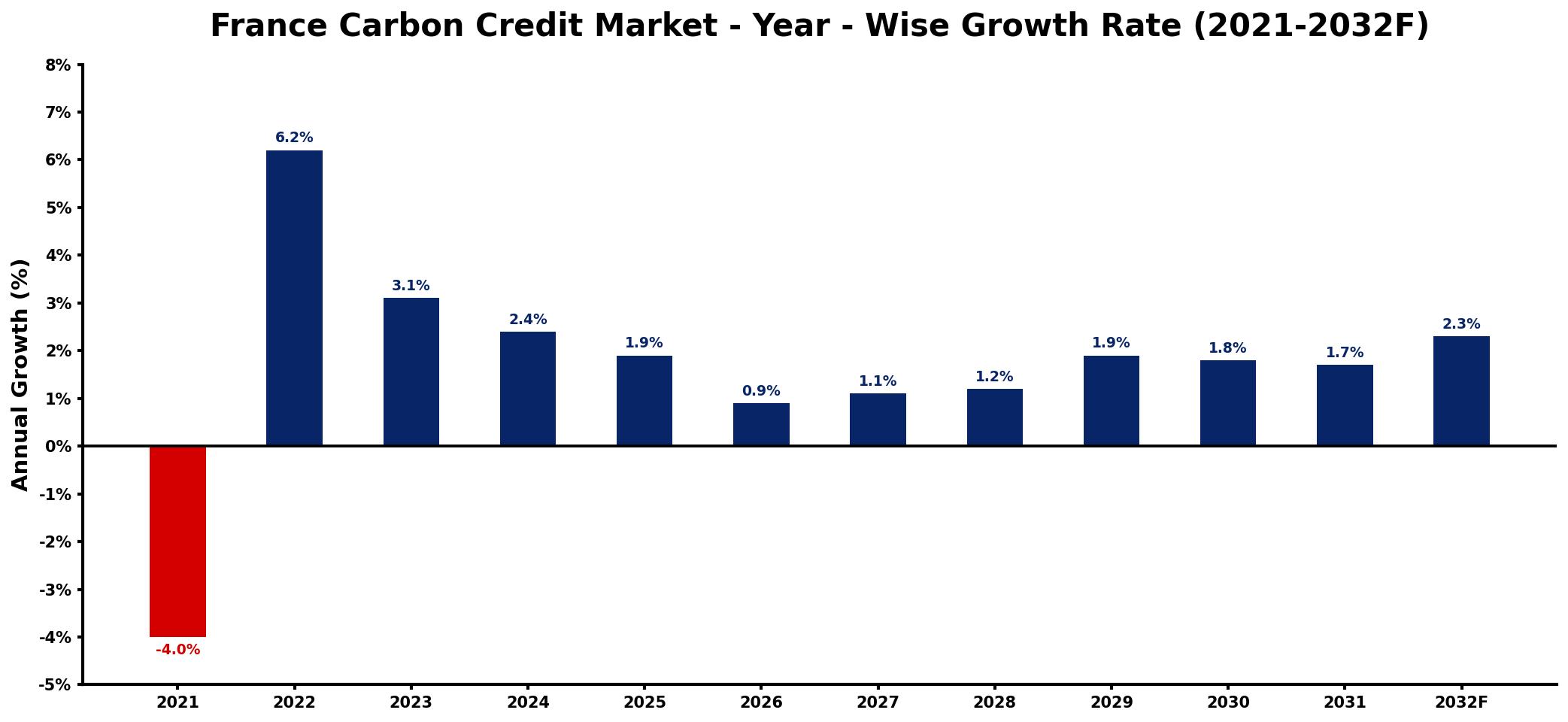
The table below presents the year‑wise growth rates along with the key drivers influencing the market
| Year | Growth Rate | Major Drivers |
| 2021 | -4.0% | decreased industrial sustainability investments |
| 2022 | 6.2% | increased corporate sustainability initiatives |
| 2023 | 3.1% | growing regulatory compliance requirements |
| 2024 | 2.4% | expansion of renewable energy projects |
| 2025 | 1.9% | rising consumer environmental awareness |
| 2026 | 0.9% | enhanced corporate social responsibility focus |
| 2027 | 1.1% | increased international climate commitments |
| 2028 | 1.2% | growing demand for sustainable practices |
| 2029 | 1.9% | strengthened environmental policy frameworks |
| 2030 | 1.8% | expanding green technology innovations |
| 2031 | 1.7% | increased private sector investments |
| 2032 | 2.3% | growing market for sustainable solutions |
Note: Market size estimations and growth projections presented in this report are based on 6Wresearch's proprietary forecasting methodology, utilizing the latest available industry data, government publications, and primary research inputs.
France Carbon Credit Market Synopsis
In the France Carbon Credit Market, a notable increase in demand for carbon credits is evident as businesses work towards achieving their sustainability targets. This demand surge is largely driven by stringent environmental regulations and an urgent need for carbon neutrality as climate change concerns grow.
Participants in this market include a diverse range of stakeholders, such as industrial firms, energy producers, and financial institutions, all seeking compliance or investment opportunities. As France ramps up its initiatives toward renewable energy, the market is poised for sustainable growth.
France Carbon Credit Market Key Takeaways
- The market is growing steadily, driven by regulatory demands and increased corporate sustainability efforts.
- France's commitment to the EU ETS is a foundational element that shapes market dynamics.
- Standardization and transparency in carbon credit trading are becoming more pronounced, enhancing market efficiency.
- Investment opportunities are emerging in various projects aimed at reducing carbon footprints.
- Market participants face challenges related to regulatory uncertainty and price volatility.
Evaluation of Restraints in France Carbon Credit Market
Despite the promising growth, several factors are constraining the France Carbon Credit Market. Regulatory uncertainties stemming from shifting government policies pose risks for businesses trying to navigate compliance landscapes. Additionally, the absence of standardized pricing mechanisms creates volatility, complicating investment decisions. Stakeholders often struggle to access reliable data regarding carbon emissions and trading activities, which inhibits informed decision-making. Concerns over fraudulent transactions and lack of transparency in some segments of the market further hinder its credibility, underscoring the need for stricter governance and oversight.
France Carbon Credit Market Trends
The France Carbon Credit Market is currently experiencing a significant trend towards increased demand for transparency in trading platforms. Companies are becoming more sophisticated in their approach, utilizing data analytics to assess their carbon footprints and identify potential areas for credit acquisition. Moreover, there is a rising focus on integrating renewable energy projects into carbon credit generation, creating a synergy between sustainability and economic incentives.
France Carbon Credit Market Opportunities
The landscape offers numerous avenues for investment, particularly in projects that effectively reduce emissions, such as renewable energy initiatives, energy efficiency upgrades, and afforestation ventures. Investors can capitalize on trading carbon credits by leveraging market fluctuations for financial returns. With increasing global momentum toward environmental responsibility, the market presents an attractive opportunity for those committed to both profitability and sustainability.
Government Initiatives in the France Carbon Credit Market
The French government has introduced several proactive policies aimed at bolstering the Carbon Credit Market. Central to these efforts is the enforcement of the EU Emissions Trading System, which provides a cap-and-trade framework for regulated industries. Additionally, France has implemented a national carbon pricing mechanism known as the Carbon Tax to incentivize emissions reductions. Support for renewable energy projects through grants and subsidies further illustrates the governments dedication to fostering a low-carbon economy, reinforcing its commitment to combat climate change.
Future Insights of the France Carbon Credit Market
Looking ahead to the period between 2026 and 2032, the France Carbon Credit Market is expected to expand substantially as the country intensifies its focus on sustainability. With the EUs ambitious climate goals driving demand for carbon credits, regulatory frameworks are likely to become more stringent, creating additional demand. Furthermore, as companies increasingly pursue carbon neutrality, the market will likely experience a surge in both participation and value, presenting a compelling opportunity for stakeholders.
France Carbon Credit Market Latest Developments (2025 - 2026)
Recent developments in the France Carbon Credit Market indicate a strong shift towards greater transparency and efficiency. Initiatives to standardize trading platforms are gaining traction, as stakeholders seek to enhance trust and reliability. Moreover, increased collaboration among industries and government entities is fostering innovative approaches to carbon credit generation, aligning with the broader goals of the EU's climate strategy.
France Carbon Credit Market - Key Attractiveness of the Report
- 10 Years of Market Numbers
- Historical Data Starting from 2022 to 2025
- Base Year: 2025
- Forecast Data until 2032
- Key Performance Indicators Impacting the Market
- Major Upcoming Developments and Projects
Key Highlights of the Report:
- France Carbon Credit Market Outlook
- Market Size of France Carbon Credit Market, 2025
- Forecast of France Carbon Credit Market, 2032
- Historical Data and Forecast of France Carbon Credit Revenues & Volume for the Period 2022-2032F
- France Carbon Credit Market Trend Evolution
- France Carbon Credit Market Drivers and Challenges
- France Carbon Credit Price Trends
- France Carbon Credit Porter's Five Forces
- France Carbon Credit Industry Life Cycle
- Historical Data and Forecast of France Carbon Credit Market Revenues & Volume By Sector for the Period 2022-2032F
- Historical Data and Forecast of France Carbon Credit Market Revenues & Volume By Energy for the Period 2022-2032F
- Historical Data and Forecast of France Carbon Credit Market Revenues & Volume By Transportation for the Period 2022-2032F
- Historical Data and Forecast of France Carbon Credit Market Revenues & Volume By Residential And Commercial Buildings for the Period 2022-2032F
- Historical Data and Forecast of France Carbon Credit Market Revenues & Volume By Industry for the Period 2022-2032F
- Historical Data and Forecast of France Carbon Credit Market Revenues & Volume By Agriculture for the Period 2022-2032F
- Historical Data and Forecast of France Carbon Credit Market Revenues & Volume By Forestry for the Period 2022-2032F
- Historical Data and Forecast of France Carbon Credit Market Revenues & Volume By Water And Wastewater for the Period 2022-2032F
- France Carbon Credit Import Export Trade Statistics
- Market Opportunity Assessment By Sector
- France Carbon Credit Top Companies Market Share
- France Carbon Credit Competitive Benchmarking By Technical and Operational Parameters
- France Carbon Credit Company Profiles
- France Carbon Credit Key Strategic Recommendations






































