France Dairy Cream Market Top 5 Importing Countries and Market Competition (HHI) Analysis
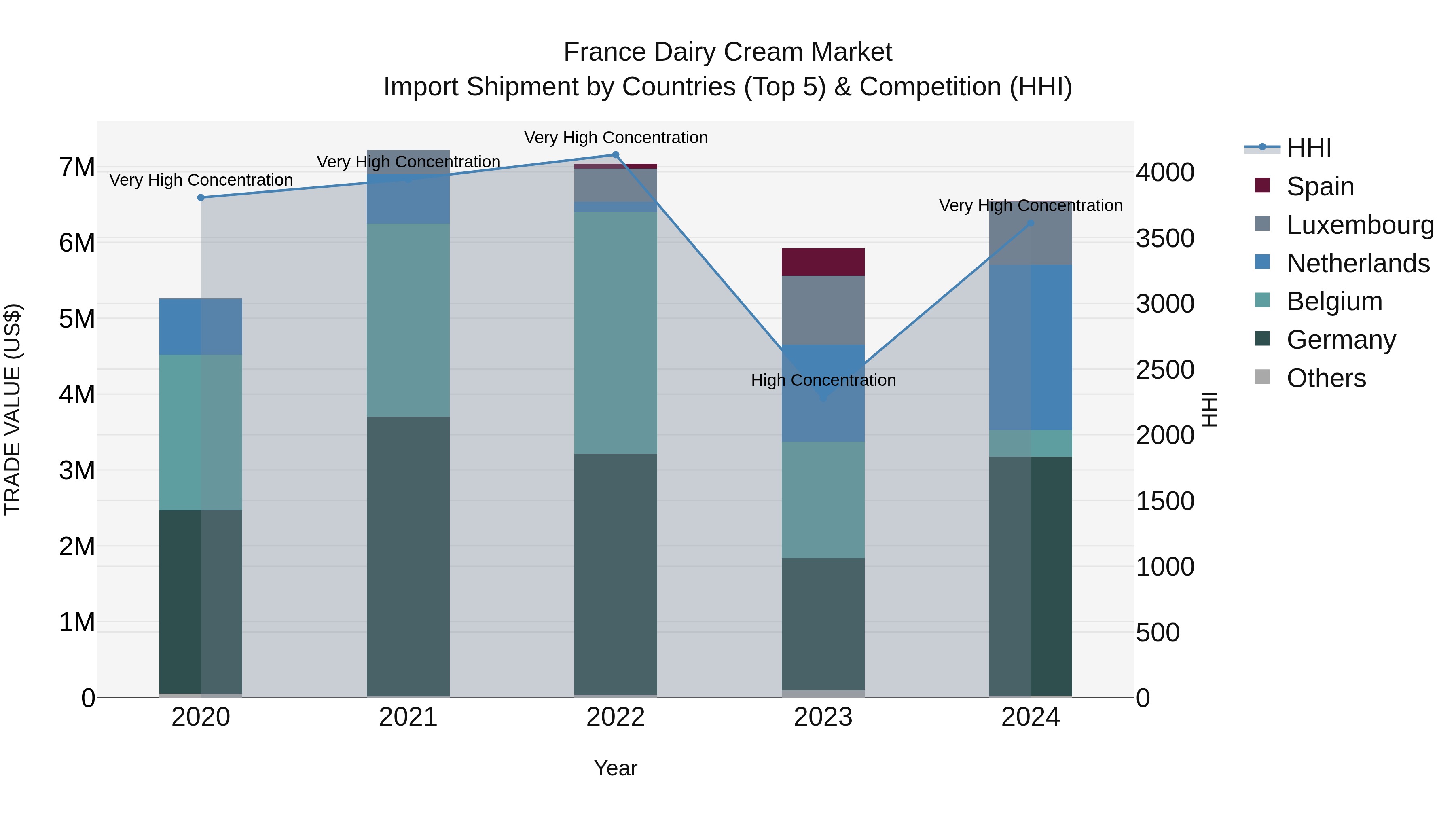
France`s dairy cream import market continues to show strong growth, with a CAGR of 5.57% from 2020 to 2024. The top exporting countries to France, including Germany, Netherlands, and Belgium, demonstrate the importance of European trade partnerships. The market concentration, as measured by the HHI, has increased significantly, indicating a trend towards higher concentration among exporters. The impressive growth rate of 10.52% from 2023 to 2024 suggests a thriving market with increasing demand for dairy cream imports in France.
France Dairy Cream Market Overview
The France Dairy Cream Market is a significant segment within the overall dairy industry in France, characterized by a variety of products such as whipping cream, heavy cream, and crème fraîche. Growth in this market is primarily driven by factors such as increasing consumer preference for convenience foods, rising demand for bakery and confectionery products, and the popularity of French cuisine globally. Market players are focusing on product innovation, clean label ingredients, and sustainable packaging to cater to evolving consumer preferences for healthier and environmentally friendly options. The market is highly competitive, with key players including Lactalis, Danone, and Nestlé, among others. Despite challenges such as fluctuating milk prices and changing consumer dietary patterns, the France Dairy Cream Market is projected to continue its steady growth trajectory in the foreseeable future.
France Dairy Cream Market Trends
In the France Dairy Cream Market, there is a growing trend towards premium and organic products, driven by consumer preferences for higher quality and more natural options. Manufacturers are increasingly focusing on producing dairy creams with clean labels, free from artificial additives and preservatives. Health-conscious consumers are also seeking low-fat and low-calorie options, leading to the development of light and reduced-fat dairy cream varieties. Additionally, there is a rising demand for lactose-free and plant-based alternatives to traditional dairy creams, catering to individuals with dietary restrictions or preferences. With a strong emphasis on sustainability and ethical sourcing practices, brands are incorporating eco-friendly packaging and promoting transparency in their supply chains to appeal to environmentally conscious consumers. Overall, innovation and diversification in product offerings are key strategies driving the France Dairy Cream Market.
France Dairy Cream Market Challenges
In the France Dairy Cream Market, key challenges include increasing competition from plant-based alternatives, changing consumer preferences towards healthier options, and regulatory constraints related to sustainability and animal welfare. The growing trend of plant-based products poses a threat to traditional dairy cream products, leading to market share erosion. Consumers are becoming more health-conscious, leading to a shift towards low-fat or alternative options, impacting the demand for traditional dairy cream. Additionally, regulations on environmental sustainability and animal welfare practices in dairy production can pose challenges for market players in terms of compliance and operational costs. To succeed in this market, companies need to innovate with new product offerings, address consumer health concerns, and adapt to evolving regulatory requirements.
France Dairy Cream Market Investment Opportunities
The France Dairy Cream Market presents various investment opportunities due to the growing consumer demand for premium and high-quality dairy products. Investors can consider opportunities in product innovation and development to cater to changing consumer preferences, such as the demand for organic, lactose-free, or plant-based dairy cream alternatives. Additionally, investments in sustainable and environmentally friendly production processes can appeal to the increasing focus on sustainability in the food industry. Collaborations with local dairy farmers to ensure a stable and high-quality milk supply can also be a strategic investment in the France Dairy Cream Market. Overall, investing in the France Dairy Cream Market offers opportunities for growth and profitability by tapping into the evolving consumer trends and preferences in the dairy sector.
France Dairy Cream Market Government Policy
In France, government policies related to the Dairy Cream Market primarily focus on ensuring product quality, safety, and compliance with industry standards. The French government regulates dairy cream production through various agencies such as the Ministry of Agriculture and Food and the National Institute of Origin and Quality (INAO). These agencies oversee the certification process for dairy cream products, ensuring they meet specific criteria for origin, production methods, and quality. Additionally, there are regulations in place to protect consumer health and prevent fraudulent practices within the industry. The government also supports the promotion of French dairy cream products both domestically and internationally through marketing campaigns and trade agreements to maintain the competitiveness of the sector.
France Dairy Cream Market Future Outlook
The future outlook for the France Dairy Cream Market appears positive, with steady growth expected in the coming years. Factors driving this growth include the increasing trend of consumers seeking out premium and indulgent food products, as well as the versatility of dairy cream in various culinary applications. Additionally, the growing popularity of baking and cooking at home, especially during the COVID-19 pandemic, has further boosted the demand for dairy cream. Manufacturers are likely to focus on product innovation, such as introducing organic or plant-based dairy cream options, to cater to changing consumer preferences. Overall, the France Dairy Cream Market is projected to experience a healthy expansion as consumers continue to prioritize quality and convenience in their food choices.
Key Highlights of the Report:
- France Dairy Cream Market Outlook
- Market Size of France Dairy Cream Market, 2021
- Forecast of France Dairy Cream Market, 2031
- Historical Data and Forecast of France Dairy Cream Revenues & Volume for the Period 2018 - 2031
- France Dairy Cream Market Trend Evolution
- France Dairy Cream Market Drivers and Challenges
- France Dairy Cream Price Trends
- France Dairy Cream Porter's Five Forces
- France Dairy Cream Industry Life Cycle
- Historical Data and Forecast of France Dairy Cream Market Revenues & Volume By Type for the Period 2018 - 2031
- Historical Data and Forecast of France Dairy Cream Market Revenues & Volume By Fresh Cream for the Period 2018 - 2031
- Historical Data and Forecast of France Dairy Cream Market Revenues & Volume By Thickened Cream/Heavy Cream for the Period 2018 - 2031
- Historical Data and Forecast of France Dairy Cream Market Revenues & Volume By Whipping Cream for the Period 2018 - 2031
- Historical Data and Forecast of France Dairy Cream Market Revenues & Volume By Sour Cream for the Period 2018 - 2031
- Historical Data and Forecast of France Dairy Cream Market Revenues & Volume By Other Types for the Period 2018 - 2031
- Historical Data and Forecast of France Dairy Cream Market Revenues & Volume By Distribution Channel for the Period 2018 - 2031
- Historical Data and Forecast of France Dairy Cream Market Revenues & Volume By Supermarkets/ Hypermarkets for the Period 2018 - 2031
- Historical Data and Forecast of France Dairy Cream Market Revenues & Volume By Convenince Stores for the Period 2018 - 2031
- Historical Data and Forecast of France Dairy Cream Market Revenues & Volume By Online Retail Stores for the Period 2018 - 2031
- Historical Data and Forecast of France Dairy Cream Market Revenues & Volume By Other Distribution Channels for the Period 2018 - 2031
- France Dairy Cream Import Export Trade Statistics
- Market Opportunity Assessment By Type
- Market Opportunity Assessment By Distribution Channel
- France Dairy Cream Top Companies Market Share
- France Dairy Cream Competitive Benchmarking By Technical and Operational Parameters
- France Dairy Cream Company Profiles
- France Dairy Cream Key Strategic Recommendations






































