France Industrial Machinery Market Top 5 Importing Countries and Market Competition (HHI) Analysis
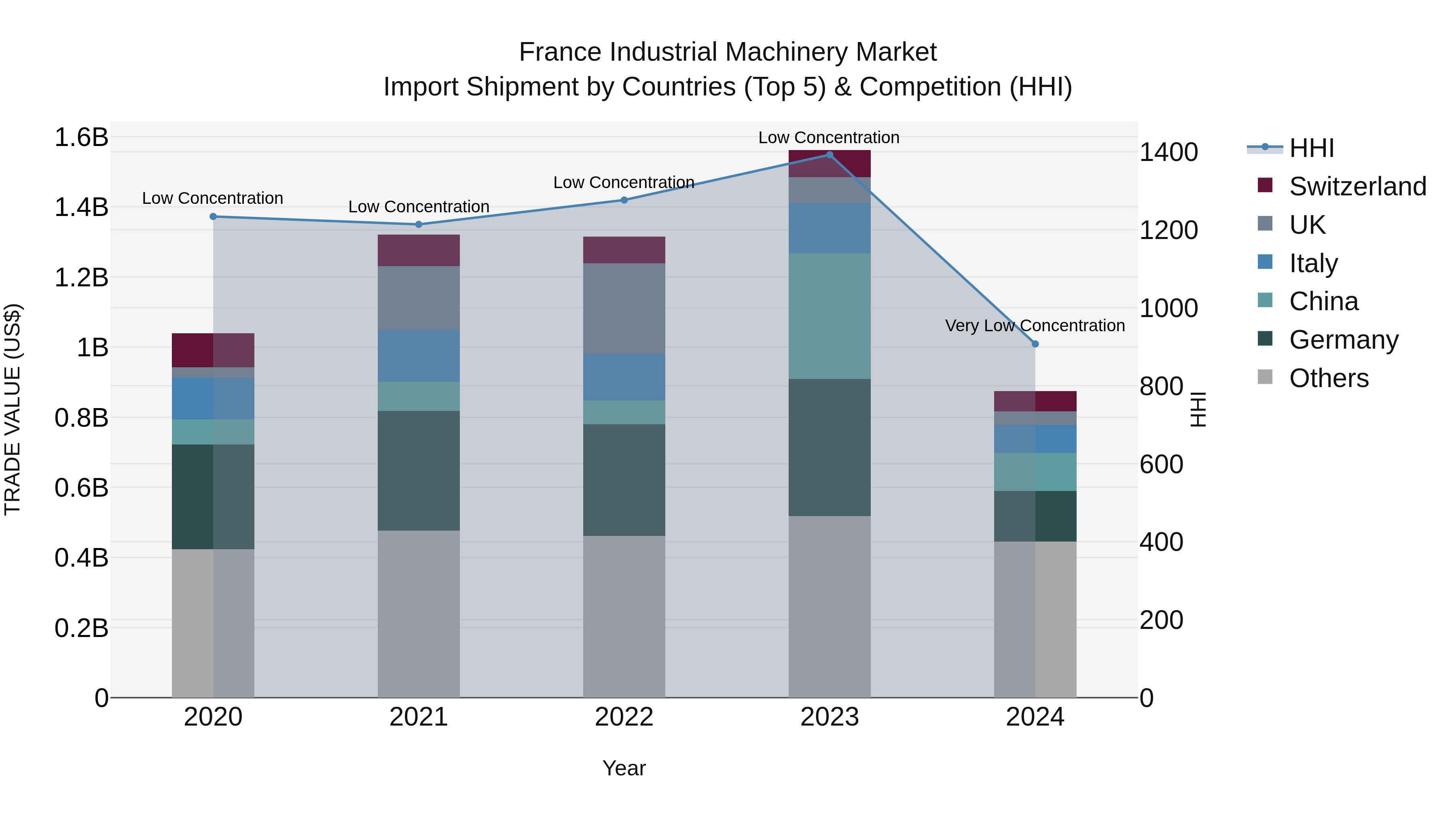
France`s industrial machinery import shipments in 2024 were dominated by key exporters including Germany, China, South Korea, Austria, and Italy. The market displayed a notable decrease in concentration levels, indicating a more diversified import landscape. With a negative CAGR of -4.23% over the period of 2020-2024 and a steep decline in growth rate at -43.98% from 2023 to 2024, the industry experienced significant challenges and potential shifts in demand dynamics. Monitoring these trends will be crucial for stakeholders navigating the evolving market conditions.
France Industrial Machinery Market Overview
France industrial machinery market serves diverse sectors such as manufacturing, construction, agriculture, and transportation, providing a wide range of equipment and machinery for production, processing, and infrastructure development. Industrial machinery includes machine tools, industrial robots, material handling equipment, and construction machinery, offering automation, efficiency, and precision in industrial operations. With ongoing technological advancements and infrastructure investments, there is a growing demand for advanced industrial machinery in France, driving market growth and innovation.
Drivers of the market
The expansion of manufacturing sectors such as automotive, aerospace, machinery, and electronics is driving the demand for industrial machinery in France. Industrial machinery encompasses a wide range of equipment and systems used in production, processing, and assembly operations, including machine tools, robotics, automation systems, and packaging machinery. With a focus on productivity, quality, and flexibility, there`s a growing need for machinery that can offer precision machining, high throughput, and seamless integration with digital technologies and automation solutions. Moreover, the adoption of Industry 4.0 principles, the demand for customizable and connected manufacturing solutions, and the emphasis on sustainability and resource efficiency are driving innovation and investments in the industrial machinery market in France.
Challenges of the market
Challenges in the France industrial machinery market include adapting to automation and digitalization trends, optimizing machinery performance and efficiency, and addressing skills gaps in the workforce for operating and maintaining advanced manufacturing equipment.
Government Policy of the market
Regulations in France concerning equipment standards, workplace safety, and product quality impact the industrial machinery market. Government policies may include safety standards for machinery design and operation, workplace training requirements for equipment operators, and product certification requirements to ensure the safety, reliability, and compliance of industrial machinery.
Key Highlights of the Report:
- France Industrial Machinery Market Outlook
- Market Size of France Industrial Machinery Market, 2024
- Forecast of France Industrial Machinery Market, 2031
- Historical Data and Forecast of France Industrial Machinery Revenues & Volume for the Period 2021-2031
- France Industrial Machinery Market Trend Evolution
- France Industrial Machinery Market Drivers and Challenges
- France Industrial Machinery Price Trends
- France Industrial Machinery Porter's Five Forces
- France Industrial Machinery Industry Life Cycle
- Historical Data and Forecast of France Industrial Machinery Market Revenues & Volume By Application for the Period 2021-2031
- Historical Data and Forecast of France Industrial Machinery Market Revenues & Volume By Agriculture for the Period 2021-2031
- Historical Data and Forecast of France Industrial Machinery Market Revenues & Volume By Construction for the Period 2021-2031
- Historical Data and Forecast of France Industrial Machinery Market Revenues & Volume By Packaging for the Period 2021-2031
- Historical Data and Forecast of France Industrial Machinery Market Revenues & Volume By Food Processing for the Period 2021-2031
- Historical Data and Forecast of France Industrial Machinery Market Revenues & Volume By Mining for the Period 2021-2031
- Historical Data and Forecast of France Industrial Machinery Market Revenues & Volume By Semiconductor Manufacturing for the Period 2021-2031
- France Industrial Machinery Import Export Trade Statistics
- Market Opportunity Assessment By Application
- France Industrial Machinery Top Companies Market Share
- France Industrial Machinery Competitive Benchmarking By Technical and Operational Parameters
- France Industrial Machinery Company Profiles
- France Industrial Machinery Key Strategic Recommendations






































