Kuwait Industrial Machinery Market Size, Share & Growth Rate
The Kuwait Industrial Machinery Market was estimated at USD 217 Million in 2025 and is projected to reach USD 277 Million by 2032, growing at a CAGR of 3.5% from 2026 to 2032. This growth trajectory is fueled by a combination of robust industrialization efforts, particularly in manufacturing and construction, alongside a pressing need for modernized equipment that enhances automation and efficiency. As Kuwait invests heavily in infrastructure development, the demand for diverse machinery, including advanced material handling systems and industrial robots, is expected to surge.
Kuwait Industrial Machinery Market Year-wise Growth Rate and Key Drivers
This graph highlights how the Kuwait Industrial Machinery Market has steadily grown over the years, supported by major growth factors.
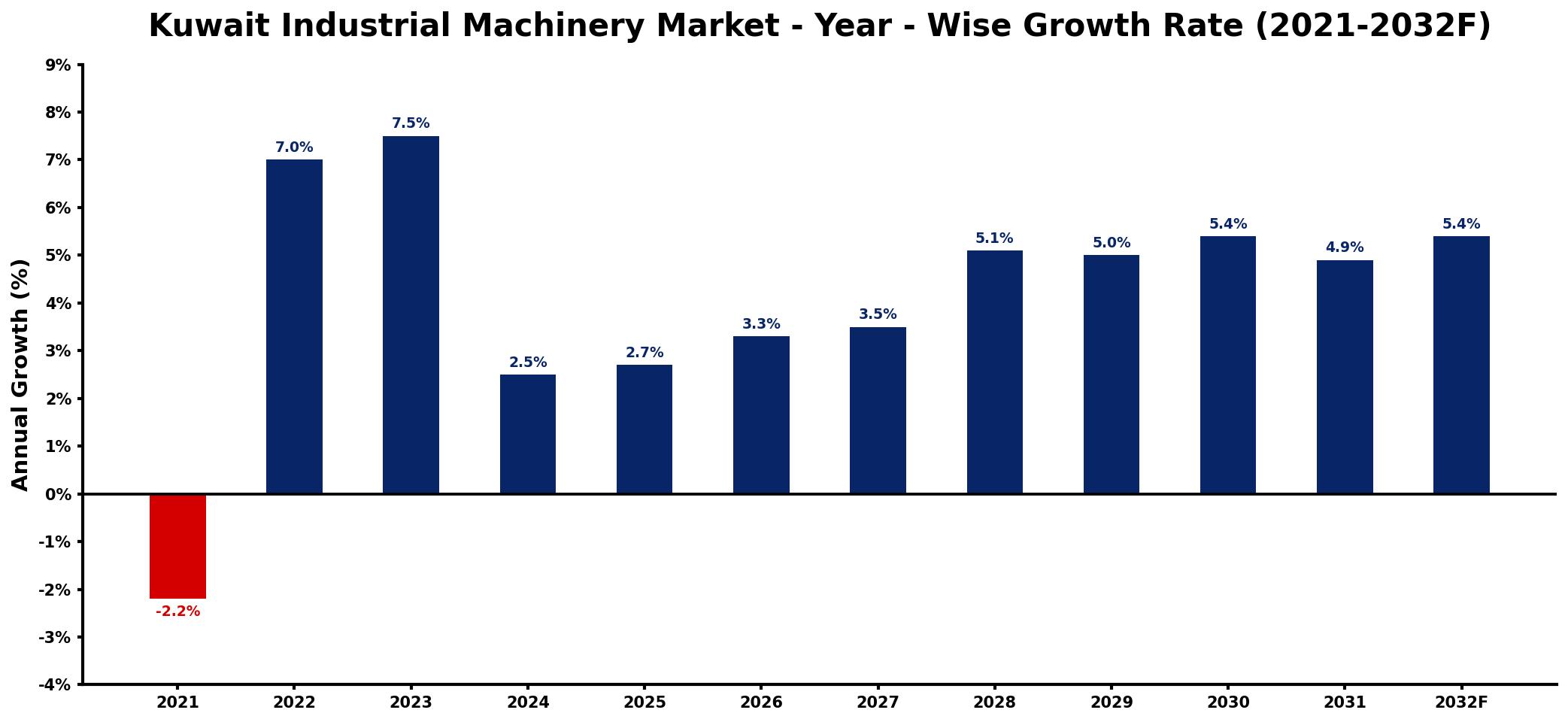
The table below presents the year‑wise growth rates along with the key drivers influencing the market
| Year | Growth Rate | Major Drivers |
| 2021 | -2.2% | decreased demand from construction sector |
| 2022 | 7.0% | increased investment in infrastructure projects |
| 2023 | 7.5% | growing adoption of automation technologies |
| 2024 | 2.5% | expansion of manufacturing capabilities |
| 2025 | 2.7% | rising demand for energy solutions |
| 2026 | 3.3% | enhanced focus on sustainability practices |
| 2027 | 3.5% | growing regional consumption patterns |
| 2028 | 5.1% | growth in regional trade activities |
| 2029 | 5.0% | increased government support initiatives |
| 2030 | 5.4% | growing emerging market penetration |
| 2031 | 4.9% | upsurge in technological innovations |
| 2032 | 5.4% | growing demand for smart solutions |
Note: Market size estimations and growth projections presented in this report are based on 6Wresearch's proprietary forecasting methodology, utilizing the latest available industry data, government publications, and primary research inputs.
Kuwait Industrial Machinery Market Synopsis
Recent momentum in the Kuwait Industrial Machinery Market has been marked by an influx of innovative technologies, transforming the way industries operate. However, as the market approaches 2032, a convergence of automation and precision will be pivotal in shaping future growth, aligning with global industry standards.
While traditional machinery remains vital, the push toward more advanced applications will lead to a notable shift in demand dynamics. Companies are now prioritizing automation and smart machinery solutions that not only improve productivity but also reduce operational costs, thereby redefining their investment strategies.
Kuwait Industrial Machinery Market Key Takeaways
- The market is witnessing increasing adoption of automation technologies, propelling growth in productivity.
- Government initiatives aimed at infrastructure development are driving machinery demand in construction and manufacturing.
- Technological advancements in machinery, such as CNC and robotics, are enhancing operational efficiency.
- Market players are focusing on comprehensive solutions to address diverse industry requirements.
- Robust growth potential exists in emerging sectors, particularly due to urban development projects.
Evaluation of Restraints in Kuwait Industrial Machinery Market
Despite the growth prospects, the Kuwait Industrial Machinery Market faces notable restraints that could temper its expansion. The evolving landscape demands advanced machinery capable of integrating seamlessly with emerging technologies, including AI and IoT. Additionally, maintaining equipment reliability and minimizing downtime are critical concerns. Companies must navigate these challenges while also ensuring that their offerings remain cost-effective, which could hinder investment in high-end machinery solutions.
Kuwait Industrial Machinery Market Trends
Current trends indicate a significant shift towards automation and smart technologies across Kuwait's industrial sectors. The integration of robotics is becoming increasingly vital, particularly in manufacturing processes aimed at enhancing precision and reducing labor costs. Moreover, sustainability is gaining traction, with many organizations seeking machinery that meets environmental standards while optimizing performance.
There is also a growing emphasis on digital transformation, with industries leveraging data analytics to refine operations and enhance decision-making. The focus on comprehensive machinery solutions reflects a broader trend toward enhancing not just equipment quality but also the overall service offering to clients.
Kuwait Industrial Machinery Market Opportunities
The Kuwait Industrial Machinery Market presents various growth and investment opportunities, particularly in sectors aligned with national development goals. Urbanization efforts are anticipated to spur demand for construction machinery, while initiatives in manufacturing could create openings for advanced machinery that boosts productivity. Additionally, companies that innovate in automation and provide tailored solutions will likely find substantial market traction, catering to the unique needs of Kuwaiti industries.
Government Initiatives in the Kuwait Industrial Machinery Market
Kuwaits government is actively fostering the industrial machinery sector through strategic initiatives aimed at enhancing operational safety and compliance. Policies are in place to enforce standards related to machinery design and performance, ensuring that equipment adheres to safety protocols while promoting worker welfare. Public spending on infrastructure and industrial projects is also poised to elevate demand for advanced machinery solutions.
Future Insights of the Kuwait Industrial Machinery Market
Looking ahead to 2026-2032, the Kuwait Industrial Machinery Market is likely to evolve significantly, influenced by technological advancements and shifts in industrial demand. As businesses embrace more sophisticated automation solutions, the market will adapt to prioritize precision, efficiency, and flexibility. Increased collaboration between machinery manufacturers and technology providers will play a critical role in addressing the complexities of modern industrial applications, shaping a promising landscape for growth.
Kuwait Industrial Machinery Market Latest Developments (2025 - 2026)
The recent direction of the Kuwait Industrial Machinery Market highlights a growing focus on integrating advanced technologies into traditional manufacturing processes. As industries seek to enhance their competitive edge, there has been a notable uptick in investment towards automation and data analytics solutions. Moreover, government-backed initiatives are fostering partnerships aimed at upgrading machinery standards, ensuring that Kuwait's industrial base remains aligned with global best practices.
Kuwait Industrial Machinery Market - Key Attractiveness of the Report
- 10 Years of Market Numbers
- Historical Data Starting from 2022 to 2025
- Base Year: 2025
- Forecast Data until 2032
- Key Performance Indicators Impacting the Market
- Major Upcoming Developments and Projects
Key Highlights of the Report:
- Kuwait Industrial Machinery Market Outlook
- Market Size of Kuwait Industrial Machinery Market, 2025
- Forecast of Kuwait Industrial Machinery Market, 2032
- Historical Data and Forecast of Kuwait Industrial Machinery Revenues & Volume for the Period 2022-2032F
- Kuwait Industrial Machinery Market Trend Evolution
- Kuwait Industrial Machinery Market Drivers and Challenges
- Kuwait Industrial Machinery Price Trends
- Kuwait Industrial Machinery Porter's Five Forces
- Kuwait Industrial Machinery Industry Life Cycle
- Historical Data and Forecast of Kuwait Industrial Machinery Market Revenues & Volume By Application for the Period 2022-2032F
- Historical Data and Forecast of Kuwait Industrial Machinery Market Revenues & Volume By Agriculture for the Period 2022-2032F
- Historical Data and Forecast of Kuwait Industrial Machinery Market Revenues & Volume By Construction for the Period 2022-2032F
- Historical Data and Forecast of Kuwait Industrial Machinery Market Revenues & Volume By Packaging for the Period 2022-2032F
- Historical Data and Forecast of Kuwait Industrial Machinery Market Revenues & Volume By Food Processing for the Period 2022-2032F
- Historical Data and Forecast of Kuwait Industrial Machinery Market Revenues & Volume By Mining for the Period 2022-2032F
- Historical Data and Forecast of Kuwait Industrial Machinery Market Revenues & Volume By Semiconductor Manufacturing for the Period 2022-2032F
- Kuwait Industrial Machinery Import Export Trade Statistics
- Market Opportunity Assessment By Application
- Kuwait Industrial Machinery Top Companies Market Share
- Kuwait Industrial Machinery Competitive Benchmarking By Technical and Operational Parameters
- Kuwait Industrial Machinery Company Profiles
- Kuwait Industrial Machinery Key Strategic Recommendations






































