Chile Industrial Machinery Market Top 5 Importing Countries and Market Competition (HHI) Analysis
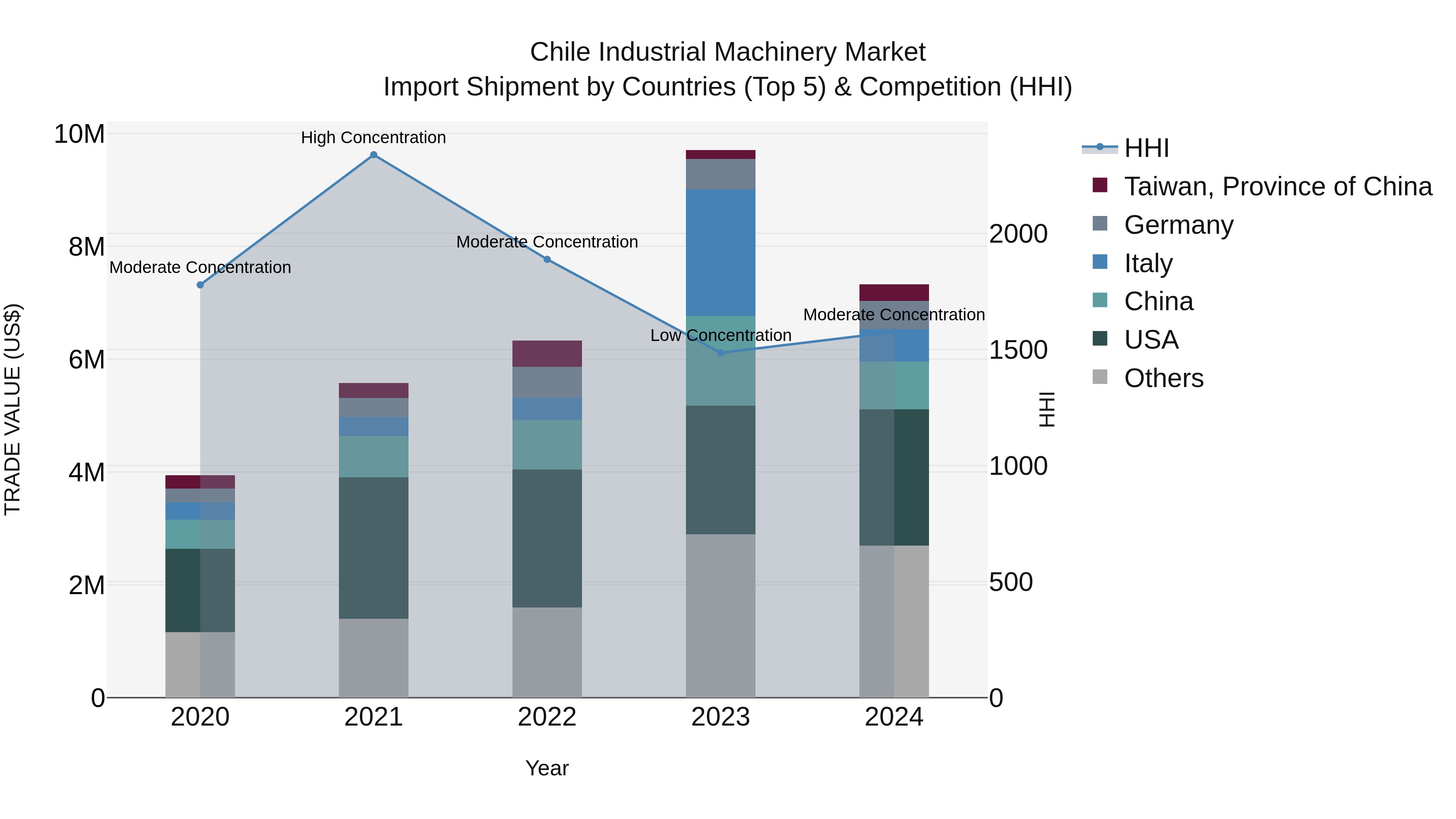
Chile`s industrial machinery import shipments in 2024 saw a shift in concentration levels, moving from low to moderate concentration compared to the previous year. The top exporting countries to Chile in 2024 were the USA, Australia, China, Italy, and Germany. Despite a negative growth rate from 2023 to 2024, the compound annual growth rate (CAGR) from 2020 to 2024 remained strong at 16.75%, indicating a sustained demand for industrial machinery in the Chilean market. The diversity of exporting countries suggests a broad range of sources for industrial machinery, potentially offering Chilean businesses a variety of options to choose from.
Chile Industrial Machinery Market Overview
The Chile Industrial Machinery market involves the manufacturing, distribution, and utilization of machinery and equipment used in industrial manufacturing, processing, and assembly operations across various sectors. Industrial machinery includes machine tools, automation systems, material handling equipment, and robotics designed to automate production processes, enhance productivity, and improve product quality. With industries seeking to optimize manufacturing efficiency, flexibility, and competitiveness, the market for industrial machinery is evolving with innovations in robotics, AI (Artificial Intelligence), and IoT (Internet of Things) technologies to enable smart, connected, and agile manufacturing solutions.
Drivers of the market
The growth of various industrial sectors in Chile, including mining, agriculture, and manufacturing, drives the demand for diverse machinery and equipment. Factors such as technological advancements, automation trends, and infrastructure development initiatives influence market dynamics.
Challenges of the market
A challenge in the Chile Industrial Machinery market may be the demand for advanced manufacturing technologies and automation solutions for improving productivity and competitiveness. Industrial machinery such as CNC machines, robots, and automation systems enable precision machining, assembly, and production in various industries, but they require investments in technology adoption, skills development, and process optimization. Overcoming barriers to technology adoption and facilitating knowledge transfer is essential for accelerating industrial modernization and digital transformation in Chile.
Government Policy of the market
Industrial machinery encompasses a wide range of equipment and systems used in manufacturing, processing, and assembly operations across various industries, including automotive, aerospace, electronics, and food and beverage, enabling production automation, quality assurance, and operational efficiency. Recognizing the importance of industrial machinery in enabling economic growth, competitiveness, and technological innovation, the Chile government may implement policies to support its production, adoption, and sustainability. These policies may include incentives for machinery manufacturers to invest in advanced manufacturing technologies and digitalization solutions, regulations for machinery safety and performance standards, and public-private partnerships to promote industry collaboration and technology transfer. Additionally, the government may invest in vocational training programs and apprenticeship initiatives for machinery operators and maintenance personnel, ensuring skilled workforce development and workforce readiness for the digital age of manufacturing.
Key Highlights of the Report:
- Chile Industrial Machinery Market Outlook
- Market Size of Chile Industrial Machinery Market, 2024
- Forecast of Chile Industrial Machinery Market, 2031
- Historical Data and Forecast of Chile Industrial Machinery Revenues & Volume for the Period 2021-2031
- Chile Industrial Machinery Market Trend Evolution
- Chile Industrial Machinery Market Drivers and Challenges
- Chile Industrial Machinery Price Trends
- Chile Industrial Machinery Porter's Five Forces
- Chile Industrial Machinery Industry Life Cycle
- Historical Data and Forecast of Chile Industrial Machinery Market Revenues & Volume By Application for the Period 2021-2031
- Historical Data and Forecast of Chile Industrial Machinery Market Revenues & Volume By Agriculture for the Period 2021-2031
- Historical Data and Forecast of Chile Industrial Machinery Market Revenues & Volume By Construction for the Period 2021-2031
- Historical Data and Forecast of Chile Industrial Machinery Market Revenues & Volume By Packaging for the Period 2021-2031
- Historical Data and Forecast of Chile Industrial Machinery Market Revenues & Volume By Food Processing for the Period 2021-2031
- Historical Data and Forecast of Chile Industrial Machinery Market Revenues & Volume By Mining for the Period 2021-2031
- Historical Data and Forecast of Chile Industrial Machinery Market Revenues & Volume By Semiconductor Manufacturing for the Period 2021-2031
- Chile Industrial Machinery Import Export Trade Statistics
- Market Opportunity Assessment By Application
- Chile Industrial Machinery Top Companies Market Share
- Chile Industrial Machinery Competitive Benchmarking By Technical and Operational Parameters
- Chile Industrial Machinery Company Profiles
- Chile Industrial Machinery Key Strategic Recommendations






































