United Kingdom (UK) Industrial Machinery Market Size, Share & Growth Rate
The United Kingdom (UK) Industrial Machinery Market was estimated at USD 202 Million in 2025 and is projected to reach USD 222 Million by 2032, growing at a CAGR of 1.4% from 2026 to 2032. This growth trajectory is primarily fueled by the increasing demand for automation solutions and advanced manufacturing technologies. Additionally, the integration of innovative AI and digitalization strategies within the sector underscores the industrys shift towards enhanced productivity and efficiency.
United Kingdom (UK) Industrial Machinery Market Year-wise Growth Rate and Key Drivers
This graph highlights how the United Kingdom (UK) Industrial Machinery Market has steadily grown over the years, supported by major growth factors.
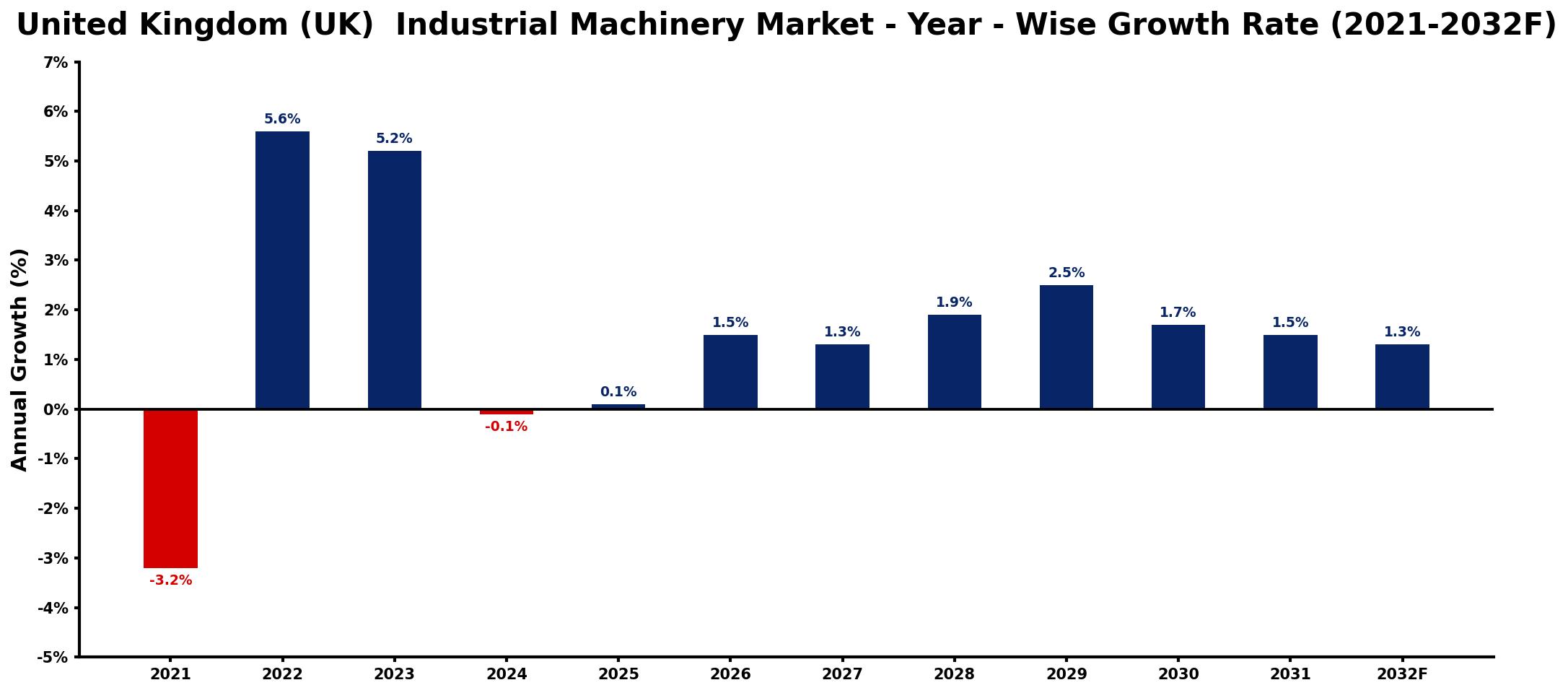
The table below presents the year‑wise growth rates along with the key drivers influencing the market
| Year | Growth Rate | Major Drivers |
| 2021 | -3.2% | decreased demand from construction sector |
| 2022 | 5.6% | increased investments in automation technology |
| 2023 | 5.2% | growing focus on sustainable practices |
| 2024 | -0.1% | decline in export opportunities |
| 2025 | 0.1% | rise in domestic production capabilities |
| 2026 | 1.5% | expansion of renewable energy projects |
| 2027 | 1.3% | increased adoption of digital solutions |
| 2028 | 1.9% | growth in infrastructure development initiatives |
| 2029 | 2.5% | surge in demand for robotics |
| 2030 | 1.7% | enhanced efficiency in supply chains |
| 2031 | 1.5% | strengthened partnerships with local firms |
| 2032 | 1.3% | improved training programs for workforce |
Note: Market size estimations and growth projections presented in this report are based on 6Wresearch's proprietary forecasting methodology, utilizing the latest available industry data, government publications, and primary research inputs.
United Kingdom (UK) Industrial Machinery Market Synopsis
The UK industrial machinery market has demonstrated remarkable resilience in recent years, propelled by a wave of technological advancements and increased automation across various sectors. However, as the landscape evolves, manufacturers face the necessity to adapt to rapidly changing consumer demands and operational efficiencies.
Looking ahead, the market is poised to embrace further innovations, particularly in AI-driven predictive maintenance and additive manufacturing. This transition not only enhances the operational capabilities of existing machinery but also aligns with the broader trends of Industry 4.0, positioning the UK as a competitive player on the global stage.
United Kingdom (UK) Industrial Machinery Market Key Takeaways
- The market is on a steady growth path, projected to reach USD 222 Million by 2032.
- Investment in automation and digital transformation is pivotal to advancing the industry.
- Adoption of smart technologies is enhancing operational efficiency and flexibility.
- Government initiatives support innovation and competitiveness in the machinery sector.
- AI and additive manufacturing are driving the future of industrial applications.
Evaluation of Restraints in United Kingdom (UK) Industrial Machinery Market
Despite the optimistic growth outlook, the UK industrial machinery market grapples with significant challenges. Rapid technological obsolescence threatens to outpace the ability of manufacturers to adapt, compelling them to continually innovate or risk becoming obsolete. Global supply chain disruptions, particularly regarding the availability of raw materials, further complicate the landscape, creating uncertainty in production timelines and costs. Moreover, the need for flexible and scalable manufacturing solutions means companies must invest heavily in research and development, which can strain budgets, especially for smaller manufacturers.
United Kingdom (UK) Industrial Machinery Market Trends
Current trends in the UK industrial machinery market include the rise of AI-driven solutions that enhance predictive maintenance capabilities. This approach not only minimizes downtime but also improves the longevity of machinery. Additionally, there is a notable shift towards additive manufacturing, allowing for customized and efficient production processes. The trend towards connected machines continues to gain traction, facilitating real-time monitoring and data analytics, which are essential for informed decision-making in manufacturing operations.
United Kingdom (UK) Industrial Machinery Market Opportunities
Genuine growth opportunities exist within the scope of smart manufacturing initiatives. Companies that leverage advanced analytics, Internet of Things (IoT) technologies, and machine learning can position themselves at the forefront of the industry. Moreover, the increasing focus on sustainability and green manufacturing opens doors for innovations in energy-efficient machinery and processes. Investing in these areas not only aligns with regulatory trends but also meets the growing consumer demand for environmentally friendly practices.
Government Initiatives in the United Kingdom (UK) Industrial Machinery Market
The UK government has implemented various policies aimed at bolstering innovation within the industrial machinery sector. These initiatives include funding for research and development in advanced manufacturing technologies, promoting the export of UK-made machinery, and providing incentives for companies to invest in automation. The emphasis on digital transformation is also evident in governmental support for programs designed to enhance the digital capabilities of the manufacturing sector, ensuring the UK remains competitive in a global market.
Future Insights of the United Kingdom (UK) Industrial Machinery Market
From 2026 to 2032, the UK industrial machinery market is anticipated to evolve significantly, driven by continued technological advancements and strategic investments in automation. The rise of smart manufacturing will likely redefine operational paradigms, emphasizing efficiency and sustainability. As companies increasingly adopt connected machinery and AI-driven processes, the market will not only grow in size but also in complexity, necessitating a shift in workforce skills and training. Stakeholders who recognize these trends early will find themselves well-positioned to capitalize on future opportunities.
United Kingdom (UK) Industrial Machinery Market Latest Developments (2025 - 2026)
Recent developments in the UK industrial machinery market indicate a heightened focus on integrating advanced digital technologies into manufacturing processes. Companies are increasingly exploring partnerships that enhance their capabilities in predictive analytics and connectivity. Meanwhile, there is a notable push for sustainability in machinery production, with firms investing in energy-efficient technologies and practices, aligning with both regulatory standards and market demand. This momentum reflects a dynamic shift towards a more innovative and environmentally conscious industrial landscape.
United Kingdom (UK) Industrial Machinery Market - Key Attractiveness of the Report
- 10 Years of Market Numbers
- Historical Data Starting from 2022 to 2025
- Base Year: 2025
- Forecast Data until 2032
- Key Performance Indicators Impacting the Market
- Major Upcoming Developments and Projects
Key Highlights of the Report:
- United Kingdom (UK) Industrial Machinery Market Outlook
- Market Size of United Kingdom (UK) Industrial Machinery Market, 2025
- Forecast of United Kingdom (UK) Industrial Machinery Market, 2032
- Historical Data and Forecast of United Kingdom (UK) Industrial Machinery Revenues & Volume for the Period 2022-2032F
- United Kingdom (UK) Industrial Machinery Market Trend Evolution
- United Kingdom (UK) Industrial Machinery Market Drivers and Challenges
- United Kingdom (UK) Industrial Machinery Price Trends
- United Kingdom (UK) Industrial Machinery Porter's Five Forces
- United Kingdom (UK) Industrial Machinery Industry Life Cycle
- Historical Data and Forecast of United Kingdom (UK) Industrial Machinery Market Revenues & Volume By Application for the Period 2022-2032F
- Historical Data and Forecast of United Kingdom (UK) Industrial Machinery Market Revenues & Volume By Agriculture for the Period 2022-2032F
- Historical Data and Forecast of United Kingdom (UK) Industrial Machinery Market Revenues & Volume By Construction for the Period 2022-2032F
- Historical Data and Forecast of United Kingdom (UK) Industrial Machinery Market Revenues & Volume By Packaging for the Period 2022-2032F
- Historical Data and Forecast of United Kingdom (UK) Industrial Machinery Market Revenues & Volume By Food Processing for the Period 2022-2032F
- Historical Data and Forecast of United Kingdom (UK) Industrial Machinery Market Revenues & Volume By Mining for the Period 2022-2032F
- Historical Data and Forecast of United Kingdom (UK) Industrial Machinery Market Revenues & Volume By Semiconductor Manufacturing for the Period 2022-2032F
- United Kingdom (UK) Industrial Machinery Import Export Trade Statistics
- Market Opportunity Assessment By Application
- United Kingdom (UK) Industrial Machinery Top Companies Market Share
- United Kingdom (UK) Industrial Machinery Competitive Benchmarking By Technical and Operational Parameters
- United Kingdom (UK) Industrial Machinery Company Profiles
- United Kingdom (UK) Industrial Machinery Key Strategic Recommendations






































