United Arab Emirates (UAE) Industrial Machinery Market Size, Share & Growth Rate
The United Arab Emirates (UAE) Industrial Machinery Market was estimated at USD 1091 Million in 2025 and is projected to reach USD 1554 Million by 2032, growing at a CAGR of 5.2% from 2026 to 2032. This impressive trajectory is largely propelled by the nation's strategic investments in infrastructure and manufacturing, which are essential components of its broader economic diversification strategy. Additionally, the rising trend of automation and technological innovation across various sectors is catalyzing businesses to adopt advanced machinery for improved productivity.
United Arab Emirates (UAE) Industrial Machinery Market Year-wise Growth Rate and Key Drivers
This graph highlights how the United Arab Emirates (UAE) Industrial Machinery Market has steadily grown over the years, supported by major growth factors.
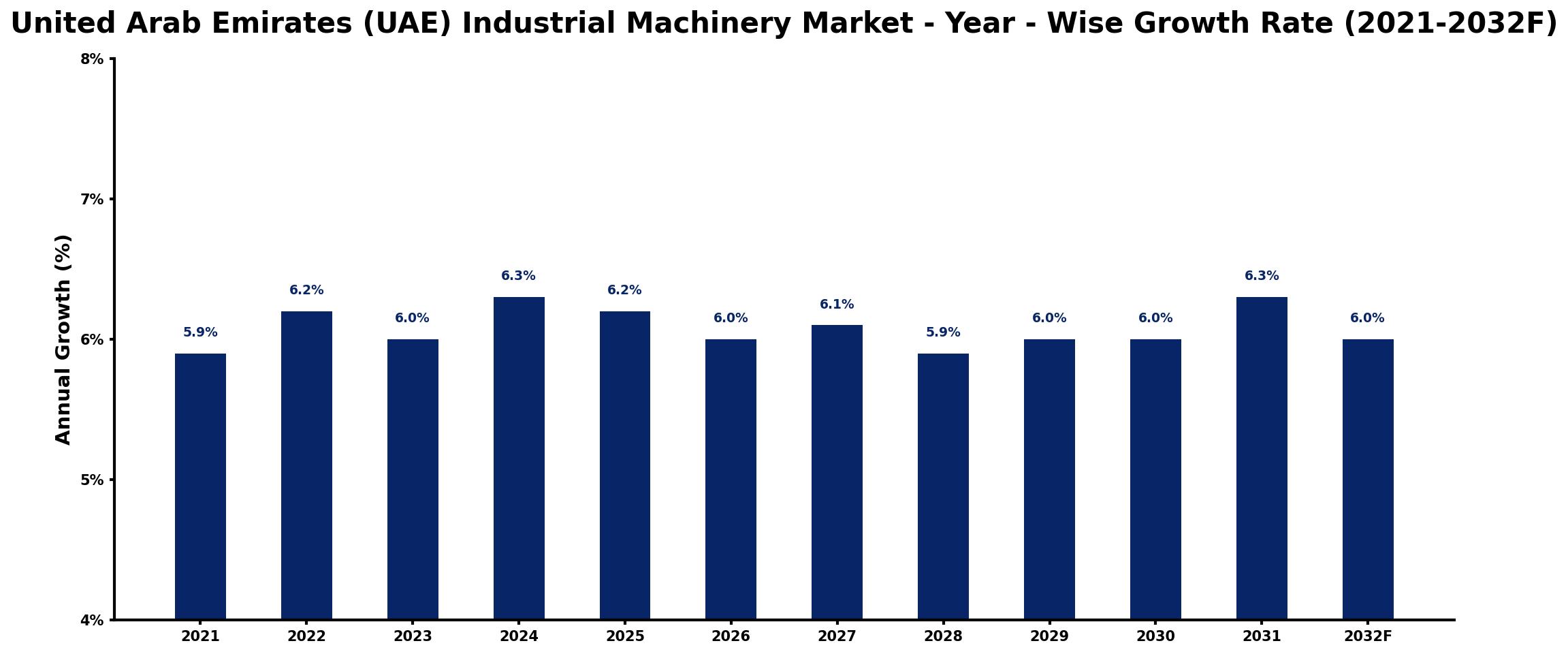
The table below presents the year‑wise growth rates along with the key drivers influencing the market
| Year | Growth Rate | Major Drivers |
| 2021 | 5.9% | increased investments in infrastructure projects |
| 2022 | 6.2% | growing demand from construction sector |
| 2023 | 6.0% | expansion of renewable energy initiatives |
| 2024 | 6.3% | rise in manufacturing automation trends |
| 2025 | 6.2% | enhanced logistics and supply chain |
| 2026 | 6.0% | focus on sustainability and efficiency |
| 2027 | 6.1% | development of smart city initiatives |
| 2028 | 5.9% | increased foreign direct investments |
| 2029 | 6.0% | growing maintenance service requirements |
| 2030 | 6.0% | rising end-use demand growth |
| 2031 | 6.3% | emphasis on technological advancements |
| 2032 | 6.0% | increased workforce training programs |
Note: Market size estimations and growth projections presented in this report are based on 6Wresearch's proprietary forecasting methodology, utilizing the latest available industry data, government publications, and primary research inputs.
United Arab Emirates (UAE) Industrial Machinery Market Synopsis
Technological advancements are the strongest force currently shaping the UAE industrial machinery market. These innovations not only enhance operational efficiency but also facilitate the adoption of smart manufacturing practices, essential for staying competitive in a globalized economy. Moreover, the rapid growth of the construction sector, driven by ambitious infrastructure projects, continues to fuel the demand for various types of industrial machinery.
As the UAE positions itself as a global trading hub, the influx of foreign direct investment is reinforcing the market's dynamics. The governments commitment to fostering a conducive business environment encourages both local and international players to invest in state-of-the-art machinery. This strategic focus ensures that the UAE's industrial machinery sector remains vibrant and capable of meeting the increasing demands of diverse industries.
United Arab Emirates (UAE) Industrial Machinery Market Key Takeaways
- Growing demand for industrial machinery driven by large-scale construction and manufacturing projects.
- Technological innovation is essential for improving productivity and operational efficiency.
- The market is significantly influenced by government policies promoting foreign investments.
- Strong competition from global manufacturers poses a challenge to local companies.
- Continuous fluctuations in global commodity prices impact production costs and competitiveness.
Evaluation of Restraints in United Arab Emirates (UAE) Industrial Machinery Market
While the UAE industrial machinery market is thriving, several constraints could limit its growth potential. Notably, competition from international manufacturers, particularly those offering cost-effective alternatives from Asia, intensifies the pressure on local firms to innovate continually. Additionally, the volatility in global commodity prices for essential raw materials can lead to unpredictable production costs, complicating the operational landscape for manufacturers within the region. Compliance with international standards remains another hurdle, as manufacturers must invest significantly in research and development to meet these benchmarks and expand their market reach.
United Arab Emirates (UAE) Industrial Machinery Market Trends
Several key trends are currently shaping the UAE industrial machinery landscape. The shift towards automation and digitization is among the most notable, as industries seek to improve efficiencies and reduce costs. Furthermore, the increasing adoption of sustainability practices is driving demand for environmentally friendly machinery solutions. Innovative technologies, including IoT and AI, are also becoming integral in enhancing manufacturing processes and improving supply chain management. These trends are expected to gather momentum as companies focus on upgrading their operational capabilities.
United Arab Emirates (UAE) Industrial Machinery Market Opportunities
The UAE industrial machinery market presents several lucrative growth opportunities for investors and stakeholders. With ongoing government initiatives aimed at enhancing manufacturing capabilities, there is a clear pathway for companies to introduce innovative machinery solutions tailored to the local context. Moreover, the burgeoning renewable energy sector is opening doors for specialized machinery aimed at supporting sustainable initiatives. The demand for custom-built industrial machinery solutions that can accommodate specific industry needs also represents a significant investment opportunity.
Government Initiatives in the United Arab Emirates (UAE) Industrial Machinery Market
The UAE government has implemented various initiatives to bolster the industrial machinery sector, aligning with its broader economic diversification goals. Programs aimed at enhancing local manufacturing capabilities, coupled with incentives for foreign direct investment, create a favorable business environment. Additionally, substantial public spending on infrastructure development is driving the demand for industrial machinery. These policies are designed to attract both local and international companies, ensuring that the UAE remains a competitive player in the global market.
Future Insights of the United Arab Emirates (UAE) Industrial Machinery Market
Looking ahead to 2026-2032, the UAE industrial machinery market is poised for robust growth, driven by ongoing investments in technological advancement and infrastructure development. The push towards smart manufacturing is likely to reshape the industry landscape, fostering a more agile and responsive market. As global trade dynamics evolve, the UAE's strategic location and commitment to economic diversification will further enhance its appeal as a manufacturing and industrial hub, attracting new players and investments.
United Arab Emirates (UAE) Industrial Machinery Market Latest Developments (2025 - 2026)
Recent developments in the UAE industrial machinery sector indicate a strong recovery from the impacts of the COVID-19 pandemic. Many industries, particularly construction and manufacturing, are ramping up operations following the easing of restrictions. Innovations in automation and machine connectivity have gained traction, with businesses prioritizing investments in technology to boost productivity. Furthermore, government-led initiatives aimed at revitalizing the industrial sector are beginning to show tangible results, enhancing the overall market sentiment.
United Arab Emirates (UAE) Industrial Machinery Market - Key Attractiveness of the Report
- 10 Years of Market Numbers
- Historical Data Starting from 2022 to 2025
- Base Year: 2025
- Forecast Data until 2032
- Key Performance Indicators Impacting the Market
- Major Upcoming Developments and Projects
Key Highlights of the Report:
- United Arab Emirates (UAE) Industrial Machinery Market Outlook
- Market Size of United Arab Emirates (UAE) Industrial Machinery Market, 2025
- Forecast of United Arab Emirates (UAE) Industrial Machinery Market, 2032
- Historical Data and Forecast of United Arab Emirates (UAE) Industrial Machinery Revenues & Volume for the Period 2022-2032F
- United Arab Emirates (UAE) Industrial Machinery Market Trend Evolution
- United Arab Emirates (UAE) Industrial Machinery Market Drivers and Challenges
- United Arab Emirates (UAE) Industrial Machinery Price Trends
- United Arab Emirates (UAE) Industrial Machinery Porter's Five Forces
- United Arab Emirates (UAE) Industrial Machinery Industry Life Cycle
- Historical Data and Forecast of United Arab Emirates (UAE) Industrial Machinery Market Revenues & Volume By Application for the Period 2022-2032F
- Historical Data and Forecast of United Arab Emirates (UAE) Industrial Machinery Market Revenues & Volume By Agriculture for the Period 2022-2032F
- Historical Data and Forecast of United Arab Emirates (UAE) Industrial Machinery Market Revenues & Volume By Construction for the Period 2022-2032F
- Historical Data and Forecast of United Arab Emirates (UAE) Industrial Machinery Market Revenues & Volume By Packaging for the Period 2022-2032F
- Historical Data and Forecast of United Arab Emirates (UAE) Industrial Machinery Market Revenues & Volume By Food Processing for the Period 2022-2032F
- Historical Data and Forecast of United Arab Emirates (UAE) Industrial Machinery Market Revenues & Volume By Mining for the Period 2022-2032F
- Historical Data and Forecast of United Arab Emirates (UAE) Industrial Machinery Market Revenues & Volume By Semiconductor Manufacturing for the Period 2022-2032F
- United Arab Emirates (UAE) Industrial Machinery Import Export Trade Statistics
- Market Opportunity Assessment By Application
- United Arab Emirates (UAE) Industrial Machinery Top Companies Market Share
- United Arab Emirates (UAE) Industrial Machinery Competitive Benchmarking By Technical and Operational Parameters
- United Arab Emirates (UAE) Industrial Machinery Company Profiles
- United Arab Emirates (UAE) Industrial Machinery Key Strategic Recommendations






































