Iraq Industrial Machinery Market Size, Share & Growth Rate
The Iraq Industrial Machinery Market was estimated at USD 169 Million in 2025 and is projected to reach USD 185 Million by 2032, growing at a CAGR of 1.3% from 2026 to 2032. This growth trajectory reflects a burgeoning demand driven by the countrys ongoing industrialization and infrastructure projects. The implementation of manufacturing automation technologies and the pursuit of operational efficiencies further fuel the appetite for advanced industrial machinery, as Iraqi businesses seek to enhance their competitive edge in both local and international markets.
Iraq Industrial Machinery Market Year-wise Growth Rate and Key Drivers
This graph highlights how the Iraq Industrial Machinery Market has steadily grown over the years, supported by major growth factors.
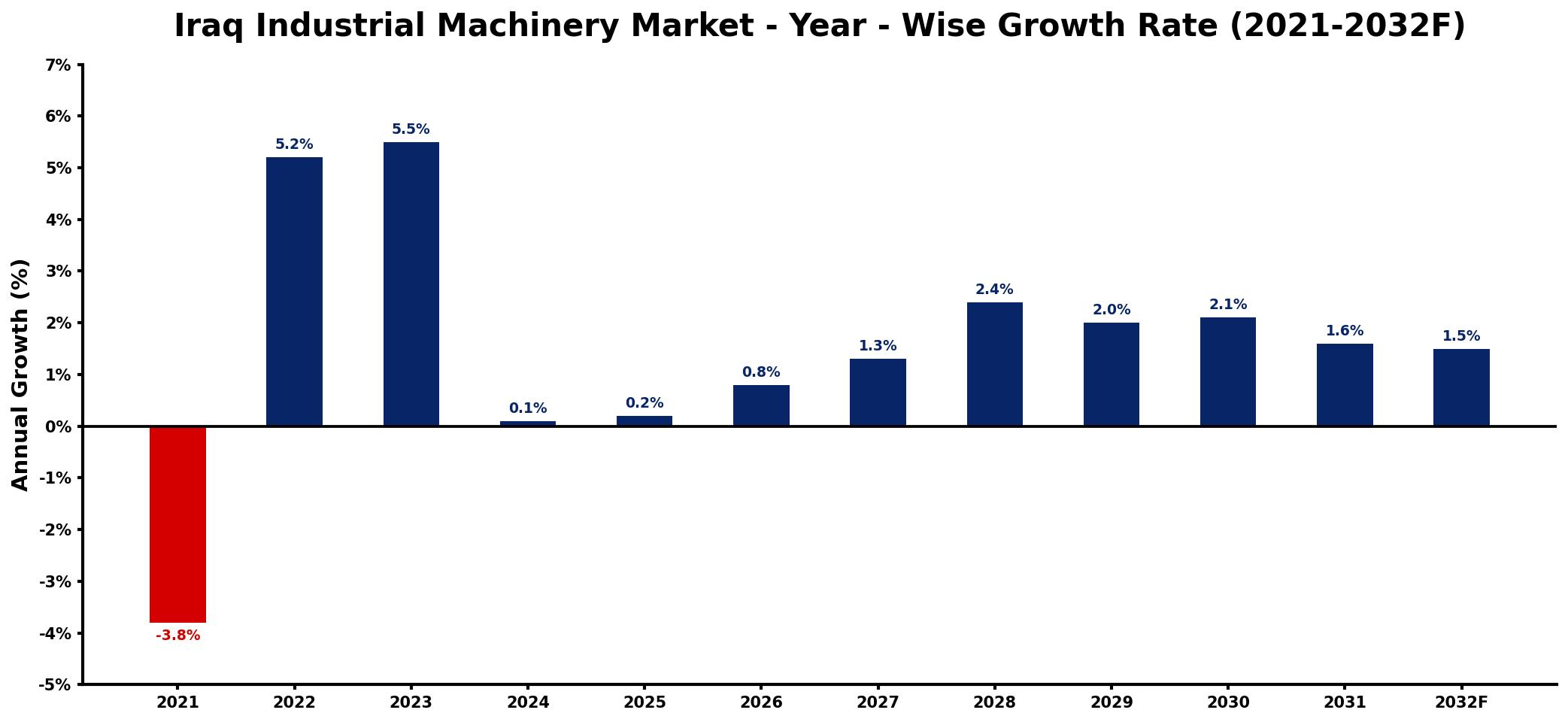
The table below presents the year‑wise growth rates along with the key drivers influencing the market
| Year | Growth Rate | Major Drivers |
| 2021 | -3.8% | decrease in construction project investments |
| 2022 | 5.2% | increased demand for manufacturing equipment |
| 2023 | 5.5% | expansion of energy sector projects |
| 2024 | 0.1% | growth in infrastructure development initiatives |
| 2025 | 0.2% | rising investments in technology upgrades |
| 2026 | 0.8% | enhanced foreign direct investment interest |
| 2027 | 1.3% | development of renewable energy projects |
| 2028 | 2.4% | growing automotive sector requirements |
| 2029 | 2.0% | expanding logistics and transportation needs |
| 2030 | 2.1% | increased agricultural sector modernization |
| 2031 | 1.6% | emerging markets driving innovation investments |
| 2032 | 1.5% | demand for sustainable production practices |
Note: Market size estimations and growth projections presented in this report are based on 6Wresearch's proprietary forecasting methodology, utilizing the latest available industry data, government publications, and primary research inputs.
Iraq Industrial Machinery Market Synopsis
The strongest force currently shaping the Iraq Industrial Machinery Market is the push for infrastructure development. As the government undertakes significant construction initiatives, a substantial demand for industrial machinery arises, positioning the market for steady growth. Coupled with this is the rise in manufacturing automation, which is transforming how Iraqi companies optimize their operations, resulting in a shift towards more sophisticated machinery.
In addition to infrastructure, the need for improved product quality and operational efficiency is compelling industries to invest in modern equipment. Industrial robots and CNC machines are becoming increasingly integral to manufacturing processes, reflecting a broader trend towards automation and enhanced productivity in Iraqs diverse industrial landscape.
Iraq Industrial Machinery Market Key Takeaways
- The market is witnessing steady growth, driven by government-led infrastructure projects.
- Manufacturing automation is becoming a critical focus for companies seeking competitive advantages.
- Technological advancements are paving the way for the adoption of sophisticated machinery and equipment.
- Economic and technological challenges continue to shape the market dynamics.
- Government incentives are aimed at promoting modernization and efficiency within the industrial sector.
Evaluation of Restraints in Iraq Industrial Machinery Market
Despite its growth potential, the Iraq Industrial Machinery Market faces significant restraints. Economic instability poses a consistent threat, with fluctuations impacting investment levels and operational continuity. Furthermore, technological limitations hinder access to advanced machinery, which stifles innovation within the sector. Supply chain disruptions further complicate the landscape, affecting the availability and reliability of critical equipment. These factors collectively challenge the industrys ability to meet the rising demand for industrial machinery effectively.
Iraq Industrial Machinery Market Trends
Current trends in the Iraq Industrial Machinery Market reflect a strong inclination toward automation and advanced manufacturing techniques. The introduction of IoT-enabled machinery and smart manufacturing systems is gaining traction, enhancing operational oversight and efficiency. Additionally, there is a growing emphasis on sustainability, pushing industries to seek energy-efficient machinery that aligns with global environmental standards. This focus on cutting-edge technology not only meets immediate operational needs but also positions Iraqi businesses for future resilience and growth.
Iraq Industrial Machinery Market Opportunities
The landscape for investment opportunities in the Iraq Industrial Machinery Market is promising, particularly in the sectors of construction and manufacturing. As the government ramps up infrastructure development, there will be increasing needs for heavy machinery and specialized industrial tools. Additionally, opportunities abound for businesses that can introduce modern automation technologies, offering solutions that enhance productivity and reduce operational costs. With strategic investments, companies can position themselves as leaders in this evolving market.
Government Initiatives in the Iraq Industrial Machinery Market
Government policies are playing a pivotal role in shaping the Iraq Industrial Machinery Market. Authorities are focused on enhancing productivity and technological advancement through various initiatives. Financial incentives are being offered to businesses to modernize their machinery and implement automation strategies. This proactive approach not only aims to boost domestic manufacturing capabilities but also to attract foreign investments, thereby stimulating the overall economy.
Future Insights of the Iraq Industrial Machinery Market
Looking ahead to 2026-2032, the Iraq Industrial Machinery Market is poised for gradual yet steady expansion. As the government continues to prioritize infrastructure and industrialization, the demand for advanced machinery will likely grow. The emphasis on automation, coupled with the need for improved operational efficiency, will drive investment in modern industrial technologies. Overall, the market is expected to evolve significantly, with innovative solutions taking center stage as businesses adapt to both local and global economic pressures.
Iraq Industrial Machinery Market Latest Developments (2025 - 2026)
Recent developments in the Iraq Industrial Machinery Market indicate a heightened focus on integrating smart technologies into existing machinery. Companies are increasingly exploring partnerships and collaborations to leverage cutting-edge automation solutions. Additionally, the government has signaled its intent to increase public spending on infrastructure projects, further enhancing the demand for industrial machinery. Market participants are keenly observing these trends, as they navigate the evolving landscape of manufacturing and construction.
Iraq Industrial Machinery Market - Key Attractiveness of the Report
- 10 Years of Market Numbers
- Historical Data Starting from 2022 to 2025
- Base Year: 2025
- Forecast Data until 2032
- Key Performance Indicators Impacting the Market
- Major Upcoming Developments and Projects
Key Highlights of the Report:
- Iraq Industrial Machinery Market Outlook
- Market Size of Iraq Industrial Machinery Market, 2025
- Forecast of Iraq Industrial Machinery Market, 2032
- Historical Data and Forecast of Iraq Industrial Machinery Revenues & Volume for the Period 2022-2032F
- Iraq Industrial Machinery Market Trend Evolution
- Iraq Industrial Machinery Market Drivers and Challenges
- Iraq Industrial Machinery Price Trends
- Iraq Industrial Machinery Porter's Five Forces
- Iraq Industrial Machinery Industry Life Cycle
- Historical Data and Forecast of Iraq Industrial Machinery Market Revenues & Volume By Application for the Period 2022-2032F
- Historical Data and Forecast of Iraq Industrial Machinery Market Revenues & Volume By Agriculture for the Period 2022-2032F
- Historical Data and Forecast of Iraq Industrial Machinery Market Revenues & Volume By Construction for the Period 2022-2032F
- Historical Data and Forecast of Iraq Industrial Machinery Market Revenues & Volume By Packaging for the Period 2022-2032F
- Historical Data and Forecast of Iraq Industrial Machinery Market Revenues & Volume By Food Processing for the Period 2022-2032F
- Historical Data and Forecast of Iraq Industrial Machinery Market Revenues & Volume By Mining for the Period 2022-2032F
- Historical Data and Forecast of Iraq Industrial Machinery Market Revenues & Volume By Semiconductor Manufacturing for the Period 2022-2032F
- Iraq Industrial Machinery Import Export Trade Statistics
- Market Opportunity Assessment By Application
- Iraq Industrial Machinery Top Companies Market Share
- Iraq Industrial Machinery Competitive Benchmarking By Technical and Operational Parameters
- Iraq Industrial Machinery Company Profiles
- Iraq Industrial Machinery Key Strategic Recommendations






































